Showing posts with label birmingham. Show all posts

Monday, June 21, 2021

Birmingham, AL: No AC


Fans in Rustavi, Caucasus Georgia. June 2012.

June 2021


I don't have AC in my Birmingham apartment, which is an interesting state of affairs when one lives in the South, and it is nigh on summer. 

The mental game

I am playing a mental game between now and when I leave Birmingham at the end of the month.

Every day that passes in which it is tolerable enough to sleep and during which I don't sweat in place - that is a day that has been stolen from Birmingham's God of the Furnace, Vulcan. 

The daily theft deeply satisfies my humid resentment toward a landlord who treats their tenants - the very same people who butter the landlords' bread with their rent payments - with contempt via malfunctioning, geriatric heating and cooling systems and shoddy installation and insulation, so that the tenants live with inadequate climate control AND pay extra because the machinery is energy-inefficient and the insulation is so poor that the tenant must also offset the influx of cold air in the winter and the egress of expensively-cooled air in the summer. 

Not that I hold a grudge. 

Fans
Fans


Other sweaty times and sweaty places

Not having AC in Birmingham takes me back to July in Rustavi, in Caucasus Georgia. Where it was so miserably hot and sweaty in the concrete vertical village, with screenless windows, and the sticky dilemma of what to do at night to sleep: 

  1. Open the bedroom window to catch a breeze and invite the apocalyptic-sized grasshoppers inside; or
  2. Keep the window closed, shutting the Satanic grasshoppers out, but sweating on the sheets?

A summer weekend in the country - in Gurjaani - the heat squatted among us, an uninvited guest: 

Even in the country, the heat was oppressive. It drained the energy from everyone. Many of us took frequent, short naps like dogs and cats. The heat pushed the odor of the outhouse into full bloom, and it wafted throughout the courtyard.

When one looks at photos of Tuscany -- the pretty scenery, the tables groaning with fruits, cheese, baguettes, and wines, the convivial gathering of smiling people, the grape arbors sheltering all beneath ... you don't think of the prosaic realities that accompany such beauty - flies that crash the party, fruit that over-ripens before your eyes, the aroma of super-heated humanity, the rationed water that means bathing is not a daily or every-other-day event.


In Nazret, Ethiopia, with its screenless windows, one can open the windows for breeze-catching until 6:00 p.m., and then you've got to close them firmly to keep out the bimbies - the mosquitoes. 

In Alamogordo, New Mexico, it was hot hot in June, until the rain came. The onset of the monsoon season, smack on time, July 1. 'Course, in Alamogordo, I had functioning air conditioning. Not like here in Birmingham. 


Wednesday, April 28, 2021

Birmingham, AL: Mulberries


Mulberries, George Ward Park, Glen Iris, Birmingham, Alabama. April 2021.

Now that the cold winter has finally slunk away, every day in this springtime gives my soul bounce. 

When I spied the mulberries on the park path yesterday, oh sweetness! 

How they took me back to another welcome spring - in Rustavi, Caucasus Georgia:

Wednesday, June 6, 2012

Georgia: The Tutebi are Here

Rustavi, Georgia. White tuta (mulberry)


There are black tutas and white tutas. In the plural, they are tutebi.

Mulberries! Beloved here. They do taste good.


The black tutas have peaked, I think, and all that I found at one tree were those which had fallen onto the ground.

Rustavi, Georgia. Black tuta (mulberry)


I had a mulberry tree in Missouri, but never saw any fruit. Evidently, it was a male, therefore fruitless.


Rustavi, Georgia. White tuta (mulberry)


Saturday, March 6, 2021

Birmingham, AL: COVID-19 Unfolding, Part 8888: Vaccination


Immunization. Photo credit: Heather Hazzan, SELF Magazine. Source: American Academy of Pediatrics Immunization Image Gallery.


A number of people in my circle have received their COVID vaccines. They live in Texas, New Mexico, and Missouri. Another, in Louisiana, has an appointment for next weekend.  

In Alabama, specifically Jefferson County (which includes Birmingham), I've found it difficult to get timely, clear, and reliable information on:

  1. How to find a vaccination source, then 
  2. How to find the route into their scheduling tool, then
  3. Discover if they've got any appointments available, which by the way, has been a no.

WBRC News: Walmart Answers to Why Birmingham Was Skipped for Vaccine Distribution 

February 21, 2021. "When the list of which Walmart vaccination locations was revealed, just one major Alabama city wasn’t on it -- Birmingham. Walmart officials said locations were picked based on federal and state input, but the state says that’s not true."

In the article below, a nearby neighborhood pharmacy evidently has or had a vaccine supply, but .... who knew? In looking at the pharmacy's website today, I see zero reference to the COVID vaccine availability. Does this mean it is out of vaccines? Does it mean only certain people get told about it, perhaps through a doctor's referral or an employer's referral or only if they are on the pharmacy's mailing list? 

Bloomberg News: A Black Neighborhood in Alabama Has Yet to Get a Single Vaccine: In a nearby wealthy White suburb, the doses flow

February 25, 2021. "More than two months into America’s vaccine rollout, a community clinic that serves the poorest of the poor on Birmingham’s majority-Black north side has yet to receive its first dose. The Alabama Regional Medical Services clinic has watched the vaccine flow elsewhere, including a pharmacy in nearby Mountain Brook, the state’s wealthiest town."

But the Alabama Regional Medical Services' (ARMS) dearth of information is no different from the Mountain Brook pharmacy's lack of actionable information re: the COVID vaccine. Which is what is so frustrating about trying to find vaccine information in Birmingham. 

Below is the ARMS so-called COVID-19 Update as of March 6, 2021: 

Screenshot, ARMS COVID Update. March 6, 2021.

It would make sense to find timely, actionable information about vaccine access on the Jefferson County Department of Health website. As of March 6, 2021, here is the mushy message one sees: 

Screenshot, Jefferson County Department of Health. March 6, 2021.

When I click on the Information Packet, there are more than 20 paragraphs of Messages From So-and-So...  that use such words as "challenge," "advocating," "personal responsibility," "good news," .... frankly, smarmy nothingness, until finally I arrive at the FAQ, and scroll through EIGHT pages until I reach the question: "I want to get a COVID-19 vaccine. What do I do?" 

Great! Actionable information! Oh, wait, no .........

Screenshot, Jefferson County Department of Health's Registration Form Portal. March 6, 2021.

Note that the submission form is "... not intended as a scheduler for vaccination. Scheduling information will come at a later date ..." 

I entered my data into the above form some weeks ago. **Crickets**

The University of Alabama-Birmingham has been a vaccine distributor. When I first visited it a few weeks ago, the site asked a bunch of intrusive questions up front, without explaining up front how the vaccine scheduling would work after one jumped through its hoops. So I skipped it, instead completing that Jefferson County Health Department form. 

But a few days ago, although loath to blindly give over so much personal info to UAB, I did finally creep into its manhole. This morning I received an email from UAB: 

"... Due to a limited amount of vaccine doses, scheduling your appointment is taking longer than we had hoped and could take up to several weeks to schedule. ... "

The surprising good-ish news is that the phone number at the Jefferson County Department of Health is active on Saturdays, and today I tried it out. Someone actually picked up within a couple of minutes! It didn't seem that my previous entry on that site from a while back had stuck, but the representative collected my info over the phone, and I received an almost-immediate confirmation email that included: 

"Your submission has been recorded and you are on the list to be contacted once you become eligible and sufficient vaccine becomes available. There is nothing else you need to do but patiently wait for further instructions from the Jefferson County Healthcare Coalition. You will be contacted once you become eligible and additional vaccine arrives in the county."
The representative told me it could be a couple of weeks. 

I'm displeased about the difficulty in finding current, clear, actionable information on how and where to schedule a vaccine. This is (or should be) a straightforward process, which has nothing to do with the shortage of the vaccines. That is an entirely different issue. I'm OK with the responses that tell me: We received your scheduling query. You are in line. We don't have enough vaccines. We estimate x weeks before we'll get a sufficient supply to reach you.We'll contact you when we're ready to schedule you.

I'll get a vaccination eventually. I'm glad to know I'm in a line today.

But I sure can't stop thinking about all the folks who don't have internet access or who aren't getting any information through any mechanism or who are without easy access to transportation. 

Fortunately, there are stories like this one: The Sororities and Fraternities Helping Black Americans get Vaccinated, particularly in rural areas.


Tuesday, February 16, 2021

Birmingham, AL: COVID Unfolding, Part 8888: Of Masks and Earrings


Widowed earring on Alabama map. February 2021.


Earrings and lipstick. If I am out, they are on me.

Until a couple of weeks ago, that is.

I suppose there are earring-wearers out there who are sufficiently mindful about removing masks to avoid losing an earring, but I am not among their number. 

After losing two earrings now since COVID began, I have surrendered to reality and my ears will henceforth go nekkid until we are a post-mask world.

I lost my green-glass dangly earring on laundry day last week. I knew I had to have lost it somewhere between my parked car and my various stops inside the laundromat: the change machine, the washing machine, the dryer, the folding table. 

I re-traced my steps twice, scanning the ground surface like a search-and-rescue spotter, to no avail. (A detour into the efficacy of search rescue eye scanning here.)

Before I left the premises, I asked the laundromat attendant if anyone had turned in an earring. "No," he replied, "but there is that homeless guy who comes around here all the time, and he was walking around holding an earring up with his hand, and talking about it being good luck for him or something, and then he left to go wherever he goes when he leaves here, still carrying it." 

So there you go. My earring, lost to me, but out in the wilderness, on a new journey. 

And I had not even been its first caretaker, as it was a rescue earring I had acquired in a Goodwill in South Louisiana. 

The day I gave up wearing earrings outside is the day I also gave up my irrational wearing of lipstick behind a mask. 


Some other thoughts on earrings, lipsticks, and masks

23 Best Mask-Proof Lipsticks

... Are Face Masks Leading Us to Kiss the Cosmetic Goodbye? 

Prevent Losing Earrings While Wearing a Mask


Thursday, January 14, 2021

Birmingham, AL: Land Acknowledgement

I first heard the term "land acknowledgement" at a November 2020 seminar called The Role of ADR in Disputes Involving Gender-Based Violence, hosted by the Ohio State Journal on Dispute Resolution. (I learned other new language at that event, too.)

I heard the term again in Northwestern University's first event in its Dream Week series of virtual events leading up to Dr. Martin Luther King's Day. 

Mariame Kaba presented the keynote for the first event. But before she spoke, Chantay Moore presented a land acknowledgement. Ms. Moore is a member of the Navajo Nation, and is also of African-American heritage.


What is land acknowledgement? 

From Northwestern University's land acknowledgement page, I've gleaned this definition: 

"A Land Acknowledgement is a formal statement that recognizes and respects Indigenous Peoples as traditional stewards of this land and the enduring relationship that exists between Indigenous Peoples and their traditional territories. ....

.... [A land acknowledgement] is an expression of gratitude and appreciation to those whose territory you reside on, and a way of honoring the Indigenous people who have been living and working on the land from time immemorial. It is important to understand the long standing history that has brought you to reside on the land, and to seek to understand your place within that history. Land acknowledgements do not exist in a past tense, or historical context: colonialism is a current ongoing process [emphasis added], and we need to build our mindfulness of our present participation."

The Native Governance Center offers a rich, reader-friendly, practical guide here for presenting a meaningful land acknowledgement.  Another good explanation is at Native Land Digital here.

Michael Redhead Champagne, author of North End MC, shares an interview he conducted in 2015 with Native Land Digital founder, Victor Temprano, about why it's important for all of us, "settlers" in particular, to educate ourselves about indigenous peoples who live(d) where we live: 

MC: Why is it important for non-indigenous people to involve themselves as respectful allies in the indigenous struggle in 2015 Canada?
Victor:  It’s important for settlers to engage with Indigenous history and nations on many levels – spiritual, physical, emotional, and more. It’s not to ‘help’ Indigenous people or cultures (at least not in the traditional sense of ‘charity’), but to help settlers get educated, to grow and to begin the hard process of decolonization. I don’t know what decolonization really looks like or feels like in our settler society, but I know it needs to happen, whether for moral, environmental, spiritual, legal, or historical reasons (or more). It is a inter-generational struggle to decolonize, and it’s already been going on, and now is a good time as any to find a way to engage one’s skills in a meaningful way.


The Association of Public & Land-Grant Universities offers a piss-poor, self-serving, so-called land acknowledgement here.


Before removal, enslavement, or extermination, what indigenous families and communities lived - and live - in what are now called Birmingham and Alabama? 


Here is an interactive map that shows us which indigenous peoples lived (live) in Birmingham and Alabama (and throughout the world).


From Encyclopedia of Alabama: 

Alabama's indigenous history can be traced back more than 10,000 years, to the Paleoindian Period. Cultural and technological developments brought changes to the societies that inhabited what is now Alabama, with the most visible evidence of those changes being the remarkable earthen mounds built by the Mississippian people throughout the Southeast, in Alabama most notably at Moundville. By the time European fortune hunters and colonialist explorers arrived in the sixteenth century, the Indian groups in the Southeast had coalesced into the cultural groups known from the historic period: the Cherokees, Choctaws, Creeks, and Chickasaws, and smaller groups such as the Alabama-Coushattas and the Yuchis. As more Europeans and then U.S. settlers flooded into the Southeast, these peoples were subjected to continual assaults on their land, warfare, the spread of non-native diseases, and exploitation of their resources. In the 1830s, the majority of the Native Americans in Alabama were forced from their land to make way for cotton plantations and European American expansion. Today, the MOWA Band of Choctaw Indians and the Poarch Band of Creek Indians maintain their traditions on portions of their tribal homelands in the state.


Trail of Tears

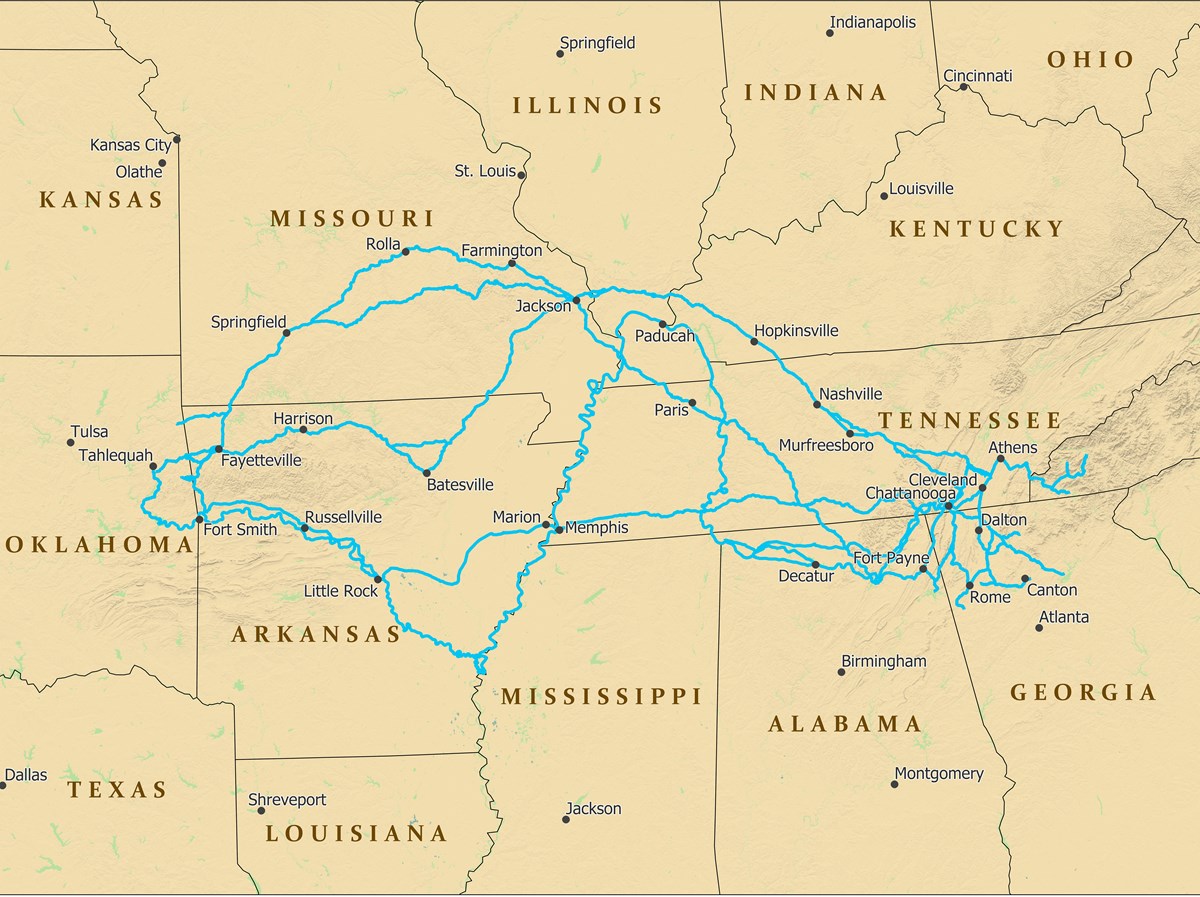
  A map depicting trails from southeast US to Oklahoma.


Alabama is not only the terminus of the Appalachian Trail, it has what some called "ends" of the Trail of Tears, for example, at Waterloo Landing.

In the article, Traveling the Trail of Tears in Alabama, Joe Cuhaj notes: "During the time of the Trail of Tears, Waterloo Landing, which is located in the town of Waterloo in the extreme northwest corner of Alabama, was situated on the banks of the Tennessee River. Since that time, the river was dammed to form Pickwick Lake, and the landing was flooded over. Because it was a final departure point for Indians from the South, Waterloo Landing was known as the "End of the Trail." Now, a historical marker denotes the location, and in September of each year a commemorative Pow-Wow is held here with traditional music and more." 

Alabama has five "certified sites" that acknowledge the Trail of Tears. 

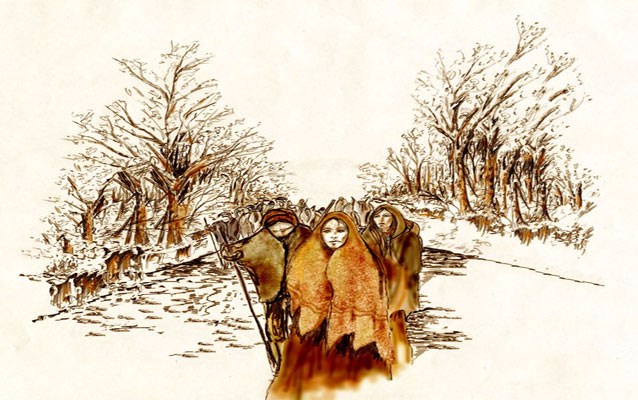
Cherokee Walking the Trail of Tears, by artist Sam Kitts. Source: NPS Trail of Tears Alabama


A grim précis of the Trail of Tears, and the motives that drove it, is on the History Channel's Trail of Tears page. 

In September 2020, PBS premiered a movie, DIGADOHI: Lands, Cherokee, and the Trail of Tears: 


Wednesday, January 6, 2021

Birmingham, AL: Roaches


Louisiana, July 2015.

Trigger alert for the squeamish. (Hell, I'm squeamish.)

They don't pay rent, take out the trash, or engage in entertaining conversation. They are squatters in my quarters.

Since being rootless, I've become familiar with these characters. Different sizes and shapes, different colorations. Some can fly, some are grounded.

But roaches, every one.

The first time I saw a roach in my Birmingham apartment was when the landlord showed the apartment to me as a prospective tenant. I gasped. The roach was big, it was fast, and it projected attitude. The landlord remarked placidly that his daughter had similar reactions as I when she encountered a roach like that. In negotiations about the apartment, the landlord agreed to one pest control application. 

After I moved in, I discovered two populations living rent-free in my place: the American and, most likely, the German. 

There were two communities in my Tucson apartment also. Their skittery populations surged and receded like high and low tides of the sea, dependent on the ins and outs of adjacent tenants and regular sprayings by the apartment management. The Tucson arthropods were small and swift. I never knew when a singleton would dart out from under my dishcloth as I lifted it from the sink edge first thing in the morning. So startling. But both varieties succumbed quickly to an assertive spray from my bottle of Clorox Clean-Up All Purpose Cleaner with Bleach Spray. (I may be lethal, but I'm no sadist.)

I can deal with the Germans. The Clorox spray is effective for spontaneous responses. And in Birmingham, with a landlord who doesn't care about pests in their tenants' apartments, the Hot Shot Ultra Liquid Roach Bait seems effective for ongoing, passive (to me, not the to roaches) control. 

But the hulking Americans! They laugh at the Clorox spray! They don't fit into the roach traps because they are too big. Finding the right shoe or other blunt weapon for a more personal, shivery kill takes too long in response to a sudden assault by one of these behemoths. So I bought a can of roach spray, which, if applied with vigor, ends them almost immediately. 

Thank goodness, I've never seen an American roach up on my kitchen counter or in my cabinets. Doesn't mean they didn't (don't) go there, I've just never seen one there. Consequently, my brain can deploy the "not seen, so doesn't happen" wash, and I can move about my kitchen in blithe serenity.

The Birmingham American roach prefers to loiter in the bathtub, so I have learned to open the shower curtain briskly, look quickly for an encroacher, and be ready to jump for the spray. 

I was not ready to see what I saw one day, something my brain can never un-see. 

Be prepared to be as grossed out as I was. 

In my self-care regimen, I strive for baby-smooth heels. To aid in this, I have a foot file. It has a steel grater on one side and sandpaper on the other side. 

I kept it on the side of my tub. 

Until .... 

 .... that one morning when I walked into my bathroom and I saw a GIGANTIC AMERICAN ROACH GRAZING ON THE DEAD SKIN REMNANTS ON THE FILE!!!!!!

Gahhhhhh!!!!!!! 

Gross, gross, gross. 

I killed the beast and then sanitized the file. 

These days, I wrap my file in plastic. 

But I have wondered, what else do they eat? Do they eat soap? 

Yes, apparently they do. 

Ew.


Other stories about roaches and me

2011: Ethiopia: Nazret: Introduction and a Brush With Fame

Later, I walked into the bathroom just in time to see a cockroach skittering toward me, the size of which I've only seen in a museum with a pin in it. I screamed.

2011: Ethiopia: Nazret: Saturday in Nazret

Oh, and evidently Azeb's absence was noted by Those That Creep In the Dark. When I turned the bathroom light on and counted to my usual 10 to allow furtive creatures time to scoot out, I encountered TWO of the gigantic cockroaches. Furthermore, they CHALLENGED me in such a way that I got out the broom to let them know who was (sort of) boss...... I considered several lethal options.

2011: Ethiopia: Hyenas, Fresh Goat, and a Crispy Roach [on my pizza] in Harar

Decided to lunch instead at the reliable Fresh Touch down the street. Ordered the vegetarian pizza. When it arrived, I dressed it with their wonderfully spicy chili sauce. Oh. Wait. I did order the vegetarian pizza, right? So what's with the crispy-curled roach sitting so perkily atop a pepper? Waiter! 

 2012: New Mexico: Roaches and Other Unpretty Neighbors 

Now that I'm in my apartment, it seems I see one roach per evening scuttling through my place, each a different brand. I've smashed all but one of the unwanted pests.

2013: New Mexico: Insect Life


2013: New Mexico: Arthropod Museum 

There were a couple of live Madagascar hissing roaches and Graeme was willing for me to hold one in my hands. I wanted to be willing, but I couldn't guarantee that once it was placed in my hand, I wouldn't immediately fling it across the room in squealy fear. Ryan had the good idea for me to place my hand on the table and let the roach creep crawl walk on it. I did do this, all the while giggling in the way one does when one is actually scared and not amused.

2013: New Mexico: Cup o' Roaches

2014: Louisiana - A general note about the insect situation: 

"South Louisiana is a giant sponge. That's why we keep in constant motion. If you stand still, you'll either sink or be eaten alive by giant insects."  Dave Robicheaux, Pegasus Descending, by James Lee Burke

2015: Louisiana: Creepy Crawly Day at Chico State Park  

Why do I feel compelled to look at things that make me go "ewww"?

2019: New Mexico: The Jump

The first time I walked through the passageway ..., I saw the enormous, segmented exoskeleton of the arthropod above, and I jumped like a cat surprised by a cucumber. 


Tuesday, January 5, 2021

Birmingham, AL: An Annoyance of Facts


Room temperature, Birmingham, Alabama. January 2021.
 

In my apartment, I have been confronted by an annoyance of facts. 

An annoyance of facts. Like a conspiracy of lemurs. A crash of rhinoceroses. A murder of crows. A deceit of lapwings. A gang of turkeys. 

An annoyance of facts. The facts are the lighthouse and I am the ship, so I'm the one who has to move.

There is no central heat in my apartment. 

Instead, I have:

  • A poorly-functioning window unit that purports to both cool and heat,
  • An oil-filled portable heater, and
  • A "ceramic element" heat fan. 
  • A whopping first-electric-bill-of-the-winter.

Furthermore, wind billows through and around the window unit. 

The front door has a gap in the upper left corner that perfectly aligns with the gap in the upper left corner of the storm door. Long fingers of cold air swoosh through between the door and its frame. The windows are single-pane relics of the 1950s held in place with leaky metal frames.

So when winter hit, I felt fucking cold. And coldly resentful. 

I  knew from experience regarding my apartment's malfunctioning refrigerator and malfunctioning stove (since addressed), that the landlord would question my definition of cold, so I bought two small room thermometers. 

Well, fuck all. 

 I discovered that the low temperatures were in the upper 60s at 8:42 in the morning (after three hours of electric heat when I arose for the day), with a low of 65 during the previous night. 

On one hand, this annoyed the hell out of me because, absent any objective data, I had felt very, very cold, and it just didn't seem possible that this could be the accurate temperature. 

But now that I had temp facts, I still felt cold, but less so.

How annoying.


Room temperature, Birmingham, Alabama. January 2021.


Monday, January 4, 2021

Birmingham, AL: The New Abolitionism: A Birmingham Connection


Angela Davis mural, Avondale neighborhood, Birmingham, Alabama. December 2020.
Angela Davis mural, by Tim Kerr, Avondale neighborhood, Birmingham, Alabama. December 2020.

In November I attended a dispute resolution workshop hosted by the Ohio State Journal on Dispute Resolution, which featured keynote speaker, Mariame Kabe. 

Ms. Kabe and others in the workshop spoke a language new to me:

After the workshop, I sought more information on abolition feminism .... 

.... which led me to Angela Davis, who, until I visited the Avondale neighborhood recently, and saw her image on a mural, I had no idea was from Birmingham. 

Sidebar: Or that the Girl Scouts had played a positive role in her life as an activist, oh, let's go ahead and say it - a revolutionary. An aside from this 2019 Washington Post article: 

 “[Angela Davis is] someone who, from a very young age, has provoked enormous controversy over whether her ideas were good or bad,” says Jane Kamensky, director of Harvard University’s Schlesinger Library on the History of Women in America. “She cast herself as a revolutionary. And we have liked our civil rights activists firmly in the reform tradition, and we have liked our revolutionaries male.”


Abolition feminism

My current understanding of what it means to be feminist has expanded beyond my introduction in the 1970s and my membership in a Women's Political Caucus chapter in the 1990s. A sampling of new-to-me influences, learned since 2010, include:

1. Audre Lorde:

"I am a lesbian woman of Color whose children eat regularly because I work in a university. If their full bellies make me fail to recognize my commonality with a woman of Color whose children do not eat because she cannot find work, or who has no children because her insides are rotted from home abortions and sterilization; if I fail to recognize the lesbian who chooses not to have children, the woman who remains closeted because her homophobic community is her only life support, the woman who chooses silence instead of another death, the woman who is terrified lest my anger trigger the explosion of hers; if I fail to recognize them as other faces of myself, then I am contributing not only to each of their oppressions but also to my own, and the anger which stands between us then must be used for clarity and mutual empowerment, not for evasion by guilt or for further separation. I am not free while any woman is unfree, even when her shackles are very different from my own. And I am not free as long as one person of Color remains chained. Nor is anyone of you."

Source: Black Past


2. Women's Revolutionary Law of the EZLN in Chiapas, Mexico: 

  • "First, women have the right to participate in the revolutionary struggle in the place and at the level that their capacity and will dictates without any discrimination based on race, creed, color, or political affiliation.
  • Second, women have the right to work and to receive a just salary.
  • Third, women have the right to decide on the number of children they have and take care of.
  • Fourth, women have the right to participate in community affairs and hold leadership positions if they are freely and democratically elected.
  • Fifth, women have the right to primary care in terms of their health and nutrition.
  • Sixth, women have the right to education.
  • Seventh, women have the right to choose who they are with (i.e. choose their romantic/sexual partners) and should not be obligated to marry by force.
  • Eighth, no woman should be beaten or physically mistreated by either family members or strangers. Rape and attempted rape should be severely punished.
  • Ninth, women can hold leadership positions in the organization and hold military rank in the revolutionary armed forces.
  • Ten, women have all the rights and obligations set out by the revolutionary laws and regulations."  
Source: Wikipedia


3.  Criticisms of the 2017 Women's March: 

"The expanding dialogue about rape culture, and the indictments of patriarchy are inspiring, but they don’t change my ambivalence about organizing with White women, or my discomfort with the assumption that when White women organize for their freedom, they are organizing for mine too. They are not, and cannot, until they unpack the ways in which they have been taught to ignore the oppression of Black and Brown women – and continue to benefit from our oppression. Within hours of the March, some attendees Tweeted about how there were no arrests made that day at the major marches. Clearly, they lacked analysis or sensitivity for why peaceful protests where attendees are majority Black or Brown would be targeted for arrest.

"Fifty-four percent of White women voted for Trump. “Protecting” our borders and emboldening White supremacy were more important to them than autonomy over their own bodies and families." 

Source: Katina Parker in A Charge to White Women


4. The 1950s Mine-Mill Strike in Grant County, New Mexico


OK. So what does holistic feminism have to do with PIC abolition? 

From Angela Davis: 

1. "When we look at women in prison, we learn about the system as a whole, the nature of punishment, the very apparatus of prison." 

Source: Angela Davis in Windy City Times article by Yasmin Nair.


2. "Davis influentially condemned feminist approaches which emphasized incarcerating perpetuators, or carceral feminism.  Instead she and other abolitionist feminists focused on how the state mirrored intimate partner violence and abuse as it punished survivors for self defense and forcibly sterilized hundreds of thousands of women."  

Source: UCLA's Rebel Archives article, Angela Davis and Abolitionist Feminism.


3. "Confronting and abolishing the power relations embodied in PIC required a Black feminist approach that addressed the interwoven nature of state violence and people’s struggles. 

"Davis’ Black feminist theory took shape in the everyday work of organizations like the Santa Cruz Women’s Prison Project and the California Coalition for Women Prisoners, which helped the voices and experiences of incarcerated women break through prison walls. Rejecting the machismo that characterized earlier prison struggles, women and their allies revealed the gendered violence and trauma both led marginalized women to prison and was exacerbated by state violence. As Californian prisons became infamously overcrowded, incarcerated people faced medical neglect and abuse even more extreme than the conditions described at Soledad years earlier. All these circumstances and the will of incarcerated women to struggle for their own survival built a new inside outside movement that continues to this day." 

Source: UCLA's Rebel Archives, Introduction to series Sisters in Struggle: The California Coalition for Women Prisoners, Feminism, and Abolition. 


Women In Prison
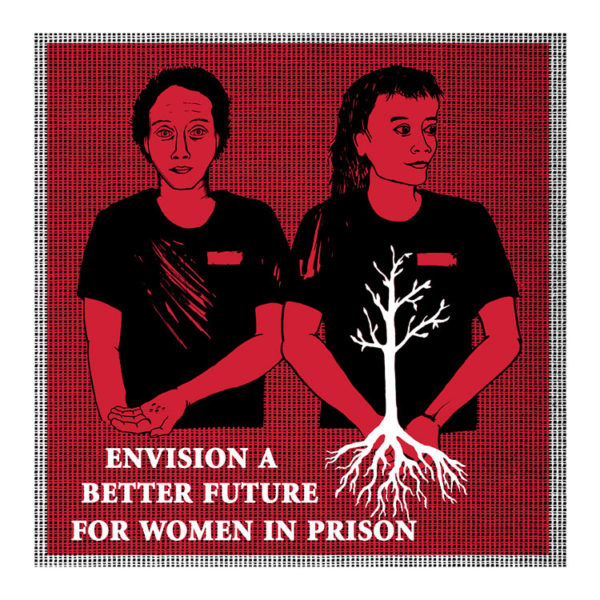
Women in Prison, by Lydia Crumbley, 2009. Find it at Justseeds.


I have so much to learn. 


Saturday, December 19, 2020

Birmingham, AL: "... Such Beautiful Scenery. We Didn't Have a Sense of Fear."


USPS stamp, Alabama.


Before I moved to Alabama, if I were on a shrink's couch and she ran me through an associations exercise, and she said, "black," I'd say "white," and if she said "Alabama," I'd say "racism."

One day, I went to the post office in Tucson to buy stamps. They didn't have many artistic choices that day, but they did have one - just one - of the state stamps from its series of state stamps. It was Alabama. My hand practically recoiled from the proffered page of stamps. An Alabama stamp?! On my mail?! Never!

The only positive whisper I had about Alabama was the comment of a friend who'd gone to Birmingham on a business trip some years ago. I asked him what he thought of Birmingham. He replied: "It's pretty and the people are friendly."

I share all of this backstory to build up to this point: When I drove into Alabama in July, I thought: Wow! It is so pretty here!

On a subsequent weekend trip to Oxford and Anniston, I thought: Wow! It is so pretty here!

Every time I move through Birmingham's forested neighborhoods, up hills, across ridges, over the mountain, I think: Gosh almighty, it's so pretty here. 

And then I think: If it weren't for Alabama's racism brand, the state could be a paradise!

Which leads me to the documentary I just watched,  PBS American Experience: Freedom Riders [the link takes you to the entire documentary].

Here is the trailer to the documentary:


Before the virgin voyage of the Freedom Rider campaign, Dr. Martin Luther King counseled the students: "... and if I were you, I probably wouldn't go into Alabama."

But this is the quote that grabs me, from one of the first wave of Freedom Riders, Mae F. Moultrie Howard: 

"It was such a beautiful day. It was such a quiet feeling that day ... it was bright and sunny. The sky was blue. And it was such beautiful scenery. We didn't have a sense of fear."

How can such horrible acts occur in such a beautiful land?

Julian Bond: "The people on the Trailways bus going to Birmingham don't know that the Greyhound bus in Anniston has been burned, ..... now the [people on the Trailways bus are] going to a city which is the worst city for race in the whole United States. It literally is a police state, ruled by one of the worst figures in American history, Bull Connor, who must have been some kind of psychopath, just rabid on the subject of race."

Unknown: "I think when they learn that when they go somewhere to create a riot, that there's not going to be somebody there to stand between them and the other crowd, they'll stay home."

John Siegenthaler, recounting the phone conversation he had with Freedom Rider leader, student Diane Nash: "'I understand there are more Freedom Riders coming down from Nashville. You must stop them if you can. Do you understand you're going to get somebody killed?' Her response was: 'They're not going to turn back. They're on their way to Birmingham.' .... soon I was shouting, 'Young woman, do you understand what you're doing? ... Do you understand you're going to get somebody killed!?' And there's a pause and she said, 'Sir, you should know, we all signed our last wills and testaments last night before they left. We know someone will be killed. But we cannot let violence overcome nonviolence.'"

Governor Patterson: "... these [freedom riders] are rabble rousers and we can't protect them."

Governor Patterson: "We don't need the federal marshals here in [Montgomery]. The situation here is well in hand, and if the outside agitators who came here and deliberately stirred up this controversy, would go home, and the marshals go home, it'd be best for everybody and the situation would return to normal very quickly."


Right after I finished watching Freedom Riders, I watched a short documentary that centered on James Armstrong, The Barber of Birmingham: Foot Soldier of the Civil Rights Movement.

Perhaps the most moving quote in this documentary came from Faya Rose Touré, a civil rights activist and litigation attorney: 

"The only way to freedom land, is on the backs of unknown people whose bodies are stacked so high that you eventually can walk to freedom land. And it's those foot soldiers who really make change. We always remember the Dr. Kings and the Rosa Parks, but we have to remember our foot soldiers."


On the foot soldiers, Ms. Touré added later: "The foot soldiers are some of the most important people in the Civil Rights Movement. These are people who will never be known by name. 'Cause they're people, who left their jobs, who risked their lives, may have been fired from their jobs. Who went out to march, not just one day, but every day. They weren't there just on Bloody Sunday, but they were there on Bloody Monday, fire me Tuesday, can't find a job Wednesday."


".... Such beautiful scenery. We didn't have a sense of fear."


I've been other places where the placid beauty of a surface hides the monsters - some still alive, some not - beneath. 

Example 1: The Trinity Site in New Mexico, the site of atomic bomb testing before Hiroshima and Nagasaki

I wrote then: 

... I do experience some cognitive dissonance in the low levels of radiation that exist there today (apparently) versus what we've had pounded into our psyches about how many eons it takes for radiation from an atomic bomb to go to "safe" levels. Does this mean I take away a sense that atomic weapons are "not that bad"? No. The take-away is my inability to reconcile two alleged realities.

Example 2: Bayou Corne the Sinkhole, Part 2

I wrote then: 

Once the immediate shock of the Bayou Corne's suck was over, could I believe what my eyes told me about the apparent return to [a] heretofore idyllic paradise, with the fish still biting, the birds still swooping gracefully, the water still rippling peacefully, the sky still blue, the trees still shading and sheltering?

I couldn't see what was - and wasn't - below my feet. Couldn't feel what was - or wasn't - there. Who could I trust to tell me the truth?


 ... such beautiful scenery.


Monday, December 14, 2020

Birmingham, AL: A Sunday Afternoon in Avondale Park


Avondale Park, Birmingham, Alabama. December 2020.

A sunny winter day in Birmingham, perfect to visit Avondale Park for the first time. 


Avondale Park, Birmingham, Alabama. December 2020.


A library is adjacent to the park - what a perfect pairing! Books in a park! 


Avondale Park, Birmingham, Alabama. December 2020.


Avondale Park is in the, ummmm, which Birmingham neighborhood? I assumed the Avondale neighborhood, but further investigation suggests the park looks at the Avondale neighborhood while it resides in the Forest Park neighborhood. 


Avondale Park, Birmingham, Alabama. December 2020.


My post-visit research into the park also reminds me how often we go to a place, seeing only what we see in those moments, and we have no idea of what we don't see. 

For example, on a superficial level, I didn't notice the rose garden. 

I also didn't know that for centuries, local folk and wayfarers refreshed themselves with the spring waters that flowed from an opening in Red Mountain down to what is now Avondale Park. Mortals have baptized the spring with different names over the years: King's Spring, Big Spring, Cave Spring, and now Avondale Spring, neither knowing nor inquiring of the spring how she calls herself.  The spring feeds the park's duck pond.

I didn't know, of course, the rich and diverse social history of the park. 

Consider the stories of John Todd and the elephant under his care, Miss Fancy. Miss Fancy lived at Avondale Park, back when it had a zoo. 


Avondale Park, Birmingham, Alabama. December 2020.

I wish I knew how Miss Fancy fared after she lost her beloved John Todd. I wish I knew more about Mr. Todd's story outside of Miss Fancy.

In 2019, Irene Latham published a children's book about Miss Fancy and a young Black boy in Birmingham. In Miss Fancy's time at Avondale Park, only white visitors could enter the park. Embedded in Ms. Latham's story of Miss Fancy is the grim story of Jim Crow laws. This article by James Baggett, Reading Birmingham: Miss Fancy Tells Sweet Story of Jim Crow’s Harsh Reality, explains. 


Sunday, December 6, 2020

Birmingham, AL: Update on That Lizard in a Mailbox


Lizard shedding (molting), Birmingham, Alabama. December 2020.


Hello there, little one! You're in a doorway today! Nice to see you again.


Lizard shedding (molting), Birmingham, Alabama. December 2020.


What's this? A crack in your tail? Did something happen? I didn't close the storm door on you, did I? 


Ohhhh, you're molting! That explains the gray collar in the mailbox photos!  


Hmm, but now I'm thinking there are two of you. Mailbox lizard who had completely molted except for the collar, and doorway lizard who had completely molted except for the tail.


Lizard shedding (molting), Birmingham, Alabama. December 2020.


I don't think I knew lizards molted. Snakes, yes. 


An informational video here. 


Wednesday, November 25, 2020

Birmingham, AL: Lizard in a Mailbox


Lizard in a mailbox, Birmingham, Alabama. November 2020.


The title says it all. 


Lizard in a mailbox, Birmingham, Alabama. November 2020.

Lizard in a mailbox, Birmingham, Alabama. November 2020.

Lizard in a mailbox, Birmingham, Alabama. November 2020.

Lizard in a mailbox, Birmingham, Alabama. November 2020.


Monday, November 23, 2020

Birmingham, AL: The Birmingham Jail

Birmingham Jail site, South Titusville, Birmingham, Alabama. November 2020.


On a cloudy afternoon, I found my way to the Birmingham Jail. 


Birmingham Jail site, South Titusville, Birmingham, Alabama. November 2020.


Bail bondsmen storefronts give off a cheery cottage vibe, like a clutch of souvenir shops and cafes in a beachside village. 

Birmingham Jail site, South Titusville, Birmingham, Alabama. November 2020.

Birmingham Jail site, South Titusville, Birmingham, Alabama. November 2020.

Today's carceral campus design presents us with both Old Testament damnation and New Testament salvation, revealed by the implacable, brutalist architecture adjacent to a pastoral woodland warmed by a heavenly light.


Birmingham Jail site, South Titusville, Birmingham, Alabama. November 2020.

Birmingham Jail site, South Titusville, Birmingham, Alabama. November 2020.


Letters From Birmingham Jail

Dr. Martin Luther King's Letter From Birmingham Jail is, of course, what brought me to the jail site in the South Titusville neighborhood of Birmingham. 

I have read the Letter many times. With each reading, I discover something new and brilliant in the Letter about standing up for human rights, for civil rights. Every time I read some crazy-ass allegation about Black Lives Matter or when people paint protests as "riots," I can refer to the Letter From Birmingham Jail, written more than 50 years ago, for a precise, on-point response to whatever fear-filled, ignorant point they think they're making.

I have created a lesson plan for my ESL students from the letter. In addition to content, we can talk about the Letter as a work of fine literature.

Here is a recording of Dr. King's reading of the letter.


The song

When we were young, my mother sang to me and my siblings in her clear, quiet alto voice. One of the songs in her repertoire was an Appalachian folk song, Down in the Valley.

I didn't know until I moved to Alabama that the song also went under the title, Birmingham Jail. This came about because of a stanza added in the 1920s by Jimmy Tarleton, who passed some time in the jail. What a surprise! Here is an early (the first?) recording of the song in its Birmingham Jail iteration, performed by Jimmy Tarleton and Tom Darby. 


Jimmy Tarleton's lyrics:

    "Down in the levee; levee so low
    Late in the evening, hear that train blow
    Hear the train blow love, hear the train blow
    Late in the evening, hear the train blow.

    Roses love sunshine; violets love dew
    Angels in heaven know I love you
    Write me a letter; send it by mail
    Send it in care of Birmingham jail

    Birmingham Jail, love, Birmingham jail
    Send it in care of Birmingham jail

    Bessie my darlin; Bessie my dear
    Bessie I love you, oh yes I do

    Down in the meadow, down on my knees
    Praying to heaven, give my heart ease
    Lighting a candle, singin' so low
    Kiss me once more, love, that I might go."


And below is Leadbelly's version of the song, Birmingham Jail, whose lyrics expand on the jail experience:


Leadbelly's lyrics: 

Hear the wind blow boys
Hear the wind blow
Put your head out the window
And hear the wind blow

Write me a letter
Send it by mail
Address it all over
That Birmingham Jail

Birmingham Jail boys
The Birmingham Jail
Address it all over
That Birmingham Jail

High sheriff will arrest you
Bond you over in jail
Can't get nobody
To go your bail

To go your bail boys
To go your bail
Can't get nobody
To go your bail

Send for your lawyer
Come down to your cell
He'll swear he can clear you
In spite of all hell

In spite of all hell boys
In spite of all hell
He'll swear he can clear you
In spite of all hell

Give the biggest your money
Come back for the rest
Tell you to plead guilty
For he knows that it's best

He knows that it's best boys
He knows that it's best
Tell you to plead guilty
He knows that it's best

Down in the valley
The valley so low
Put your head out the window
And hear the wind blow

You can hear the wind blow
Put your head out the window
And hear the wind blow


Below is a slideshow of the Birmingham Jail and its environs:

Birmingham Jail