Showing posts with label native american. Show all posts

Thursday, January 14, 2021

Birmingham, AL: Land Acknowledgement

I first heard the term "land acknowledgement" at a November 2020 seminar called The Role of ADR in Disputes Involving Gender-Based Violence, hosted by the Ohio State Journal on Dispute Resolution. (I learned other new language at that event, too.)

I heard the term again in Northwestern University's first event in its Dream Week series of virtual events leading up to Dr. Martin Luther King's Day. 

Mariame Kaba presented the keynote for the first event. But before she spoke, Chantay Moore presented a land acknowledgement. Ms. Moore is a member of the Navajo Nation, and is also of African-American heritage.


What is land acknowledgement? 

From Northwestern University's land acknowledgement page, I've gleaned this definition: 

"A Land Acknowledgement is a formal statement that recognizes and respects Indigenous Peoples as traditional stewards of this land and the enduring relationship that exists between Indigenous Peoples and their traditional territories. ....

.... [A land acknowledgement] is an expression of gratitude and appreciation to those whose territory you reside on, and a way of honoring the Indigenous people who have been living and working on the land from time immemorial. It is important to understand the long standing history that has brought you to reside on the land, and to seek to understand your place within that history. Land acknowledgements do not exist in a past tense, or historical context: colonialism is a current ongoing process [emphasis added], and we need to build our mindfulness of our present participation."

The Native Governance Center offers a rich, reader-friendly, practical guide here for presenting a meaningful land acknowledgement.  Another good explanation is at Native Land Digital here.

Michael Redhead Champagne, author of North End MC, shares an interview he conducted in 2015 with Native Land Digital founder, Victor Temprano, about why it's important for all of us, "settlers" in particular, to educate ourselves about indigenous peoples who live(d) where we live: 

MC: Why is it important for non-indigenous people to involve themselves as respectful allies in the indigenous struggle in 2015 Canada?
Victor:  It’s important for settlers to engage with Indigenous history and nations on many levels – spiritual, physical, emotional, and more. It’s not to ‘help’ Indigenous people or cultures (at least not in the traditional sense of ‘charity’), but to help settlers get educated, to grow and to begin the hard process of decolonization. I don’t know what decolonization really looks like or feels like in our settler society, but I know it needs to happen, whether for moral, environmental, spiritual, legal, or historical reasons (or more). It is a inter-generational struggle to decolonize, and it’s already been going on, and now is a good time as any to find a way to engage one’s skills in a meaningful way.


The Association of Public & Land-Grant Universities offers a piss-poor, self-serving, so-called land acknowledgement here.


Before removal, enslavement, or extermination, what indigenous families and communities lived - and live - in what are now called Birmingham and Alabama? 


Here is an interactive map that shows us which indigenous peoples lived (live) in Birmingham and Alabama (and throughout the world).


From Encyclopedia of Alabama

Alabama's indigenous history can be traced back more than 10,000 years, to the Paleoindian Period. Cultural and technological developments brought changes to the societies that inhabited what is now Alabama, with the most visible evidence of those changes being the remarkable earthen mounds built by the Mississippian people throughout the Southeast, in Alabama most notably at Moundville. By the time European fortune hunters and colonialist explorers arrived in the sixteenth century, the Indian groups in the Southeast had coalesced into the cultural groups known from the historic period: the Cherokees, Choctaws, Creeks, and Chickasaws, and smaller groups such as the Alabama-Coushattas and the Yuchis. As more Europeans and then U.S. settlers flooded into the Southeast, these peoples were subjected to continual assaults on their land, warfare, the spread of non-native diseases, and exploitation of their resources. In the 1830s, the majority of the Native Americans in Alabama were forced from their land to make way for cotton plantations and European American expansion. Today, the MOWA Band of Choctaw Indians and the Poarch Band of Creek Indians maintain their traditions on portions of their tribal homelands in the state.


Trail of Tears
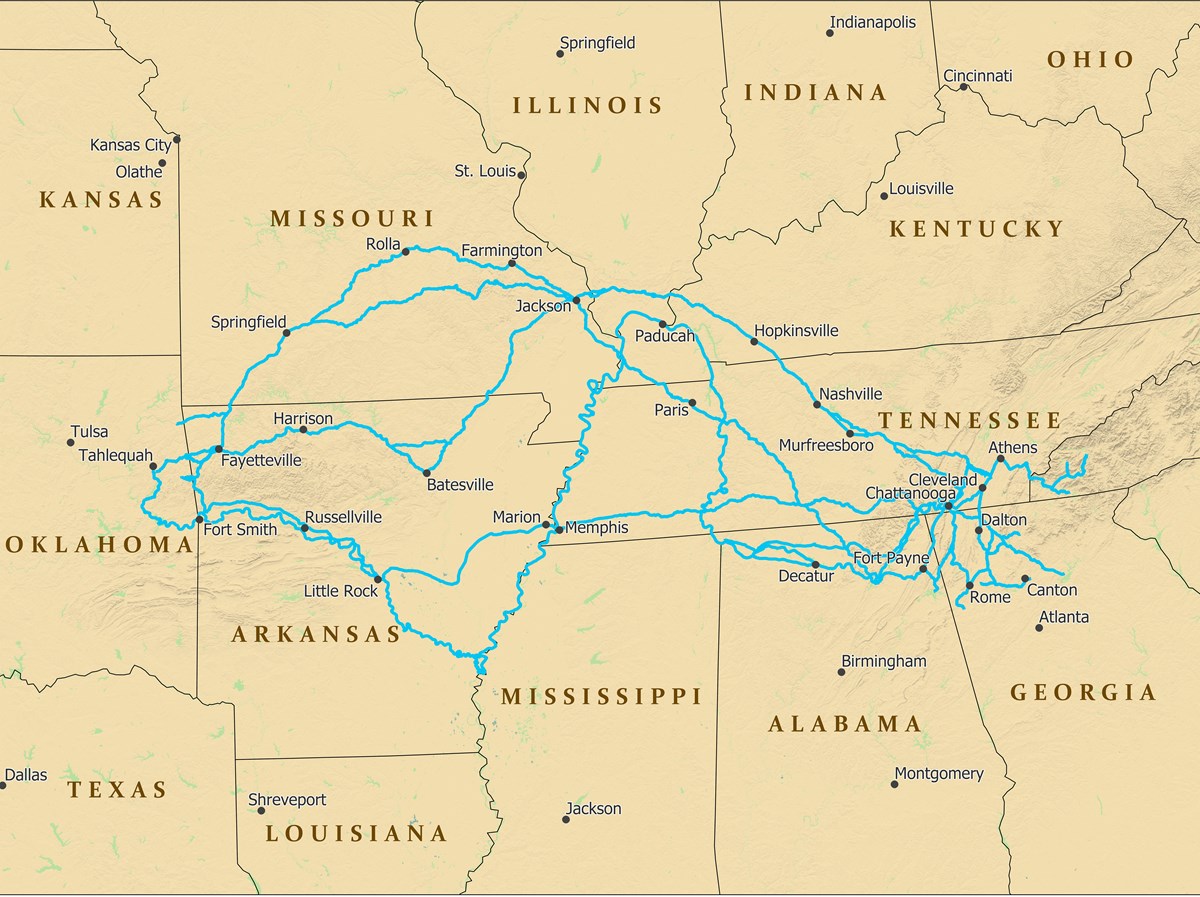
  A map depicting trails from southeast US to Oklahoma.


Alabama is not only the terminus of the Appalachian Trail, it has what some called "ends" of the Trail of Tears, for example, at Waterloo Landing.

In the article, Traveling the Trail of Tears in Alabama, Joe Cuhaj notes: "During the time of the Trail of Tears, Waterloo Landing, which is located in the town of Waterloo in the extreme northwest corner of Alabama, was situated on the banks of the Tennessee River. Since that time, the river was dammed to form Pickwick Lake, and the landing was flooded over. Because it was a final departure point for Indians from the South, Waterloo Landing was known as the "End of the Trail." Now, a historical marker denotes the location, and in September of each year a commemorative Pow-Wow is held here with traditional music and more.

Alabama has five "certified sites" that acknowledge the Trail of Tears. 
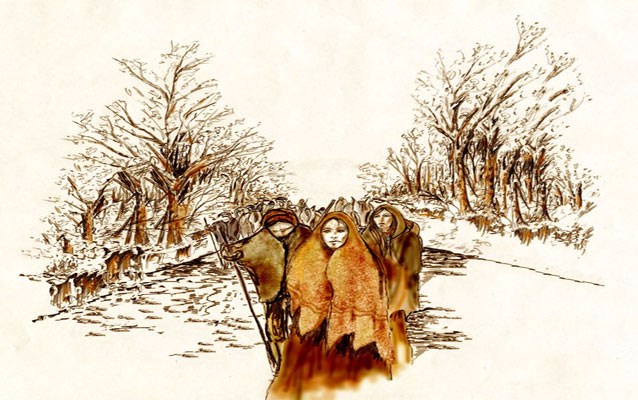
Cherokee Walking the Trail of Tears, by artist Sam Kitts. Source: NPS Trail of Tears Alabama


A grim prĂ©cis of the Trail of Tears, and the motives that drove it, is on the History Channel's Trail of Tears page. 

In September 2020, PBS premiered a movie, DIGADOHI: Lands, Cherokee, and the Trail of Tears


Wednesday, January 15, 2020

Weekend in Yuma, Arizona, Part 3: Elvis is Still in the Building


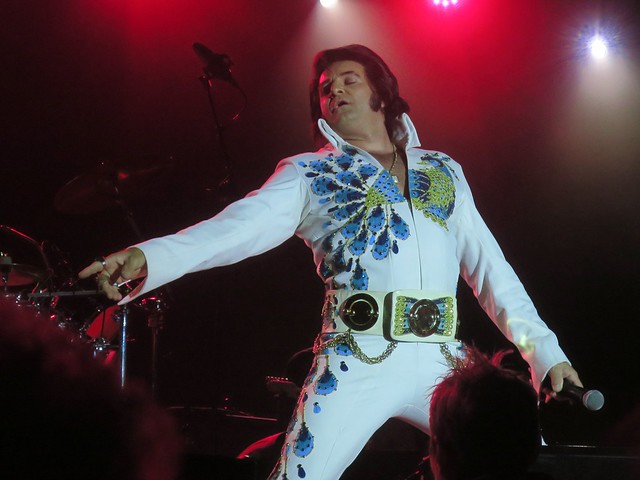
Elvis competition 2020, Quechan Casino. Winterhaven, California. January 2020.


Without hesitation, I plunked down 40 bucks to go to the Saturday night Elvis Presley impersonator competition at the Quechan Casino in Winterhaven, California, just outside of Yuma.

Elvis competition 2020, Quechan Casino. Winterhaven, California. January 2020.

For me to throw down 40 bucks for a couple of hours of entertainment is extraordinary. I'm not even particularly swoon-y over Elvis, though I do admire the singer's recorded-for-posterity voice, persona, swagger, and good looks. I liked watching his movies as a kid, and I have a cousin who, as a teen and young man, looked very much like Elvis in his prime.

While I lived in South Louisiana, I found this hypnotic song between Elvis and Kitty White, singing Crawfish, from his movie King Creole:


So. TEN Elvises on stage? When would this opportunity ever come by again? And what else could compete on a Saturday night in Yuma? This had all the cachet of going to the Olean Testicle Festival, but in a climate-controlled room in a comfortable seat!

The Elvises delivered, with the exception of the guy who chose to sing - out of all of the songs in Elvis' immense catalog - the so-called American Trilogy.

The American Trilogy is a medley of three songs:
  • I Wish I Was in Dixie
  • Battle Hymn Republic
  • All My Trials (or Sorrows)

Why, of all songs, would an Elvis competitor choose this song? And why would the contest folks permit it?

Presenting all three songs in this emo-inducing medley gives equal weight to a sentimental yearning for the "grace" of a plantation idyll, to marching Union solders, and to the cry of a mother to her infant.  ....

Oh I wish I was in the land of cotton
Old times there are not forgotten
Look away, look away, look away Dixieland.


Dixie doesn't deserve any fair-handedness. Dixie is a dark, dark period in our history, and we need to treat it as such, and stop romanticizing it.


Except in the group shots on stage, there are no photos of that Elvis who chose to sing this song.


A slide show of Elvises below:


Elvis Presley Competition 2020


<


Saturday, August 10, 2019

Arizona: Globe


Besh-Ba-Gowah, Globe, Arizona. August 2019.


I began my exploration of State Highway 77, which extends from Tucson (as Oracle Road) up past Holbrook to the edge of Navajo Nation. I made a modest plan for the day with the town of Globe as my destination.


Besh-Ba-Gowah, Globe, Arizona. August 2019.


Besh-Ba-Gowah

I spent the largest chunk of my Globe time at the ancient Salado community called Besh-Ba-Gowah, which is what the Apache called Globe in the 1800s: "Town of Metal," in recognition of its mining industry.

I'm not all that much into ancient ruins, preferring more modern-day ruins. But the Besh-Ba-Gowah site is accessible to most folks and is very much part of a living town. 

It's so much a part of a living town that it literally butts against an athletic field. At first, I found this slightly unsettling, as in: Hey, you're messing with my head-in-the-past vibe, but after that initial reaction, I did a 180, finding that I very much appreciated how two epochs sat side-by-side. 

Besh-Ba-Gowah, Globe, Arizona. August 2019.


 Oooh, but watch out for the ants there! The place teemed with them.


Ants at Besh-Ba-Gowah, Globe, Arizona. August 2019.


Two barrel cacti hosted a drunken party of ginger arthropods. Birds squeaked overhead, but in the video below, you can imagine the chirruping coming from the ants:


There's a good reason there are so many ants on the barrel cactus. From an article here:

The barrel cactus is an important partner for lots of desert species. Not only does the plant receive pollination from insects and seed dispersal from vertebrates, but it also hires ants to defend it against insect herbivores. It does this by producing sugary nectar that the ants can feed on.


A couple of bees tussled briefly over nectar in this video:


The Besh-Ba-Gowah museum had real pottery shards to smooth one's fingerpads over. It felt special to touch the same surfaces held by our first Americans so many centuries ago. A way to hold the hands of our antecedents.

Besh-Ba-Gowah, Globe, Arizona. August 2019.


The differences among preservation, conservation, restoration, renovation, and reconstruction interest me. This sign presents a quickie explanation of stabilization and reconstruction:

Besh-Ba-Gowah, Globe, Arizona. August 2019.


A plethora of lizards, of course. This lithe one tucked himself behind a stone face, but hey little dude, I could still see your curled tail!

Besh-Ba-Gowah, Globe, Arizona. August 2019.


A garden is adjacent to the ruins and museum; there is also a lower botanical garden, which is a ribbon along a path.


Besh-Ba-Gowah, Globe, Arizona. August 2019.


Overall, I received many utils of pleasure in return for the investment of a four-hour round trip drive. There's a tight little museum with artifacts gleaned from the site, a video that's not too long and not too short, pleasant museum staff, an interesting and accessible ruin site itself, and two gardens to stroll.


Holy Angels Catholic Church

Pretty.

My favorite stained glass window: the holy flautist, as she reminded me of a Celtic flautist friend.

Holy Angels Catholic Church, Globe, Arizona. August 2019.


One discordant note, however. I get that pews and statuary and windows often have the names of the donors inscribed on same. But it discomfits me for the Christ over the altar to also have the donor's name. It makes me think of a sports stadium that has no sense of place at all, but only the name of a corporation.


Holy Angels Catholic Church, Globe, Arizona. August 2019.


This Mass brought to you by .....


A slide show of Arizona State Highway 77 below (inclusive of Globe):

Arizona: State Highway 77


Monday, March 6, 2017

El Paso: Stopped at the West


The end of a road over Segundo Barrio, El Paso, Texas. October 2016.


An El Paso buddy of mine is an American of Yaqui, Spanish, and Mexican descent. Maybe a pinch of Mescalero Apache.

When he was young, his parents moved from Segundo Barrio out to the Lower Valley, which is in southeast El Paso. His was the second family to move into a brand new subdivision there, where they bought a house.

In the 1970s, when he was an adolescent, he would, from time to time, ride his bicycle to El Paso's West Side. Let's say the West Side boundary, at that time, sat just north of the current UTEP campus.

I'm a little blurry on where the west/east boundary was, but I'm not fuzzy about this: Each time my friend rode his bike to the west side of the city, a police officer stopped him and told him he could go no further. He had to stay on the east side of the city.

In He Forgot To Say Goodbye, Benjamin Alire Saenz touches on the geographical demarcations in El Paso in the not-so-distant past:
[Ramiro] We have our own house on Calle Concepcion. …. Mrs. Herrera, my English teacher. She … thinks we’re just a bunch of dumb-ass Mexicans good for nothing but flipping burgers and making breakfast burgers at Whataburger, and that I’ll grow up to be one of the better burrito-makers. Yup, that’s what she pretty much thinks, we’re all a bunch of burrito guys.  … Thomas Jefferson High School [in South-Central El Paso]… “La Jeff.” .. And our rival school, well that would be “La Bowie.” .....

There’s a pre-med magnet school that they built right next to our school …. all the pre-med students that come from the other parts of town all go to their classes in their nice separate building and have their nice separate classes. Put it this way: The good, intelligent pre-med magnet school students attend their classes in a separate facility. So we don’t even have “contact.” That’s the word they use, too. “Contact.” Like they’ve landed on the moon. … What are we gonna do to those kids, kill them? Touch them? Infect them with Mexican ways of thinking? Make them ride burros? Take their English and put it in between two pieces of corn tortillas until it sounds like Spanish? …


Wednesday, August 5, 2015

Gathering of Nations, Part 3


Gathering of Nations, Albuquerque, New Mexico. May 2013.


Here it is August 2015, and I found this draft from back in 2013. Do you think anyone will notice my tardiness?

Not sure how I intended to tie things up with Part 3, but below are the links to Parts 1 and 2:

Gathering of Nations, Part 1. Includes links to my posts on the Red Paint Powwow in Silver City. Also includes notice of troubling remarks related to women by one of the Gathering of Nations emcees. I heard a similar discordant note at the recent Coushatta Powwow last month in Louisiana.

Gathering of Nations, Part 2: A Whole 'Nother Genre of Music. I wrote about the revelation of "round dance songs." Wow. This is where I first heard the captivating voice of Fawn Wood.  

I know that I did intend to educate myself on some of the current activist and cultural streams as a result of puzzling statements I heard by emcees or performers. The statements alluded to tensions in the powwow world and also in the greater Native communities societally. That research never happened.

A good article on powwows, though:

Powwow 101, from Native Peoples Magazine, 2004


A slide show from my Gathering of Nations visit:


In fact, I have a number of New Mexico post drafts yet to be published. I've even got a post from Caucasus Georgia still to put out there. Because readers dip in and out of blogs irrespective of chronology, well, that just works out fine.


Monday, August 3, 2015

Flashback to August 2013: New Mexico: The Jingle Dress Dance

From my August 2, 2013 post about the Mescalero Apache parade in July:


Friday, August 2, 2013


The Jingle Dress Dance


Jingle dress dancer, Mescalero parade, Mescalero, New Mexico


There were jingle dancers at the Mescalero parade in July:


Here, a woman tells the story - several stories, in fact - about the history and meaning of the jingle dress dance.

An excerpt:
One of the most profound elements of Jingle Dress dancing is its spiritual power, which originates as an energy generated from the sound of the cones that sing out to the spirits when dancers lift their feet in time with the drum. The very act of dancing in this dress constitutes a prayer for healing, and often spectators, musicians, and other dancers will make gifts of tobacco to a dancer and request that she pray for an ill family member while she dances. An example of hidden spirituality and ritual within a public forum, the ever-unfolding story of the Jingle Dress Dance is unique in Indian Country. There is little fanfare and no public announcement when the Jingle Dance is performed as a healing prayer, only a quiet circulation of family members from dancer to dancer, a whispered request, and a quick nod of thanks by both parties.

Jingle dress dancer, Mescalero parade, Mescalero, New Mexico


Wednesday, June 17, 2015

Elton, Louisiana: On My Way to the Powwow: A First Look at a Cultural Intersection


Not the usual mural in Acadiana. Elton, Louisiana, showing its Indian heritage. The hills must be an example of artistic license. June 2015.


A cultural informant told me about Elton.


A jailhouse, a train, a white picket fence, and a red something that holds something. Elton, Louisiana. June 2015.


Elton is a village on 190 between Eunice and Kinder. Which may not help most people much in visualizing its location. So let's say it's about two hours west of Baton Rouge. And it's east of ........well, hell, you'd have to go a really long way west to make it east of something most of us would recognize. So let's come at it from another direction - it's about an hour northwest of Lafayette.


Elton, Louisiana. June 2015.

Population about 1200.


Elton, Louisiana. June 2015.

My cultural informant told me that, at one time, Elton was a tiny confluence of Indian, Creole, and Cajun tribes. Even today, he said, you might find it difficult to completely follow a conversation amongst old-timey locals because of the rich, intermingled dialects. 


Elton, Louisiana. June 2015.


So when I decided to go to the Coushatta Powwow, it was a happy surprise to see that Elton was on my way there. I'd already stopped to visit the Savoy Music Jam and gawk at roseate spoonbills. The wet drizzle kept me in my car, but I saw enough to make me want to go back for a drier look-see in the future.

A train blew through while I pondered the meaning of the jailhouse and the red storage structure in the city park. Surrounded by a white picket fence.


Very nice.

Here is a bit of history on the Coushatta Tribe, which has a base on the edge of Elton. There are a couple of stories at this website, but for me, anyway, the recordings were too choppy to listen to. Don't know if the issue is on my end or the server end. There is more historical information about the Coushattas at KnowLA (Encyclopedia of Louisiana).


Sunday, June 14, 2015

Kinder, Louisiana: Coushatta Powwow 2015

Coushatta Powwow 2015, Kinder, Louisiana.


The sounds of the Coushatta Powwow were a beauteous retreat from my usual rich supra of Cajun and Zydeco beats. Many drum groups there, with the songs reverberating through my bones.


Coushatta Powwow 2015, Kinder, Louisiana.

The Coushatta Powwow raised good memories of my year in New Mexico. Hey, here's an excuse to share again my video of Red Bear Drum Group at Jemez Springs Heritage Site for the Pueblo Independence Day 2013:


The Coushatta Powwow takes place in the pavilion at Coushatta Casino campus. The pavilion also serves as a rodeo site and there is a nearby stable. The sounds from the pavilion also pipe into the stable. It is very eerie - an entirely empty, cavernous stable that resounds with drum songs:


OK, now listen to this. The MC - on several occasions - when women dancers had finished, I swear to God, said "you can return to your husbands." Sheesh. Maybe it's an inside cultural joke? One hopes.

The powwow was in a good venue. Spacious. Air-conditioned. Excellent sound system. Interesting things being sold. A variety of foodstuffs. Very economical entrance fee - five bucks! 

I did miss seeing the gourd dance, and I've come to like that solemnity of that dance very much.

Below is a slide show:


#30


Friday, May 17, 2013

Gathering of Nations 2013, Part 1

Gathering of Nations 2013, Albuquerque, New Mexico


Several folks have remarked to me that they like small powwows more than large ones. The Gathering of Nations is certainly in the large category, billed as the largest powwow in North America.

Now having done both small and large, I'll agree with those who prefer the smaller events. On the other hand, an event as large as the Gathering of Nations brings perspectives you might not see at small powwows.

A mishmash of impressions below.


Gathering of Nations 2013, Albuquerque, New Mexico


The Red Paint Powwow (January) in Silver City was my first powwow

This is where I learned about the components of some powwows. I went into considerable detail back then, and if you're interested, you can read about them in the links below, as I won't repeat them in the Gathering of Nations post.

Part 1: Golden Eagle
Part 2:  The Chinese Hopi
Part 3: The Gourd Dance
Part 4: The Grand Entry
Part 5: Gaan Dancers
Part 6: North and South and drum and Drum
  

The Gathering of Nations - in size - exceeded the Red Paint Powwow by a factor of, I don't know, a hundred. It's big.


Gathering of Nations 2013, Albuquerque, New Mexico


Sound

The sound is excellent everywhere in the arena.

Bring earplugs - you never know where you might end up, and it might be right next to a monster speaker.


Gathering of Nations 2013, Albuquerque, New Mexico

Photos

Getting good photos is a challenge because you're either too far away or, if you're close to the performance floor, there are likely people standing in your line of sight.

Also, most people you want to photograph are moving - dancing, drumming, walking, jumping - and transferring in and out of your frame. While movement can result in beautiful photographs, it means you'll need to take lots of shots to guarantee a successful few.

One option is to forego the camera and live in the moment.


Gathering of Nations 2013, Albuquerque, New Mexico


Sun

Holy mother, there is no shade in the outside area with the food vendors and the music stages.

If you'll be at the GON during the day, bring both a hat and sunglasses. The sun is brutal.

Note: You don't have to go outside if you don't want. There are also food vendors and artisan items indoors.  


Gathering of Nations 2013, Albuquerque, New Mexico


The emcee(s)

I attended the Gathering of Nations on Saturday, and it seemed there were two emcees, trading off. I couldn't help but compare the emcees at the GON with the emcee at Red Paint. All had liquid radio voices, pleasant to listen to. .

All expressed humor. Red Paint Powwow's emcee, Otis Half Moon, had a wry wit that touched on history, sociology, politics, even poverty.

I felt a couple of comments by one of the GON emcees were inappropriate, with references such as "give me some tongue" and "chasing tail."

Given the troubling reports of an appallingly high rate of sexual assault against Native girls and women by Native men - such comments felt, at best, tasteless, especially at a family event such as GON.

And especially with the Native American Women Warriors, aka "lady warriors," serving as this year's Color Guard (and given the U.S. military's disgusting tolerance of sexual assault of women soldiers by their male comrades and commanding officers.)


"Lady warriors"of the Color Guard, Gathering of Nations 2013, New Mexico.


A giving tradition

At GON, after the New Zealand Maori dance troupe finished, the blanket was laid out for donations to help them defray its travel costs. Perhaps on different days of GON or at different times, other groups benefit from blanket collections.

Gathering of Nations 2013, Albuquerque, New Mexico

I always smile when I think how Red Paint's emcee encouraged donations during a blanket collection, noting that even government cheese was welcome. (There was a time when I had to get me some of that government cheese.)


Next --> Part 2: A Whole New Music Genre

Friday, February 8, 2013

New Mexico: Of Turquoise, Coral, and Spiny Oysters

Ruidoso Downs, Cowboy Symposium 2012


A know-nothing disclaimer

Me offering a discourse on stones that Native Americans of the Southwest use to make jewelry is pretty presumptuous, since I know barely anything about it.

On the other hand, I'm a consumer of jewelry made by Indians of the Southwest, therefore I have standing to publicly fumble and bumble my way up a learning curve.


Turquoise

You'd think turquoise would be a straightforward matter. Special kind of blue with black veins spidering through it. Got it, right?

If only.


Here's a list of names for turquoise:
  • "Natural" turquoise
  • Turquoise "treated" to stabilize the stone
  • Turquoise enhanced to add color
  • "Reconstituted" turquoise (sometimes includes turquoise "trash" and sometimes has no turquoise at all) 
  • Substituted turquoise (uses a real stone, but one that is enhanced to imitate turquoise or that is sold as turquoise, falsely)
  • Fake stone (e.g. made from plastic or polymer clay)

There's nothing inherently wrong with any of the above as long as the seller is honest about his product, allowing the buyer to make an informed decision about his purchase. 

Here is a clear and concise discourse on the subject of turquoise. The Turquoise Guide also offers a good overview. Reading both will give you the best picture. 


Information that surprised me

  • I used to think turquoise was plentiful, but it isn't. Indeed, most of the turquoise mines, worldwide, have been tapped out. 
  • Very little turquoise jewelry is made of so-called "natural turquoise," that is, turquoise virtually untouched by any sort of processing before being made into jewelry. And there's good reason for this - natural turquoise can fracture easily, and because it's very porous, it is susceptible to discoloration, stains, and fading. So treating the turquoise can extend the life and beauty of the stone.

So the important tip about buying turquoise is to ask the seller to tell you about the turquoise she's selling.


Red coral aka precious coral. Credit: Oceana


Coral

I used to hold three contradictory beliefs about coral. I "knew" it was a stone and I also "knew" it was the remains of a formerly-living marine animal. And because I always associated it with Southwest Indian jewelry, I held the unexamined belief that coral was "somehow" indigenous to the Southwest, from prehistoric seas perhaps.


Of course, now I know I didn't really know anything.

The color red has always been prized in Native American jewelry. Before Europeans introduced coral to Indians about 600 years ago, they often used spiny oyster shell for the desired red. Spiny oyster had been used for centuries in North America, believed to be traded north from as far away as Ecuador. 

The red coral we usually think about in Indian jewelry doesn't come from the shallow coral reefs such as the Great Barrier Reef in Australia or the Belize Barrier Reef. Rather, it comes from the deeps of the sea. For centuries, such coral could be found off  in the Mediterranean, off the coast of Italy.

But red coral is now scarce because of over-harvesting. Some jewelers no longer sell jewelry made with red coral because it encourages the depletion of remaining red coral. Some artists only use coral salvaged from old pieces of jewelry.

As with turquoise, there's coral and then there's "coral." 
  • Red, precious, blood, or oxblood coral (endangered and regulated)
  • Bamboo coral or "apple coral," often dyed to replicate red coral
  • Sponge coral, often dyed to replicate red coral

As with turquoise, nothing is intrinsically wrong with bamboo or sponge coral being treated to appear as red coral, as long as you know this is what you're buying.


Spiny oyster. Credit: Wikipedia


Spiny oyster shell

I love spiny oyster shell. I like the name, I like the variegated color, and I like that such beauty comes from something so prosaic as a shell. 

I'd never heard of spiny oyster til I was in Hannibal, Missouri, for a weekend some years ago. My travel companions and I popped in and out of some stores, and one was a jewelry store, where I saw this ring:


The owner explained that he got his jewelry from the Southwest, and as with the odd mythical beliefs I had about coral, I also had the confused idea that spiny oyster was also indigenous to the Southwest. In fact, some sources say it exists only in along Baja California; other sources say it is also in South America.

I wish there were more information on spiny oyster shell, but sadly, I'm unable to find much. But the colors range among red, orange, and purple.


Sunday, December 30, 2012

Mescalero, New Mexico: St. Joseph Apache Mission Church

St. Joseph Apache Mission Church, Mescalero, New Mexico


The St. Joseph Apache Mission Church is a stunning construction, inside and out. It has a majestic presence that draws one's eye from Highway 70, as you drive through the Mescalero Apache Reservation.


St. Joseph Apache Mission Church, Mescalero, New Mexico

The church has been undergoing a long restoration project, which is almost complete. A slide show of the church below.

St. Joseph Apache Mission Church

About 350 families are members of the church.

My mother and I attended Mass today .... (I've attended Mass three times in two months in New Mexico, which is about the same number of times I've attended Mass in the last 15 years) .... the service was in English, but there were two songs in Apache.

After the service, the congregation typically repairs to the parish hall for refreshments. Today there was actually a full lunch comprised of tortillas, Indian bread, beans, cake, and various stews that congregants brought in. Delicious, and the church members welcoming.