Showing posts with label gathering of nations. Show all posts

Wednesday, August 5, 2015

Gathering of Nations, Part 3


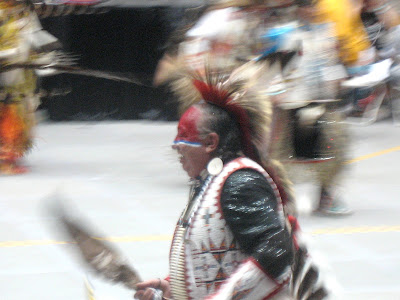
Gathering of Nations, Albuquerque, New Mexico. May 2013.


Here it is August 2015, and I found this draft from back in 2013. Do you think anyone will notice my tardiness?

Not sure how I intended to tie things up with Part 3, but below are the links to Parts 1 and 2:

Gathering of Nations, Part 1. Includes links to my posts on the Red Paint Powwow in Silver City. Also includes notice of troubling remarks related to women by one of the Gathering of Nations emcees. I heard a similar discordant note at the recent Coushatta Powwow last month in Louisiana.

Gathering of Nations, Part 2: A Whole 'Nother Genre of Music. I wrote about the revelation of "round dance songs." Wow. This is where I first heard the captivating voice of Fawn Wood.  

I know that I did intend to educate myself on some of the current activist and cultural streams as a result of puzzling statements I heard by emcees or performers. The statements alluded to tensions in the powwow world and also in the greater Native communities societally. That research never happened.

A good article on powwows, though:

Powwow 101, from Native Peoples Magazine, 2004


A slide show from my Gathering of Nations visit:


In fact, I have a number of New Mexico post drafts yet to be published. I've even got a post from Caucasus Georgia still to put out there. Because readers dip in and out of blogs irrespective of chronology, well, that just works out fine.


Sunday, May 26, 2013

Gathering of Nations 2013, Part 4: Veterans


Native American Women Warriors, Gathering of Nations 2013, Albuquerque, New Mexico

In both of the powwows I've attended - Red Paint and the Gathering of Nations - veterans featured prominently.

You can see this as well at the grand entry of the Denver March Powwow earlier this year:


The Native American Women Warriors served as this year's color guard at the Gathering of Nations.


The Marines had a large presence among the outdoor exhibitors.

Marines, Gathering of Nations 2013, New Mexico

From Wacipi Powwow:

Native American people who served in the United States armed services are greatly honored in the American Indian community. The translation for soldier, warrior, protector and helper are all the same word. In Dakota that word is Akicita and in Ojibwe it is Ogichida.
As Ed Godfrey, a Dakota/Lakota veteran explains, "It was always the warrior who was first in defending Mother Earth. It was his duty to be first. It is a part of traditional values, a part of protecting against any outside invasion that would endanger the people, our people and the land."
It is a remarkable fact that Indian people served the United States long before they were even given United States citizenship. In fact, between 1917 and 1918, over 10,000 American Indian people enlisted into the armed services to serve in World War I. Although this was the greatest number of enlisted peoples from any one non-anglo culture, citizenship (with the right to vote) for Native Americans was not granted until 1924.
The warrior is seen as having an important and ongoing role. As Chief Ernest Wabasha, hereditary chief of the Dakota people, explains. "Sometime in the future we believe that we will be back to protect the environment and everything else."
 
Gathering of Nations 2013, New Mexico

Monday, May 20, 2013

Gathering of Nations 2013, Part 4: Princesses

Although I have few possessions, I still have this card by George Littlefield. I bought it in Arizona in 2001, on my second solo road trip. 


Winner of the Miss Hobbema Indian Princess Pageant, by George Littlefield


I saw many princesses at the Gathering of Nations.

Princesses, Gathering of Nations 2013, New Mexico.


Princesses, Gathering of Nations 2013, New Mexico.


Princesses, Gathering of Nations 2013, New Mexico.


Princesses, Gathering of Nations 2013, New Mexico.


Princesses, Gathering of Nations 2013, New Mexico.


And the winner of the Miss Indian World pageant was .....


Gathering of Nations, Part 3: Buckskin Grace


Gathering of Nations 2013, New Mexico


During some ladies' buckskin dances, I happened to be sitting on a court-side bleacher. Thus it was I saw how gracefully the buckskin fringe swayed with the womens' steps.

In the dance below, which includes both buckskin and cloth dresses, you can see the beautiful fringe sway of  a buckskin dancer from the back. ... and I love the song.


Below you can see how the fringe moves from the front and side, as you watch the Head Woman Dancer lead her family, friends, and village supporters on a march around the court. Another lovely song.


Below is a video from a 2007 event, highlighting three buckskin dancers. Dignity and grace are two of the hallmarks of buckskin dancing.


I enjoyed reading these discussion about making a buckskin dress:

In this thread, ladies talk about traditional and contemporary colors of buckskin dresses - that eons-old tension between old ways and new in all cultures.  

In a discussion thread about how to make a buckskin dress, this dressmaker packs so much information in her response - family history, traditions, technique, blending of the spiritual with the making, and a generous offer to mentor the original poster:  

Gathering of Nations 2013, New Mexico
Hi! I make Buckskin Dresses for a living and work on them everyday!

I agree with Friend of Bear that the best way to learn to make one is too look at a good dress and see how it was put together. I took my Mother's dress and studied every part of it (without taking it apart...it would have meant death!!).

Ask someone's hands-on help because there is a lot of feeling the hides and looking at the hides which will tell you which hide is good for which piece...top, skirt, fringe.
One thing that we never, ever, never do...is use glue on any part of a Buckskin Dress!!!! And we do not use a hole punch either!

There is no need for glue if you are going to tie a skirt and you use an awl for all holes. I hand sew my dresses unless specifically asked to be tied at the sides. If you sew the seam, you cut the side fringe separately and sew it into the seam inside out, of course, the the hides back to back...smooth side in. Work with it...you will find the right way.

The most important thing is to use good tools. That would be my best advise. A very good, very sharp pair of leather scissors. Good buckskin needles, awls, a small pair of gripping pliers (don't know the real name) to help you pull the needle through 3 layers of buckskin when it is stubborn. Sometimes just a firm grip is all you need. Good strong thread or sinew.

I cut all my strings straight, not in a circle.. and I harldly ever stretch my commercial hides. If you cut the dress right and fit it right...they will never be stretched on the body! The current Comanche Nation Princess is wearing a dress I made for her when she was 13 and she is now 19 and she always sits properly, so that the back of the skirt has never "pooched".

The only part of the dress that does get stretched are the fringes when I am cutting them. This is good to do so that gravity does not pull the fringes too long as they wear the dress so they become uneven and have to be trimmed all the time.

Making a Buckskin Dress is a constant learning experience. I find new and better ways of doing some part of it on each new dress I make. I also listen to comments and ideas from other Dress makers and from wearers and I am always open creative thinking. And of course the elders. Even though the dress has evolved so much from the old days...there are always reasons for a dress being made a certain way and by listening to them you can learn so much, or realize why you are doing something...or, what makes me feel good, is when they validate something you are already doing, by saying they do it the same way.

Make your own patterns..start with your own shape (especially if the dress is for you, duh!!) and take your measurements and transfer them to paper. Then go through the hides that you have to find the right one for the right piece and cut it from your pattern. I am not a professional seamstress, I've never made anything from a Simplicty pattern, and I don't know how to use a sewing machine, but I figured this out and you can do it too!

I am so sorry to go on and on...I just wanted you to have the basics...it takes me two weeks to put a dress together...choosing the hides to making the pattern and cutting and sewing and that is with my life and cooking and talking to customers and going to Pow-Wows in between (notice I left out cleaning house), and if I am diligently using every other spare moment on the dress.

It has taken me 10 years to get to be asked to make dresses for some of he best Championship winning dancers in the country and I have a waiting list one year long, but I would be glad to share any info that I can in writing.

If you are ever in SW Oklahoma, drop in on me and we'll do it together!

You know, I forgot the most important thing!!! I pray before I ever cut a hide in thankfulness for the deer (or elk) that the Creator gave us (I learned that from a 90 year old dress maker Alice Littleman) and I thank God everyday for the talent and vision and the strength and the health that he allows me to have that I need to make dresses. All Glory goes to God!!!
Ah-ho!!


Saturday, May 18, 2013

Gathering of Nations 2013, Part 2: A Whole 'Nother Music Genre


Gathering of Nations 2013, New Mexico


From my experience at the Red Paint Powwow, I knew about the (big) drum contests, but I didn't know anything about the hand drums.

It opened up an entirely new genre of  music to me. Totally unexpected experience.

Sometimes one, sometimes two, sometimes a group of people standing in front of the mic, holding hand drums. First they'd sing in a Native language, then there'd be a pause, and then the song would be in English. Romantic at times. Poignant. Funny.

They're "round dance"songs. 


A sampling of songs 

Ask Your Mom For Fifty Cents 


Ask your mom for fifty cents
To watch the fat man jump the fence
He jumped so high he touched the sky
He never came down til Fourth of July. 


Just for You


I don't know what to do 
I can't just say I love you
After all we've been through
What am I supposed to do
I've always been meant just for you.


What a voice.


Sonny Boy


Sonny boy, Daddy's proud of you
In every thing you do
Daddy's here for you
Sonny boy, Daddy cares for you
Daddy loves you, too
You are Daddy's pride and joy


What is a round dance song? 

I found this remembrance on a youtube video of a round dance song, Honey Open the Door:

Imagine this, when I was a kid in the 50;s, rounddances were held in people's houses,teams of horses and sleighs would arrive with singers and dancers. Us kids would play outside till we had enough, the house would be rocking, the room blue with smoke. There'd be deer meat soup and boiled potatoes and of course bannock and lard, berries and canned milk. Granny would make us a bed somewhere and we'd watch and listen till we fell asleep.


Chickamauga Cherokee gives a bit of explanation about round dance music, with an excerpt below: 
The origins of Round Dance come from the healing dances of the Plains Indians – it retains its spiritual core and inspires joy and happiness – men and women, young and old dance in a spectacular display of kinship and harmony.  It has developed into a friendship dance that has long been held as a courting activity. This dance is one of the few Native American dances in which women get to dance with men. Native American traditional dances are usually segregated by gender.  It is performed during a portion of a powwow and during many social occasions. The round dance has an infectious upbeat tempo and creates a simple and fun activity. The beat of the drum is different from other dances.


A Saskatchewan library hosted a round dance in 2011, and noted this:

Protocol
First Nation protocol and information for the pipe ceremony and feast [which would precede the round dance]: Women who are on their monthly cycle must refrain from attending.  [Emphasis added.] Women are encouraged to wear a long skirt to all traditional gatherings.

The text above that I highlighted in pink is a good example of what I was talking about back here - the restrictions on women's self-determination in the guise of culture, religion, "respect," or "protection." The fact that a public library in Canada prohibited some of its members from attending a public event, based on their gender, is repellent.

But I digress.

I love the round dance songs and plan to listen to many more of them. 

Friday, May 17, 2013

Gathering of Nations 2013, Part 1

Gathering of Nations 2013, Albuquerque, New Mexico


Several folks have remarked to me that they like small powwows more than large ones. The Gathering of Nations is certainly in the large category, billed as the largest powwow in North America.

Now having done both small and large, I'll agree with those who prefer the smaller events. On the other hand, an event as large as the Gathering of Nations brings perspectives you might not see at small powwows.

A mishmash of impressions below.


Gathering of Nations 2013, Albuquerque, New Mexico


The Red Paint Powwow (January) in Silver City was my first powwow

This is where I learned about the components of some powwows. I went into considerable detail back then, and if you're interested, you can read about them in the links below, as I won't repeat them in the Gathering of Nations post.

Part 1: Golden Eagle
Part 2:  The Chinese Hopi
Part 3: The Gourd Dance
Part 4: The Grand Entry
Part 5: Gaan Dancers
Part 6: North and South and drum and Drum
  

The Gathering of Nations - in size - exceeded the Red Paint Powwow by a factor of, I don't know, a hundred. It's big.


Gathering of Nations 2013, Albuquerque, New Mexico


Sound

The sound is excellent everywhere in the arena.

Bring earplugs - you never know where you might end up, and it might be right next to a monster speaker.


Gathering of Nations 2013, Albuquerque, New Mexico

Photos

Getting good photos is a challenge because you're either too far away or, if you're close to the performance floor, there are likely people standing in your line of sight.

Also, most people you want to photograph are moving - dancing, drumming, walking, jumping - and transferring in and out of your frame. While movement can result in beautiful photographs, it means you'll need to take lots of shots to guarantee a successful few.

One option is to forego the camera and live in the moment.


Gathering of Nations 2013, Albuquerque, New Mexico


Sun

Holy mother, there is no shade in the outside area with the food vendors and the music stages.

If you'll be at the GON during the day, bring both a hat and sunglasses. The sun is brutal.

Note: You don't have to go outside if you don't want. There are also food vendors and artisan items indoors.  


Gathering of Nations 2013, Albuquerque, New Mexico


The emcee(s)

I attended the Gathering of Nations on Saturday, and it seemed there were two emcees, trading off. I couldn't help but compare the emcees at the GON with the emcee at Red Paint. All had liquid radio voices, pleasant to listen to. .

All expressed humor. Red Paint Powwow's emcee, Otis Half Moon, had a wry wit that touched on history, sociology, politics, even poverty.

I felt a couple of comments by one of the GON emcees were inappropriate, with references such as "give me some tongue" and "chasing tail."

Given the troubling reports of an appallingly high rate of sexual assault against Native girls and women by Native men - such comments felt, at best, tasteless, especially at a family event such as GON.

And especially with the Native American Women Warriors, aka "lady warriors," serving as this year's Color Guard (and given the U.S. military's disgusting tolerance of sexual assault of women soldiers by their male comrades and commanding officers.)


"Lady warriors"of the Color Guard, Gathering of Nations 2013, New Mexico.


A giving tradition

At GON, after the New Zealand Maori dance troupe finished, the blanket was laid out for donations to help them defray its travel costs. Perhaps on different days of GON or at different times, other groups benefit from blanket collections.

Gathering of Nations 2013, Albuquerque, New Mexico

I always smile when I think how Red Paint's emcee encouraged donations during a blanket collection, noting that even government cheese was welcome. (There was a time when I had to get me some of that government cheese.)


Next --> Part 2: A Whole New Music Genre