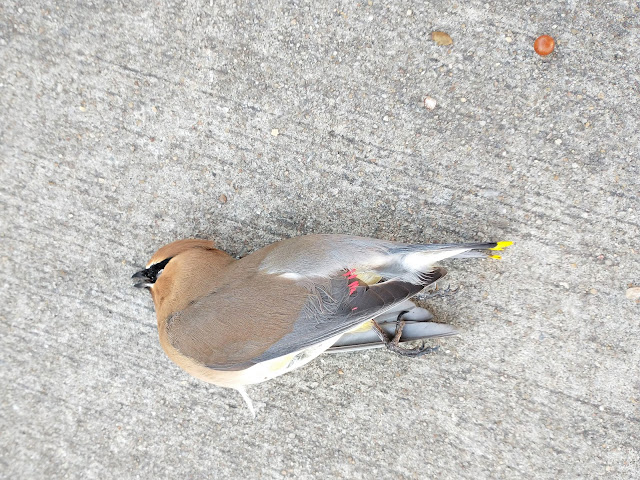
Cedar waxwing, dead. Mobile, Alabama. February 2022. Credit: Mzuriana.
Although I didn't touch the body, it emitted an essence of still-warm plumpness.
I found a small stick and I gently moved it off the sidewalk pavement so as to save it from the indignity of an unintentional crush by a pedestrian's footfall.
How did it die? There was no evidence of injury. Note the small berry in the upper right corner of the photo. If it is a nandina berry, this can kill cedar waxwings that binge on them. But is it a nandina? I don't know.
Hmm, but now I'm thinking there are two of you. Mailbox lizard who had completely molted except for the collar, and doorway lizard who had completely molted except for the tail.
Lizard shedding (molting), Birmingham, Alabama. December 2020.
Notwithstanding COVID, I was not alone in my campsite. Strangers pushed into my corona bubble.
The night before my departure from Lake Livingston State Park, as I sat outside in the gloaming, I felt-heard a small rustling beneath my chair. Discounted it. Then I heard it again. Pulled out my phone and hit the flashlight feature. Who - what - goes there? I panned the leafy floor.
A frog.
The next morning, as I broke camp, other site mates revealed themselves.
Tucked into the space between my tent roof and the rain fly, a walking stick.
Gripping the side of my colorful tablecloth - a sentimental artifact from the road trip my daughter and I took to Alaska when she was 16 - a green lizard.
Neither the walking stick nor the lizard gave me any mind.
Cholla in bloom, San Pedro Riparian National Conservation Area, Arizona. May 2019.
In my elementary and middle school eras, the same girl sat behind me in homeroom. Karen had long brown hair, with every thick strand always in perfect place. Many mornings, Karen would lean over her school desk toward the back of my head to tell me a joke. It was usually off-color. Several of Karen's jokes are imprinted into my brain.
Cholla in bloom, San Pedro Riparian National Conservation Area, Arizona. May 2019.
One of them was a question-and-answer joke:
Karen: Have you ever smelled mothballs?
Me: Yes.
Karen: How'd you get their tiny little legs apart?
Cholla in bloom, San Pedro Riparian National Conservation Area, Arizona. May 2019.
Early this month, as I stood in line one evening at my local Fry's grocery store, the woman in front of me exclaimed to the cashier that she'd just returned from hummingbird banding, and how exhilarating it was.
Cholla in bloom, San Pedro Riparian National Conservation Area, Arizona. May 2019.
I had two immediate reactions:
I must go there!
How'd they get their tiny little legs apart?
Cholla in bloom, San Pedro Riparian National Conservation Area, Arizona. May 2019.
I did go.
You may wonder why I've planted so many flowering cholla photos in an article on hummingbird banding.
Cholla in bloom, San Pedro Riparian National Conservation Area, Arizona. May 2019.
The empty hummingbird feeder below - rigged up with a remote-control trap - tells the story. The bulk of the north-flying migrant hummingbirds have already passed through, leaving mostly the resident flutterbirds, who maybe weren't in the mood for tricky human shenanigans on the day of my visit.
Hummingbird trap, San Pedro Riparian National Conservation Area, Arizona. May 2019.
However, one lady hummingbird took a hit for the home team, and I've got some of the weighing, banding, and release rituals captured in the video below:
One of the volunteers suggested I return the last week of August or the first week of September to enjoy the height of the southbound migration. I will do so, for sure.
Cholla in bloom, San Pedro Riparian National Conservation Area, Arizona. May 2019.
When I lived in Alamogordo, I was a lucky chick to participate in duck banding at the annual Bosque del Apache National Refuge's Festival of Cranes. I got to hold a newly-banded duck and release it into the air. Gosh, that was fun. A video of a group release below:
In case you can never get enough of flowering chollas, you can find the video of same swaying in the breeze here.
Cholla in bloom, San Pedro Riparian National Conservation Area, Arizona. May 2019.
A library on El Paso's westside is the Dorris van Doren Library on Redd Road. This library has a small courtyard; inside the courtyard is an A-frame. Groups use the A-frame for young-child activities or meetings. When available, individuals enjoy the space while reading, studying, or contemplating the artfully-framed view of the outdoors from within. The A-frame has a fireplace, a cozy arrangement of soft chairs, and a couple of large group-study tables.
The courtyard is a pleasant space to sit outside to read alone or have quiet tete-a-tetes between tutor and student or friends.
It is so good to sit inside the A-frame and do nothing but look outside. Once I saw hawks wheeling over the ridge. Another time a young rabbit tarried next to the window, perhaps enjoying the shade on a hot day.
The Westside Community Park is just on the other side of the ridge that you see through the window.
One day, after a meeting in the A-frame, I climbed up that ridge and walked along one of the park's trails. I saw both flora and fauna:
Cactus flower on Westside Community Park trail. August 2016.
Lizard on Westside Community Park trail. August 2016.
Banana spider, aka golden silk orb weaver spider. Lake Fausse Point State Park, Louisiana. September 2015.
When I take pictures of flashy spiders like the golden silk orb weavers, it is always with this thought: Oh my God, look at this spider, it's so cool, but don't let it touch me, oh no, but let me get a picture of it, oh ick, oh cool, eww!
I took these two pics at Lake Fausse Pointe State Park this past September, but posted these later photos from Chicot State Park first.
I am grimacing as I write this.
Banana spider, aka golden silk orb weaver spider. Lake Fausse Point State Park, Louisiana. September 2015.