From a friend's garden of spring blooms. April 2023. Credit: Mzuriana.
A Kansas City friend and I met in Columbia recently. She brought me the best kind of flowers: Cut from her own garden and in a glass vessel from her home.
Add to that spirited conversation over coffee (me) and tea (her) on a sunny, warm day .... yes, 'tis spring.
This is my friend who packed 6000 condoms in her suitcase on a volunteer mission to a country whose people suffer from a very high STI rate and a shortage of just about everything else.
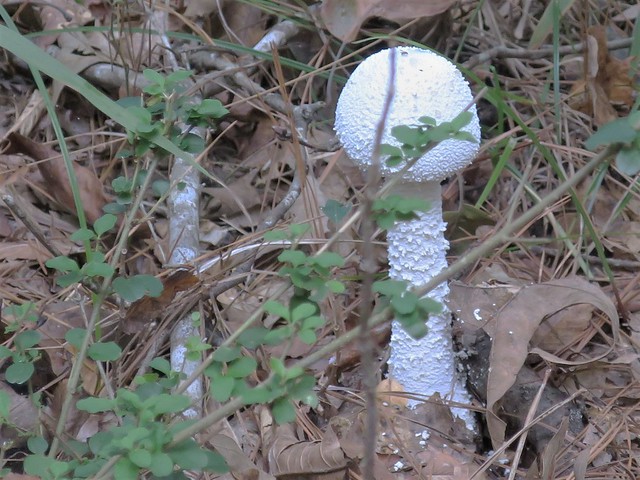
I look at them in the wild. I look at my pictures of them.
I crave them. I want very, very much to bite into them.
Seductive mushroom. Mobile, Alabama. July 2022. Credit: Mzuriana.
I fantasize about their texture, their flavor. Surely the taste would be a limb-melting union of a warmed English muffin, buttery. Soft like the fluffiest of pancakes and yet with a bit of resistance to my teeth. The lightest feathered dusting of cornflour up top, and porous pockets within.
Seductive mushroom. Mobile, Alabama. July 2022. Credit: Mzuriana.
Seductive mushroom. Mobile, Alabama. July 2022. Credit: Mzuriana.
Seductive mushroom. Mobile, Alabama. July 2022. Credit: Mzuriana.
Alas, I have yet to discover their name, and maybe they could kill me.
Petite white mushroom, Historic Blakeley State Park, Alabama. October 2021.
Mushrooms. Umami. Mmmm.
Despite their predilection for growing on dead stuff, mushrooms are often pretty, or at least intriguing, and to bite one is to transport me to a sensual reverie of flavor, aroma, texture, and chewiness. Earthy.
Fungi Farm, a local commercial mushroom farm, hosted a mushroom foraging foray at Historic Blakeley State Park in early October.
Mushroom, Historic Blakeley State Park, Alabama. October 2021.
'twas hot and sweaty work, but so satisfying to be in the woods. We were a group of at least 25 people.
One of my favorites was this velvety mushroom that reminded me of the so-soft lamb's ear leaves. And on its underside, you could leave your fingerprint.
Mushroom, Historic Blakeley State Park, Alabama. October 2021.
Mushroom, Historic Blakeley State Park, Alabama. October 2021.
Major lesson learned from the foray: Bring a pocket notebook! Alan, a Fungi Farm principal, helped identify the mushrooms we found, and although the names of many remain rooted in my head, the matching of same with the samples are fuzzy. Like said mushroom above. But some names include (mixing common names and scientific names of individuals and genus) turkey tail, false turkey tail, boletes, russula, and .......
Below is a sample of the group's foraging finds.
Mushroom, Historic Blakeley State Park, Alabama. October 2021.
A slide show below on my cumulative mushroom collection over the years and locales.
Honey mushrooms, Birmingham, Alabama. October 2020.
I glanced out my kitchen window, which opens to the back yard.
Wa! What happened there?!
Clutches of golden mushrooms seemed to have blossomed overnight. I walked out to investigate.
Soft, golden mushrooms stood close together, like giggling girls on the playground during recess, talking deliciously about those cute boys over there.
Honey mushrooms, Birmingham, Alabama. October 2020.
And "over there," squads of flat butterscotch boys with curled-up edges.
Honey mushrooms, Birmingham, Alabama. October 2020.
A new friend identified them for me as honey mushrooms. "Them" being all of them, even though, to my untrained eyes, they looked like entirely distinct varieties due to their different colors, shapes, and sizes.
But apparently the butterscotch boys are mature golden girls.
The above photos are from the first day I saw them.
Oi. How things changed in just two days.
Maggots on honey mushrooms, Birmingham, Alabama. October 2020.
From mushrooms to mush. Made so by the little white maggots? Or did someone go by and zap them with a fungicide?
Ewwww.
Regardless of the cause, maybe this mushifying is karma, as apparently, honey mushrooms prey on tree roots, living or dead.
Honey mushrooms, Birmingham, Alabama. October 2020.
Cholla in bloom, San Pedro Riparian National Conservation Area, Arizona. May 2019.
In my elementary and middle school eras, the same girl sat behind me in homeroom. Karen had long brown hair, with every thick strand always in perfect place. Many mornings, Karen would lean over her school desk toward the back of my head to tell me a joke. It was usually off-color. Several of Karen's jokes are imprinted into my brain.
Cholla in bloom, San Pedro Riparian National Conservation Area, Arizona. May 2019.
One of them was a question-and-answer joke:
Karen: Have you ever smelled mothballs?
Me: Yes.
Karen: How'd you get their tiny little legs apart?
Cholla in bloom, San Pedro Riparian National Conservation Area, Arizona. May 2019.
Early this month, as I stood in line one evening at my local Fry's grocery store, the woman in front of me exclaimed to the cashier that she'd just returned from hummingbird banding, and how exhilarating it was.
Cholla in bloom, San Pedro Riparian National Conservation Area, Arizona. May 2019.
I had two immediate reactions:
I must go there!
How'd they get their tiny little legs apart?
Cholla in bloom, San Pedro Riparian National Conservation Area, Arizona. May 2019.
I did go.
You may wonder why I've planted so many flowering cholla photos in an article on hummingbird banding.
Cholla in bloom, San Pedro Riparian National Conservation Area, Arizona. May 2019.
The empty hummingbird feeder below - rigged up with a remote-control trap - tells the story. The bulk of the north-flying migrant hummingbirds have already passed through, leaving mostly the resident flutterbirds, who maybe weren't in the mood for tricky human shenanigans on the day of my visit.
Hummingbird trap, San Pedro Riparian National Conservation Area, Arizona. May 2019.
However, one lady hummingbird took a hit for the home team, and I've got some of the weighing, banding, and release rituals captured in the video below:
One of the volunteers suggested I return the last week of August or the first week of September to enjoy the height of the southbound migration. I will do so, for sure.
Cholla in bloom, San Pedro Riparian National Conservation Area, Arizona. May 2019.
When I lived in Alamogordo, I was a lucky chick to participate in duck banding at the annual Bosque del Apache National Refuge's Festival of Cranes. I got to hold a newly-banded duck and release it into the air. Gosh, that was fun. A video of a group release below:
In case you can never get enough of flowering chollas, you can find the video of same swaying in the breeze here.
Cholla in bloom, San Pedro Riparian National Conservation Area, Arizona. May 2019.
I'm a bit of a camping Goldilocks, perhaps, in that I don't want to camp when it's too cold and I don't want to camp when it's too hot.
The first weekend in May was a splendiferous time for my first Missouri camping foray this year.
I chose Arrow Rock State Park. I've been there before. I like that the state park is tucked up against the village of Arrow Rock, and it's pleasant to poke around town.
Cold coffee fixings, Arrow Rock State Park, Missouri. May 2018.
To keep things super easy for me, I decided not to cook a damn thing. Not even coffee. Whoa, wait a minute! Not that I'd do without coffee, for God's sake! Nope, I'd bring my favorite instant coffee, some sweetener, a flavored creamer, and shake it all up in cold water each morning. Damn good stuff.
Arrow Rock State Park, Missouri. May 2018.
When I arrived at the campground, I nabbed the second to the last available campsite. Hoo-wee, that was lucky! The Audubon Society was hosting a weekend birding event, so I got there in the nick of time. I saw a lot of big-rig camera gear. Impressive.
I took several walks over the weekend.
Arrow Rock State Park, Missouri. May 2018.
One of the coolest things I saw was this tree being consumed by beaver bites.
Beaver teeth markings, Arrow Rock State Park, Missouri. May 2018.
Beaver teeth markings, Arrow Rock State Park, Missouri. May 2018.
Beaver teeth markings, Arrow Rock State Park, Missouri. May 2018.
Beaver teeth markings, Arrow Rock State Park, Missouri. May 2018.
I had the thought to record morning birdsong at my campsite and see about adding that to a slide show for my youtube channel. Below is my result:
As winter continues to hang on, the morning began overcast and chilly. Begrudgingly, it did lighten and warm some as the day grew.
Nevertheless, petite wildflowers made a showing. Two adept identifiers, the hike guide and one of the hikers, named spring beauties, wake robin (trillium), sweet william, wild plum (tree), pussytoes, toothwort, lousewort, Dutchmen's breeches, bluebells, false rue anemone, [true] rue anemone, yellow violet, common violet, large bellwort, and a couple I'm forgetting.
Wake robin (trillium). Three Creeks Conservation Area, Missouri. April 2018.
We saw the foliage for future blooming may apples, wild ginger, wild geranium, and colombine.
Paw prints. Three Creeks Conservation Area, Missouri. April 2018.
It wasn't just wildflowers. I added two carcasses to my carcass collection:
Dead frog. Three Creeks Conservation Area, Missouri. April 2018.
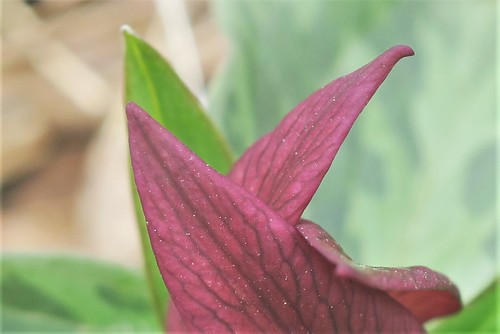
The trees haven't leafed out yet, but there are several varieties of wildflowers waving in the breeze - deep purples, some flashes of underside-fuschia, white, periwinkle blue.
Dismembered carcasses of trees pounded by last year's flooding lay atop the grasses.
Bringing Spring home. Ferguson, Missouri. April 2018.
Oh, where is Spring?
Bringing Spring home. Ferguson, Missouri. April 2018.
It snowed on Easter.
Bringing Spring home. Ferguson, Missouri. April 2018.
Unacceptable.
Bringing Spring home. Ferguson, Missouri. April 2018.
I had to take matters into my own hands.
Bringing Spring home. Ferguson, Missouri. April 2018.
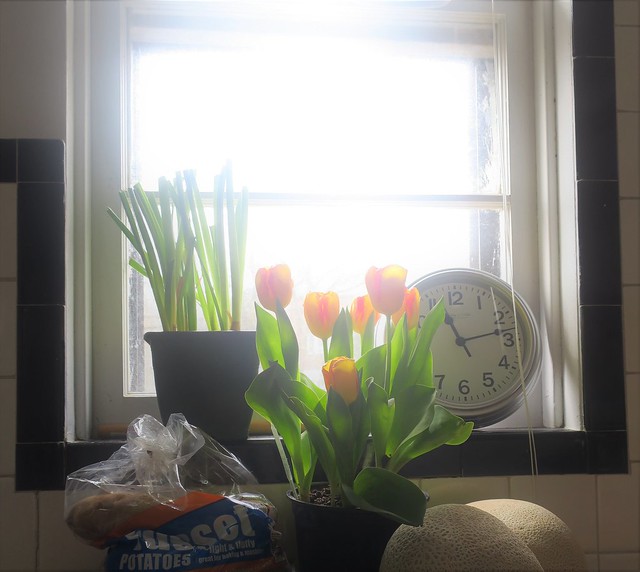
On Monday, I picked up a bouquet of Spring from the local grocer. I put it next to the long-ago deflowered paper whites from official winter, which I clip every once in awhile to create the illusion of Spring to come.
Bringing Spring home. Ferguson, Missouri. April 2018.
No, no, no, no. I am finished with winters in cold lands.
Bringing Spring home. Ferguson, Missouri. April 2018.
I am already planning my next annual home. It will be a warm and sunny place.
In the meantime, these yellow and red-cheeked tulips sustain my spirit.