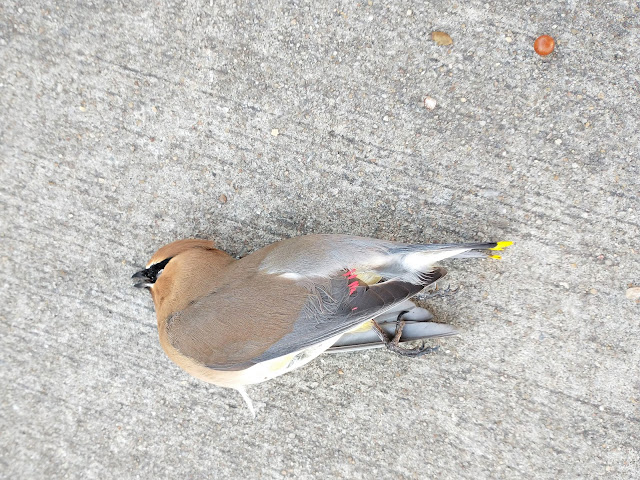
Cedar waxwing, dead. Mobile, Alabama. February 2022. Credit: Mzuriana.
Although I didn't touch the body, it emitted an essence of still-warm plumpness.
I found a small stick and I gently moved it off the sidewalk pavement so as to save it from the indignity of an unintentional crush by a pedestrian's footfall.
How did it die? There was no evidence of injury. Note the small berry in the upper right corner of the photo. If it is a nandina berry, this can kill cedar waxwings that binge on them. But is it a nandina? I don't know.
Cholla in bloom, San Pedro Riparian National Conservation Area, Arizona. May 2019.
In my elementary and middle school eras, the same girl sat behind me in homeroom. Karen had long brown hair, with every thick strand always in perfect place. Many mornings, Karen would lean over her school desk toward the back of my head to tell me a joke. It was usually off-color. Several of Karen's jokes are imprinted into my brain.
Cholla in bloom, San Pedro Riparian National Conservation Area, Arizona. May 2019.
One of them was a question-and-answer joke:
Karen: Have you ever smelled mothballs?
Me: Yes.
Karen: How'd you get their tiny little legs apart?
Cholla in bloom, San Pedro Riparian National Conservation Area, Arizona. May 2019.
Early this month, as I stood in line one evening at my local Fry's grocery store, the woman in front of me exclaimed to the cashier that she'd just returned from hummingbird banding, and how exhilarating it was.
Cholla in bloom, San Pedro Riparian National Conservation Area, Arizona. May 2019.
I had two immediate reactions:
I must go there!
How'd they get their tiny little legs apart?
Cholla in bloom, San Pedro Riparian National Conservation Area, Arizona. May 2019.
I did go.
You may wonder why I've planted so many flowering cholla photos in an article on hummingbird banding.
Cholla in bloom, San Pedro Riparian National Conservation Area, Arizona. May 2019.
The empty hummingbird feeder below - rigged up with a remote-control trap - tells the story. The bulk of the north-flying migrant hummingbirds have already passed through, leaving mostly the resident flutterbirds, who maybe weren't in the mood for tricky human shenanigans on the day of my visit.
Hummingbird trap, San Pedro Riparian National Conservation Area, Arizona. May 2019.
However, one lady hummingbird took a hit for the home team, and I've got some of the weighing, banding, and release rituals captured in the video below:
One of the volunteers suggested I return the last week of August or the first week of September to enjoy the height of the southbound migration. I will do so, for sure.
Cholla in bloom, San Pedro Riparian National Conservation Area, Arizona. May 2019.
When I lived in Alamogordo, I was a lucky chick to participate in duck banding at the annual Bosque del Apache National Refuge's Festival of Cranes. I got to hold a newly-banded duck and release it into the air. Gosh, that was fun. A video of a group release below:
In case you can never get enough of flowering chollas, you can find the video of same swaying in the breeze here.
Cholla in bloom, San Pedro Riparian National Conservation Area, Arizona. May 2019.
No bird exemplifies Southwestern deserts better than the noisy Cactus
Wren. At all hours of the day they utter a raw scratchy noise that
sounds like they are trying to start a car. Cactus Wrens are always up
to something, whether hopping around on the ground, fanning their tails,
scolding their neighbors, or singing from the tops of cacti.
I didn't know about the cactus wren until I walked by one of its nests in the Chisos Basin Campground.
The above description is about the cactus wren's charming side. It also has less Disney-esque characteristics, also described here.
I was damned impressed by its nest:
Cactus wren nest, Chisos Basin Campground, Big Bend National Park, Texas. September 2017.
Cactus wren nest, Chisos Basin Campground, Big Bend National Park, Texas. September 2017.
Cactus wren nest, Chisos Basin Campground, Big Bend National Park, Texas. September 2017.
Cactus wren nest, Chisos Basin Campground, Big Bend National Park, Texas. September 2017.
Below is a video of cactus wren calls, including a lagniappe of slow-action fly catching by a cactus wren (videographer Don DesJardin):
Although cactus wrens turn my head, I am still loyal to mockingbirds for their long, complicated melodies such as my English-speaking neighbor in Opelousas here and my Georgian-speaking neighbor in Rustavi here.
Ibis on Highway 9, east of Columbus, New Mexico. September 2016.
September 2016
Brother 4 came to visit and we pondered what to do with an entire day. So many ideas to consider:
Go for a hike in the Franklin Mountains?
Take a grand tour up to Cloudcroft, New Mexico, and nearby sweet spots, then swing over to White Sands National Monument, maybe even stopping en route at one of the natural areas that hug the Organ Mountains?
Or just focus on one of the grand tour destinations?
Step into Mexico at one of the various border crossings close by?
Hit up some El Paso museums?
We decided to go simple and low-key --> a lil' road trip to Columbus, New Mexico, and Palomas, Chihuahua, Mexico.
Ibis on Highway 9, east of Columbus, New Mexico. September 2016.
More on some of that later. The focus of this post is on the birds we saw at a watery stretch along Highway 9 just east of Columbus.
Best I can tell, these were white-faced ibis. At first, the wing spreading made me think of anhinga, but the bills here are longer and curved. I'm not at confident about my identification.
Ibis on Highway 9, east of Columbus, New Mexico. September 2016.
There's never a bad time to look at and appreciate birds, but it felt especially nice for me on this day because it took me back in spirit to South Louisiana.
My sister, Murphy, and I popped up there. She dropped me off and I walked the wide, paved trail.
I watched a kestrel as he perused the day's menu.
Kestrel. Cathy Fromme Prairie Natural Area. May 2016.
I couldn't get a decent photo, but a clutch of baby coyotes bounced about in the tall grass on a knoll, while staying within calling distance of mama.
I admired the courting flashes (or maybe a territorial protection display against other males) of a red-winged blackbird. I've got some ho-hum stills in the slideshow at the end of this post. But here is a terrific video about the birds from the Cornell Lab of Ornithology:
The Cathy Fromme Prairie Natural Area is a jewel for Fort Collins.
Osprey nest by Twin Peaks Golf Course, Ninth Street, Longmont, CO. May 2016.
**Disclosure: I am not a proponent of the current fashion in
feral cat management, but that's a conversation for some other day and
maybe some other forum.
Santo Domingo del Cerro, Antigua, Guatemala. April 2016.
Here is a flashy video of Santo Domingo del Cerro that the hotel produced. It's pretty.
Santo Domingo del Cerro, Antigua, Guatemala. April 2016.
In addition to the angel, maybe my favorite experience at Santo Domingo del Cerro was with the birds.
Santo Domingo del Cerro, Antigua, Guatemala. April 2016.
Santo Domingo del Cerro, Antigua, Guatemala. April 2016.
Santo Domingo del Cerro, Antigua, Guatemala. April 2016.
It felt special to have one hop onto my finger then waddle up my arm to my shoulder. It was good to focus all of my attention on what this small bird was doing, to be mindful of nothing else.
Santo Domingo del Cerro, Antigua, Guatemala. April 2016.
I wasn't able to capture its quality with my camera, but the light shone through the chairs' muslin covers like soft candles. The chairs glowed where the sun struck them.
Santo Domingo del Cerro, Antigua, Guatemala. April 2016.
Outside the chapel, a large foot. Don't ask me; I don't know.
Santo Domingo del Cerro, Antigua, Guatemala. April 2016.
You might be surprised, but I've seen a few celebrity toilets. Such as Stalin's. So coming across the toilet used by the late Pope John II, well, I'm just adding it to the list.
Santo Domingo del Cerro, Antigua, Guatemala. April 2016.
Santo Domingo del Cerro, Antigua, Guatemala. April 2016.
All in all, Santo Domingo del Cerro is a must-see in my book. Mostly because of the diversity of things to entertain all of the senses.
Poet Miguel Ángel Asturias. Santo Domingo del Cerro, Antigua, Guatemala. April 2016.
There are sights and sounds to see up close and far away.
Santo Domingo del Cerro, Antigua, Guatemala. April 2016.
There are things to touch, flowers to smell.
Santo Domingo del Cerro, Antigua, Guatemala. April 2016.
There are whimsical works and contemplative works. Much of the artwork is by Guatemalan artist, Efrain Recinos.
Santo Domingo del Cerro, Antigua, Guatemala. April 2016.
Although I didn't find my lunch entree or coffee to be particularly remarkable, both were perfectly OK and besides, pairing food and drink al fresco is a good in itself.
Getting ready for a party. Santo Domingo del Cerro, Antigua, Guatemala. April 2016.
Santo Domingo del Cerro, Antigua, Guatemala. April 2016.