Friday, April 15, 2016

Antigua, Guatemala: Breakfast at the Corner Place


Breakfast at Rincón Típico Restaurant, Antigua, Guatemala. April 2016.


On my first full day in Antigua, I ventured out for a walk and breakfast. Turned into the Rincón Típico Restaurant, where my eyes and belly feasted. 

Many years ago, I was proficient in Spanish, but I allowed that competency to wither to a very low level. So when I asked for a menu in the restaurant, was told there wasn't one, and then given two options for breakfast, which I barely understood, I selected one, pretty much leaving things to chance.

It was good. 

The before: 

Breakfast at Rincón Típico Restaurant, Antigua, Guatemala. April 2016.


Scrambled eggs, cheese, tortillas, refried beans.

The after: 

Breakfast at Rincón Típico Restaurant, Antigua, Guatemala. April 2016.


The wee chirpie wren was disappointed that I left him not a crumb. 

The Guatemalan tortillas have a different flavor and texture, it seems to me, from Mexican tortillas. Thicker, more textural, a little grittier? Women stand at the entrance to the restaurant, making the tortillas. By God, the tortillas are good. 

There was a lot going on at the restaurant. 

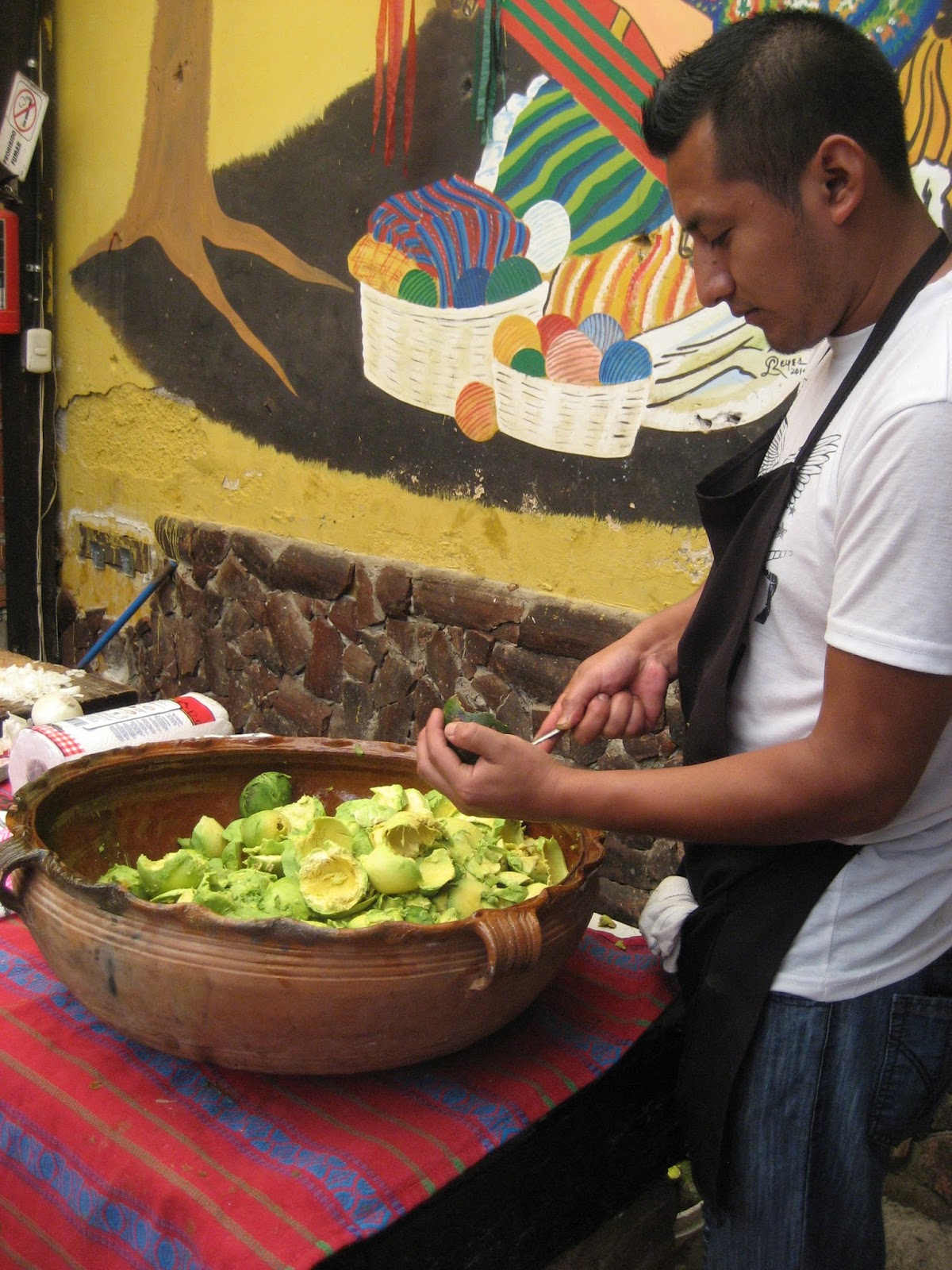
Cutting avocados for guacamole:

Breakfast at Rincón Típico Restaurant, Antigua, Guatemala. April 2016.
 

Putting whole, flattened chickens into fiery oven for roasting: 

Breakfast at Rincón Típico Restaurant, Antigua, Guatemala. April 2016.

Breakfast at Rincón Típico Restaurant, Antigua, Guatemala. April 2016.

Breakfast at Rincón Típico Restaurant, Antigua, Guatemala. April 2016.


The sound of the fountain in the center of the outdoor-albeit-sheltered dining courtyard. 

Breakfast at Rincón Típico Restaurant, Antigua, Guatemala. April 2016.


Customers chatting.

A satisfying start on my first full day in Antigua.


Wednesday, April 13, 2016

Guatemala: Packing List


Packing for my one-month Guatemala trip was similar to my packing for Playa del Carmen, Quintana Roo, Mexico, back when I studied for my CELTA. I even took the same wheeled bag! The wheeled bag still squeaks by the carry-on police, but just barely. Back when I bought it, the bag was easily within the dimension limits, but the airlines have reduced their boundaries since then.

e-bag, wheeled, carry-on bag


For a month's trip, all of my stuff fit into the above bag and a lightweight backpack.

Clothing

Similarities in both trips included:
  1. Warm weather throughout the stay, so no need to pack for wide variations in temperature; and
  2. No moving around from place to place - I'd be in same accommodations for the full month, which meant I'd have a secure place to bring and store items (e.g. technology) that I might otherwise leave at home. 
A difference in this trip and the Playa trip is ... shoes. Shaking my head on this one. I've never been one to amass great quantities of shoes, but I packed kind of an embarrassing number of pairs on this trip. This is because my Guatemala plans include:
  • Dancing! 
  • Hiking
  • Walking on uneven pavements (think Caucasus Georgia and Ethiopia)
  • Hanging around the house 
  • Maybe some evenings out that require a little bit of dressing up

So, five pairs of footwear. Sheesh. I plan to discard two pairs when I leave, as they've outlived their usefulness to me.

I'll also leave behind some of the clothing items when I go. They are in good repair, it's just that either I'm tired of them or they no longer fit well.

So in theory, my luggage on the return trip will accommodate a few gift items that I'll buy here.


Comfort items


Technology

My online work requires that I use headsets for meetings, so I packed both a primary headset and a backup headset.

Also:
  • AA batteries and AAA batteries because, again, better to have items on hand than to have to take time out to hunt them down in a local store, and because I've experienced store-supply fail.
  • Power strip/surge protector
  • Flash drives for photo storage (in addition to using a cloud backup)
  • Mouse + pad
  • Earbuds and the device I use to listen to podcasts every day
  • Unlocked, international-friendly android phone + phone charger

Laptop

My beloved primary laptop, bought in 2010, is now an elderly lady. By today's standards, she's heavy. Her after-market battery is kaput, so I've got to tether her to an electrical outlet whenever she's on. All of my life is held in her mother-brain.

Take her to Guatemala? No. It was an unnecessary risk to her fragile body and to the electronic trail of my life.

What to do? I know I've got to buy a new primary laptop but I'm not ready for that research and decision yet.

Well, I needed a backup, anyway, to my online work practice, so I bought a toy laptop.

Oooh, sha, she is so airy-light! And so come-hithery in her sexy, red dress. And at the price (well under $200), if she gets stolen or something else dire, I will be sad, but will not have suffered a devastating loss.

I loaded into her brain only those documents that I believed essential for my needs in Guatemala. Two reasons: 
  1. She doesn't have much storage space. 
  2. She can't divulge intel that she doesn't have. 

Backpack

I have a handsome backpack that I use for my primary laptop, for weekend travels, for some flights. I took it to Playa del Carmen, to Ethiopia, to Caucasus Georgia, to Dubai, to Istanbul.

e-bag backpack that I left at home


It looks as youthful today as it did when I bought it years ago.

I didn't bring it to Guatemala, however. Nope, I decided to go lighter and cheaper. I'm guessing I'll do a lot of walking in and around Antigua, and I wanted to reduce the carry load. This decision is supported by my decision to bring my toy laptop, Little Red, which requires a bag with less space and durability than my primary laptop.

I also wanted an inexpensive bag, both in price and in looks, to reduce the number of envious looks from would-be thieves. Guatemala has a bit of an unsavory reputation, you understand.


Little bags and accessories

The possibility of dancing or evening-going-out required some thought about packing small bags. Being a solo traveler, I don't have a partner to watch my bag for me at a table while I step away for dancing or even going to the restroom. So I need to be creative in how I carry stuff with me to these kinds of venues.

Choosing clothing with pockets is a good first step.

I also have three utilitarian terry-cloth, zippered wrist bands in which I can stash a credit card, some bills, and a key. (I've got one each in navy, black, and red. I may buy a new one in light beige.)

Gogo terry-cloth wristband with zipper. Source: Amazon


And, yes, I did bring the ubiquitous, LBFP, that is a tourist staple. The Little Black Fanny Pack. Or, in my case, the belly pack. Got it at a second-hand store on the cheap about a year ago.

Result: For my EDC (everyday carry) to and from language school, I've got my LBFP in front of me, attached like an infant, with my camera + reading glasses inside. I've got my wristband with some cash for the day on my wrist.  In my nondescript, blue backpack, I've got a wallet and the keys to my lodging. Both of these are out of reach of easy pick-pocketing, but of course, if someone wants to get serious about things, they'll just take the whole thing from me.

I use the backpack to cart groceries back home after class.

I feel equipped.


The phone issue

I bought my android a couple of years ago, thinking I'd be moving to Oaxaca for a year, and wanting a work backup to my laptop. We got off to a rocky start, but the edges have been smoothed over.

Coming to Guatemala was going to let my android run free like the wind, performing magical tricks that one likes to see performed when one travels outside one's homeland.

Most specifically, I intended to buy a local sim card so I could make and receive local calls. Thus far, however, there seems to be no particular need for me to make or receive local calls. Relying on email for local communication suffices, and I have plenty of wifi access here, including at my lodgings.

As for calling folks back home, I've used my phone to call them via Viber (free), Skype (I bought a one-month subscription to call the USA from Guatemala), or in a pinch, Google Hangouts for real-time communication and email for non-live communication.


Monday, April 11, 2016

Guatemala: Coffee and Salt, the Essences of Life


Mmm, salt. Source: Amazon.


I make no apologies for this: I packed both salt and, yes, get this --> instant coffee (to Guatemala! Coals to Newcastle!) for my trip to Guatemala.

Thank the baby deity I have.

I'm sure there's salt somewhere in my temporary digs, but without searching through various cabinets or finding my hostesses at home to ask, I don't care one whit where it is. Because I've got my own supply! Not a moment's worry have I had about where I can find this precious mineral.

There's coffee here, too, but the coffee maker is on the fritz, so making it requires me to do some technical things with a hand-held filter thing and a pan of heated water, and I haven't yet figured out how to make the stove burner as hot as it needs to be.

Again, it matters not! Because I have my own coffee with me! And before you scoff, let me tell you it is addictive - it's Nescafe Taster's Choice French Roast. Not the classic or the other flavor. These are fine, but the french roast - smells good, tastes good, and it makes me sigh when I take a drink. Not to mention injecting me with the requisite buzz. And my hostesses have a microwave and I can work it and therefore heat up my mug of water to fold said loamy-brown, crystalline drug into its liquid embrace.


Mmmmm. Sometimes I get the packing just right.


Friday, April 8, 2016

Guatemala: You Are a Random

Airport in Mestia, Svaneti, Georgia. 2012.


I was on the first leg of my flight journey to Guatemala. Columbia, Missouri.

"You are a random," he said.

On one level, I loved this. It was all science-fictiony, like I was an android. Immortally frozen at a good age, of course. Intelligent. Everything smooth and shiny.

I also got that it's a lazy term of art within a particular profession, in this case, the Transportation Security Administration. Like psych staff might call a patient with a certain affliction "the catatonic down the hall" or an automotive job "the oil change in bay 2." Humanity stripped off.

Hologram at Istanbul, Turkey airport. 2011.


There were no buzzers or bells or lights that I saw when I walked through the scanner portal. It was something whispered by the machine only to the TSA agent, I guess. "She is a random."

OK, no problem. I got the full-body pat down and then another TSA agent swiped the palms of my hands with a round wipe cloth. Fascinating.

Something on the palms of my hands set off an alarm.

It changed my status from a random to an alarm.

This meant a thorough-thorough search of all pieces of my luggage, including wiping down the insides of my carry-on bag with one of the round wipes. I felt some trepidation at this, trying to remember where I might have been and what I might have packed in the bag in prior trips, trying to imagine what could rattle the security sensors. Berbere from Ethiopia? That incredible fish seasoning I brought back from Caucasus Georgia, given to me by friend Sandy, who'd received some from a friend with family from west Africa, who had carried it to Georgia after a visit to her relatives there? Svaneti salt?


Bole Airport, Addis Ababa, Ethiopia. 2011.


Final outcome: My brand-new tube of toothpaste was confiscated for being too large.

Security theater.


Airport cat at Baku Airport in Azerbaijan. 2012.


Wednesday, April 6, 2016

Guatemala: The Almost Pack Fail


Canon SD600

I learned my lesson about camera backups in Ethiopia.

After that experience, I bought two used, vintage Canon Powershot SD600s to replace the exact model I lost in Ethiopia. Redundancy of peripherals and all that. Plus it was a good travel camera.

These days, I have three used cameras plus a pissant phone camera. The backup system has served me well in the four years since Ethiopia, although cracks have appeared, and a change in the future looms.

For my trip to Guatemala, I packed these cameras:

  1. Primary: One of the Canon Powershot SD600s
  2. Secondary: A used Canon Coolpix that daughter handed down to me last summer
  3. Tertiary: My Moto G phone camera, a last resort only, due to its miserable photo quality

I chose the Coolpix to bring instead of my backup Canon because I am down to only one Canon battery, the two that I'd had having finally died of old age. I only bought one replacement battery because the things are pretty expensive, and I am on the fence about when I'll buy a new camera, which will certainly use a different model of battery. With the Coolpix, I'd have a spare, charged battery on hand when the Canon's battery needed to be recharged in Guatemala.


The morning of my departure, I inserted the cameras' SD cards into my primary laptop so I could upload their contents, thereby giving me clean slates for the trip.

Oh, wait.

Do I have an SD slot in the little red toy laptop that I bought for the trip? Why .... no.

Jeez, OK. Where the heck was my camera-to-device cable that fits into one of Little Red's usb ports? Oh thank goodness! Found it! Worked just great for the Canon. Would it work for the Coolpix? No. Nooo. Who'd've thought? 


This almost-fail fell into two categories of travel mishappery: 
  • Complacency, or more accurately, just plain sloppiness of thought and preparation
  • Too smart for my own good

Close call.

I left the Coolpix at home and replaced it with the second Canon. 


Monday, April 4, 2016

Guatemala: Going To


Breakfast in Antigua at Rincón Típico. April 2016.


I wasn't going to Guatemala in April. I was going to Rwanda in June. But there you go.


My friend, Cari, one of my real-life heroines, is originally from Rwanda. She intends to travel to Rwanda this summer as a member of a group to mark the public opening of a woman's center in Kigali, organized by her sister, Dr. Bea Gallimore. Cari invited me to join the group, and I enthusiastically embarked on a path to do that.


Long story short, I just couldn't make the budget work. The clincher came when I thought to compare what it would cost for me to go to Rwanda at a real budget-bender and to go somewhere else. I looked at a few places. Then I thought: Antigua, Guatemala. Lake Atitlan. I had fallen in lust with this Lake Atitlan photo a few years back. And my brother Matt had visited both Antigua and Lake Atitlan a couple of times, highly recommending both. There ensued much keyboard tapping: flight fares searched, airbnb lodgings scanned, and Spanish tutoring probed. Decision made. A feeling of satisfaction at the rightness of it.


I'll still get to Rwanda, I'm sure. Some day.


Friday, April 1, 2016

Lafayette: A New Year's Day Party

A New Year's Day party in Lafayette, 2016.


Scenes from an annual New Year's Day party, version 2016.


A New Year's Day party in Lafayette, 2016.


A New Year's Day party in Lafayette, 2016.


Musicians jammed.


A New Year's Day party in Lafayette, 2016.


Dancers danced.


A New Year's Day party in Lafayette, 2016.


Talkers added their beats.


A New Year's Day party in Lafayette, 2016.


A New Year's Day party in Lafayette, 2016.


A grand welcome to the new year.

A New Year's Day party in Lafayette, 2016.


Wednesday, March 30, 2016

Louisiana Lit: The Music of Ernest J. Gaines

Ernest J. Gaines. Source: Academy of Achievement interview, 2001.


Alcoholic Cajun detective Dave Robicheaux, as channeled through author James Lee Burke, was an important cultural guide for my first year in South Louisiana. 


For my second year in South Louisiana, author Ernest J. Gaines was my guide. 


Like Dave, Mr. Gaines receives inspiration from music


Of the classics, he likes Mozart, Hayden, Brahms, Chopin, Bach, and Schuman. In Mozart and Leadbelly, he reports: ".. Mozart and Haydn soothe my brain while I write ..."


In Mozart and Leadbelly, in the first essay, "Miss Jane and I," Mr. Gaines says:   
I think I have learned as much about writing about my people by listening to blues and jazz and spirituals as I have learned by reading novels. The understatements in the tenor saxophone of Lester Young, the crying, haunting, forever searching sounds of John Coltrane, and the softness and violence of Count Basie’s big band – all have fired my imagination as much as anything in literature. But the rural blues, maybe because of my background, is my choice in music.


In the second essay in Mozart and Leadbelly, he says: 
 
I started collecting blues records while attending San Francisco State College in the mid-fifties and inviting friends to my room to listen to the music. Most of the whites would listen to the records out of curiosity; this was before the Rolling Stones of England had made white America aware of the art and value of black blues singers. The white boys and girls of San Francisco wanted to listen because it was “exciting.” However, very few of my African American friends from the college wanted to listen to it at all because they wanted to forget what those ignorant Negroes were singing about. They had come to California to forget about those days and those ways.

and:


. [classical music can’t] tell me about the Great Flood of ’27 as Bessie Smith or Big Bill Broonzy can. And neither can [Mozart or Haydn] describe Louisiana State Prison at Angola as Leadbelly can. And neither can tell me what it means to be bonded out of jail and be put on a plantation to work out your time as Lightnin Hopkins can [as in Mr. Tim Moore's Farm]. William Faulkner writes over one hundred pages describing the Great Flood of ’27 in his story “Old Man.” Bessie Smith gives us as true a picture in twelve lines [in Backwater Blues]. ….


Monday, March 28, 2016

Louisiana: The Slavery Museum


Children, sculpted by Woodrow Nash, Slavery Museum, Whitney Plantation, Louisiana. March 2015.


It's taken me a long time to write about my visit to the United States' very first slavery museum. Maybe because it generated polarized responses in me: Deep satisfaction in its creation. Disappointment in some of its execution.


Children, sculpted by Woodrow Nash, Slavery Museum, Whitney Plantation, Louisiana. March 2015.


I visited the museum in March 2015 with a German doctoral student in linguistics who studies the black French Creole language in South Louisiana. We shared an airbnb house at the start of my second year here, before I found my apartment in Opelousas.


Children, sculpted by Woodrow Nash, Slavery Museum, Whitney Plantation, Louisiana. March 2015.


Some memories remain vivid a year later.


Children, sculpted by Woodrow Nash, Slavery Museum, Whitney Plantation, Louisiana. March 2015.


The sculptures of the children in the church.

These children.

They are witnesses to a world that is alongside theirs, but which has different rules. These children, of an age when they know things are different for them than for others, but whose child-minds and spirits still have that buoyancy of belief in fanciful futures. 

These sculpted children observe us, the historical tourists, as we enter the church and sit in its pews and walk slowly around their figures, looking at them in their stillness. Do you see me? Each asks. Do you see me?


Children, sculpted by Woodrow Nash, Slavery Museum, Whitney Plantation, Louisiana. March 2015.


Names. The museum includes the names of men, women, and children who were enslaved. A seeing. A recognition of each person's humanity, a life lived, not just a dot in the universe labeled "slave."


Children, sculpted by Woodrow Nash, Slavery Museum, Whitney Plantation, Louisiana. March 2015.


The girl with the pretty teeth. The docent who led our group walked us through panels of names and story excerpts, asking each of us to note any that felt particularly meaningful for us. Later, she shared the story that meant the most to her, which was this, which I imperfectly relate to the best of my memory: There was a young girl, maybe 11 or 12 years old, enslaved, known for the prettiness of her teeth. And maybe she was very proud of the prettiness of her teeth. Well, the man who owned this little girl didn't care for the attention the prettiness drew. Or maybe the pride she took in their prettiness. One midday, he took the little girl into one of his outbuildings, one with the blacksmithing tools. Using an appliance, he removed one of the little girl's teeth. The next day, he did the same. The next day, the same. Every day, he removed one of her teeth.

Can you imagine? The pain of the act itself, during and after. Perhaps more stupefying, though, the anticipation of what was to come the next day. Then in the following morning. In an hour. In fifteen minutes. In one minute. Or to be the girl's parents, undergoing the same torture, albeit once removed, and being powerless to prevent it.

I regret that I didn't take the time to hunt down that story on the wall while I was there so I could be sure I heard it correctly and that I could share it here in the girl's own words. I've not been able to track it down since so I don't know how accurate my narrative is.

But I think about that girl and her fear. And I think about the capacity of cruelty that lives within all of us.


Children, sculpted by Woodrow Nash, Slavery Museum, Whitney Plantation, Louisiana. March 2015.


The Anti-Yoke Baptist Church. Later morphed into Antioch. This church at the Slavery Museum is not original to this site. It was built here and more recently moved to the Whitney Plantation, the site of the Slavery Museum.

When the museum docent explained that the original name of this church was "Anti-Yoke" as in contra the yoke that oxen wear as they work in the fields at the direction of a driver, I felt this inner exhalation of admiration for the men and women who were so bold as to give their church this in-your-face, self-determinate name.


Children, sculpted by Woodrow Nash, Slavery Museum, Whitney Plantation, Louisiana. March 2015.

There were things about the museum that underwhelmed me:
  • It costs a lot of money to get into - $22! For that, I expected to see all of the exhibits and not be kept from entering some of them because they weren't ready yet. This was annoying, especially because in a couple of cases (e.g. entering a cabin), there appeared to be no good reason to keep us out.
  • Overall, I felt the slavery experience was somewhat sanitized. This may change in the future with additional exhibits. I hardly think Auschwitz and Buchenwald are sanitized.
  • Our docent was an engaging leader and I appreciated the information she had to share, but there seemed to be gaps in her knowledge that I would have expected the museum to have covered in their staff training. 


Children, sculpted by Woodrow Nash, Slavery Museum, Whitney Plantation, Louisiana. March 2015.

But what a triumph that the Slavery Museum exists!


Related posts

The Peculiar Blindness, Part 1
The Peculiar Blindness, Part 2
The Peculiar Blindness, Part 3
Louisiana Lit: 12 Years a Slave
Rootless Lit: The Warmth of Other Suns


Friday, March 25, 2016

Louisiana: Banana Spiders, The Prequel


Banana spider, aka golden silk orb weaver spider. Lake Fausse Point State Park, Louisiana. September 2015.

When I take pictures of flashy spiders like the golden silk orb weavers, it is always with this thought: Oh my God, look at this spider, it's so cool, but don't let it touch me, oh no, but let me get a picture of it, oh ick, oh cool, eww! 

I took these two pics at Lake Fausse Pointe State Park this past September, but posted these later photos from Chicot State Park first.

I am grimacing as I write this.

Banana spider, aka golden silk orb weaver spider. Lake Fausse Point State Park, Louisiana. September 2015.


It's reminding me of this creepy-crawly affair at Chicot State Park earlier in September. And this inner-shriek-inducing visit to the Arthropod Museum in Las Cruces in 2013. Ewww. Cool! Ewwww!


Wednesday, March 23, 2016

Louisiana: The Chimpanzees From Alamogordo, Chapter 3


Cammy. Credit: Chimps to Sanctuary or Animal Protection of New Mexico. Illustrator unknown at this time.


When I lived in Alamogordo, I was astonished to discover the saga of hundreds of chimpanzees (and other primates) there. Really, it's astounding. I invite you to take some time to read it before continuing here. In addition to tragedy, there is heroism, perseverance, and eventually, for some, happy endings.

There are lessons about how expediency and the lack of exit strategies affect ethical decision-making.


Chimp Haven, Keithville, Louisiana. November 2015.


In an update story in January 2013, I wrote this: 
Today brings important news for the 169 remaining chimps at the Alamogordo Primate Facility on Holloman Air Force Base.
In short --> some? most? all? -- of these chimps will be retired to Chimp Haven in Louisiana.
Here is the final report from the Working Group on the Use of Chimpanzees in NIH-Supported Research. There is a comment period before their recommendations can be finalized, but it would seem public opinion is in favor of retiring the chimps.
What a happy ending to a dismal history.  Kudos to Chimp Haven.

When I moved to South Louisiana in November 2013, tucked in one of my brain's dusty corners was that note about Alamogordo chimps going to Louisiana.

But it wasn't until late fall 2015 (!) that I got around to cleaning out that corner, and I realized, damn, I better go take a look at these chimpanzees before I leave Louisiana for good. I discovered that the sanctuary is open to the public only a few times a year, and I'd have to go to the November 2015 open house or I'd miss my chance entirely, as my departure from Louisiana was at the end of February 2016. Spring visit days didn't start til April.

So I did go to Chimp Haven in November, whereupon I got some good news and some, well, not bad news, but personally disappointing news.


Chimp Haven, Keithville, Louisiana. November 2015.


The Alamogordo chimps didn't go to Chimp Haven, after all, as planned in 2013. Instead, they went to a sanctuary in Florida. So I didn't get to see any of "my" chimps.

However, November 2015 and March 2016 reports, which came out after my visit to Chimp Haven,  announced that other chimps from Alamogordo (the Holloman Air Force base), which had been diverted to a San Antonio, Texas, research facility in 2010, would go - and in fact, have gone - to Chimp Haven.


It's especially nice to hear that this particular contingent was sent to a sanctuary, because while at the San Antonio facility, they were still "on call" for potential research use, whereas the chimps that remained in Alamogordo were retired from research.


Chimp Haven, Keithville, Louisiana. November 2015.

So about my trip to Chimp Haven.

Chimp Haven and places like it are the culmination of hope, inspiration, money, many hard hills climbed and rocky roads trudged, money, the skill to execute on visions, and the ability to share a vision with people who have the wisdom, wealth, networks, and willingness to donate work necessary to transform the vision into reality. And more money. Oh yeah, and the ability to receive more rejections than acceptances.


A human skull and a chimp skull. Chimp Haven, Keithville, Louisiana. November 2015.

So when I visited Chimp Haven, it was with all this understanding in mind, and the consequent admiration for all that I saw.

It's a grand space for the chimps. A good amount of room to hang out in, exercise in, play in. The staff and volunteers cook up ways to keep the chimps' minds agile and engaged in life.

Polite and careful boundaries and protocols exist between chimps and caretakers.


Mmmm, salad. Chimp Haven, Keithville, Louisiana. November 2015.


Even so, a couple of factoids had me mentally tilting my head in askance.

One: For all intents and purposes, what separates the chimps from the humanoids is a watery moat. Staff confidence that this is sufficient to keep chimps from swimming across is based on the "fact" that chimps' bone density is such that it is physically impossible for chimps to swim. They'd sink. Ergo, a moat that is deep enough to require swimming is an impenetrable barrier.  This fact is (or at least was in 2012) also accepted by Steve Ross, director of the Lester E. Fisher Center for the Study of Conservation of Apes at Lincoln Park Zoo in Chicago, as cited in this ABC news story:  
Indeed, the same muscles that are considered to be the source of a chimp's strength can also be seen as a detriment for the animal. The lengthy muscle fibers mean chimps and other great apes can't swim, Ross said. To protect humans, many zoos create water barriers around the chimps' area so they cannot physically approach, Ross said.

When I heard the fact about bone density, I had to check it out. And discovered: Chimpanzees, Orangutans Can Swim and Dive, Biologists Prove (2013)


Two: On birth control. In talking with a staffer or volunteer, I learned there have been some "whoops" babies (2012) born into the community. [Also one born five years earlier per this story.]

I got the impression - perhaps mistaken - that Chimp Haven practices pregnancy prevention by way of oral contraception for the female chimps, which is added to their food. I was unclear why the male chimps wouldn't simply be vasectomized.

Well, in writing this post, I discovered that, according to the articles linked above, they are and were. But evidently there is a failure rate. Or perhaps the method used leaves the door open for a natural reversal in some cases. I dunno.

Until Chimp Haven could ensure proper new vasectomies, the female chimps received a regimen of oral contraceptives. 

This 2006 article, written by veterinarians, suggests two variables that can affect the efficacy of oral contraception:

1. Need to have a dose strong enough to do the job, but not so strong as to eliminate the appearance of 'cycling' to male chimps

During peak swelling, females demonstrate more assertive behavior.  Troop males of all ranks interact preferentially with intumescent females and their offspring.  Competition between males, concurrent with agonistic behaviors, will occur with increased frequency in the presence of cycling females.  It is has been documented that mother-raised infants benefit from the presence of cycling females in a troop and have improved adult social and sexual competence.

Because of the profound effects on the normal sociosexual behavior of chimpanzees, genital swelling should not be completely eliminated by the contraceptive option elected.    In considering contraceptive options, both genders must be evaluated to permit prevention of pregnancy while minimizing impact on troop behavior. 


2.  Got to watch out for pill-hiding shenanigans and other factors

It is critical that the female receive [the oral contraception] daily, consistently at the same time of day, and completely without refusal for optimal pregnancy prevention.  Chimpanzees can be experts at secreting pills offered so complete consumption must be assured and the training maintained by utilizing the package placebos.  When a pill is missed, a second dose should be administered promptly and if one day is entirely missed, two doses should be offered within 24 hours to maintain efficacy.  A side effect of administration of many antibiotics, particularly by the oral route, is reduced efficacy of oral contraceptives due to changes in drug metabolism. [Emphasis in the original text.]

So the issue of pregnancy prevention with chimps - not so cut (get it?) and dried as I would have thought.


Dinner coming. Chimp Haven, Keithville, Louisiana. November 2015.

Chimp Haven grows at least some of the food on campus.


Chimp snacks! Chimp Haven, Keithville, Louisiana. November 2015.

I tasted the crunchy snack in the pic above. Not bad.


More chimp snacks. Chimp Haven, Keithville, Louisiana. November 2015.

It felt good to go to Chimp Haven. Closed the circle of the Alamogordo chimp story a little bit.


Related posts: 


Monday, March 21, 2016

Opelousas: Outside My Window #1

This is a post about something I saw outside my window one year ago. The other Outside My Window posts are here.

It was a Sunday morning - March 21, 2015. I was in a zone, working happily on a creative project while listening to spirit-lifting Cajun tunes by way of the local cultural treasure, KRVS.

Presently, I notice sunlight peeking through the slats of my window blinds, and I went to open them to draw that light in.

This is what I saw right before me:

Opelousas incident, March 21, 2015, Louisiana

Let me cut to the ending right now: This story ended in tragedy. A man ultimately shot and killed himself, alone in his apartment. The man who killed himself had children. He lived with a girlfriend. Whether or not he was a good man, bad man, or something in between (one of the things that started all of this was a fight between him and his girlfriend where he evidently threatened her safety) - I don't know.


Opelousas incident, March 21, 2015, Louisiana


My first thought was that there was Something Big happening in the shopping center where we've got the Piggly Wiggly and a Mama's Fried Chicken and a Quiznos and a movie theater. An Operation that was the result of a long-term investigation.

My second thought was, damn, I had something similar happen in my backyard in Alamogordo, too! On that day, I saw a man in my backyard wearing a bullet-proof vest and carrying an automatic weapon. Can't believe I didn't write a post about it. Anyway, there were law enforcement crawling all over the vicinity in search of a fugitive. They found him hiding in the laundry room in the building next to mine. The law enforcement officer I saw in my Alamogordo backyard walked through my apartment to get to the front faster than if he had to walk all around the back of the building to get to the front.

Over time, as I watched the two Louisiana snipers on the roof, I realized the reason for there to be two was so that one could concentrate on the potential target while the other rested. I watched them take turns focusing on their objective.

When I went to the other side of my apartment and looked out my bedroom window, I saw the funeral home parking lot packed with law enforcement vehicles. I saw different law enforcement branches - state police, local police, sheriff's department.

Opelousas incident, March 21, 2015, Louisiana


I found one faction unsettling. Black SUV vehicles with windows tinted so dark, you couldn't see inside. The men who seemed to go with them wore black t-shirts and khaki-colored pants. The black t-shirts had OPD on the front and the motto "Throw Back, Take Down" on the reverse. What has happened to "protect and serve"? Why do the windows of the vehicles need to be dark, secret?


Opelousas incident, March 21, 2015, Louisiana

Rightly or wrongly, when I see "throw back, take down" - with a lightning bolt within a fist, which is the graphic on the OPD t-shirt, I assume the "take down" refers to this. And the "throw back" this. About a month after the incident, I asked a couple of police officers about the t-shirt, and they denied any knowledge about its meaning. They did say, however, that these are the folks who do the regular roundups in partnership with the marshalls and other law enforcement entities. 

Opelousas Police Department t-shirt "throw back and take down." Credit: Daily World.


So there was a lot of manpower, a bevy of police vehicles, and a shitload of weaponry. At a certain point, everyone stood down, and presently an ambulance appeared and soon after that we bystanders learned that the man had killed himself.

Sad.