Thursday, July 21, 2016

Lake Atitlan, Guatemala: Santa Cruz, Quiet Scenes at the Dock


Two women. Dock, Santa Cruz, Lake Atitlan, Guatemala. April 2016.

Dock, Santa Cruz, Lake Atitlan, Guatemala. April 2016.

Launches. Dock, Santa Cruz, Lake Atitlan, Guatemala. April 2016.

Dock, Santa Cruz, Lake Atitlan, Guatemala. April 2016.

View from the dock, Santa Cruz, Lake Atitlan, Guatemala. April 2016.

Dock, Santa Cruz, Lake Atitlan, Guatemala. April 2016.

Cafe near the dock, Santa Cruz, Lake Atitlan, Guatemala. April 2016.

Flowers at hotel near the dock, Santa Cruz, Lake Atitlan, Guatemala. April 2016.


Wednesday, July 20, 2016

Lake Atitlan, Guatemala: La Iguana Perdida: Some Louisiana and Missouri


Books. La Iguana Perdida, Santa Cruz, Lake Atitlan, Guatemala. April 2016.


I mentioned here that La Iguana Perdida seems to attract readers and that it has a library off of the dining room/bar.

How sweet it was to run into good friends here!

To wit:


Books. La Iguana Perdida, Santa Cruz, Lake Atitlan, Guatemala. April 2016.


Missouri writer, Daniel Woodrell, is an author I consider to be an Ozarkian Shakespeare because of the eloquence of his language and the universality of his themes. He wrote Winter's Bone, which, of course, became an Oscar-nominated movie, starring Jennifer Lawrence. And Woe to Live On, related to the domestic terror in Missouri and Kansas circa Civil War. (This was also made into a movie, but it did zero justice to the novel.)

Sidebar: Although Anthony Bourdain has fallen out of favor with me, I share this for those who are still charmed --> Mr. Bourdain is a big fan of Mr. Woodrell's, and even wrapped one of his No Reservations episodes around Mr. Woodrell and his Ozark culinary roots. Unfortunately, this episode, which could have been so rich, was just plain dull. And I wasn't alone in this opinion. 


Books. La Iguana Perdida, Santa Cruz, Lake Atitlan, Guatemala. April 2016.


Anyhoo. Moving on. I also met Mr. James Lee Burke in the library, my cultural guide for my first year in South Louisiana, through his very-flawed protagonist, Dave Robicheaux.

Daniel Woodrell and James Lee Burke both write about our American underclass. They do so with compassion but without romanticism. They shine a harsh light on those among us who profit from the poor and systemically-disenfranchised, whether it be politically, financially, or socially.

Well. This is leading me into a dark place, and I don't want to go there today.

What I want to express is how pleasing it was to see my Louisiana and Missouri friends at La Iguana Perdida in Santa Cruz, Lake Atitlan, Guatemala. So I'll leave it at that.


Tuesday, July 19, 2016

Lake Atitlan, Guatemala: A Candelight Dinner


Just up a little bit on the steep road from La Iguana Perdido is a second-floor café of the mom and pop variety. I drew an arrow to point it out in the photo below:


Santa Cruz, Lake Atitlan, Guatemala. April 2016.


A Santa Cruz travel buddy - Jane -  and I entered to have dinner there. It was getting dark and we weren't sure the restaurant would be open, but it was.

The señora we'd spoken to earlier in the day wasn't at the café, but a young girl, maybe between 10 and 12, was present. Another little girl appeared. They took Jane's and my order, then hustled into the tiny kitchen on the other side of the ordering counter, which was behind our table.

Santa Cruz, Lake Atitlan, Guatemala. April 2016.


There was no electricity in the cafe, and one of the girls lit the candles on our table. I don't remember what either of us ordered, but it did require cooking. We could hear the young girls talking and moving around in the petite kitchen, and working with a gas oven.

I expected the café matron to appear, but no, these little girls were both our servers and cooks. Well, some of the food had been prepared previously, so some of the work involved heating it up.

Nevertheless, the level of responsibility at play here --> Greeting us, seating us, setting the table, lighting the candles, taking our orders, preparing our dinners, serving them, accepting payment. The quiet discussions and occasional giggling behind the counter.

The señora arrived as we were preparing to leave the restaurant. She explained that one of the girls was her granddaughter. If I remember correctly, the other little girl was the señora's hired helper.

The food was tasty - neither superior nor inferior to the food I ate at La Iguana Perdida.

When encountering children who work - and who maybe go to school and maybe not - it sets up debates in my mind.

My Spanish teacher and I had a conversation about the young kids who worked at the market in Antigua. I wondered if they weren't required to attend school? Theoretically, education is mandatory between ages 7 and 14. But setting aside the theoretical requirement, my Spanish teacher countered my indirect judgmentalism with this argument: By working every day in the market, don't the children gain an education? Such as learning about real-world math in their money-handling transactions? Communication skills via salesmanship, networking, and negotiations?

On one level, sure. And there are centuries of history in many cultures, in which children have matured into educated, skilled adult artisans and merchants who live very well by dint of apprenticeship.

And it is not intrinsically bad or harmful for children to work, assuming the work is safe and does not compromise other quality of life issues.

On another level - well, my Spanish teacher's daughter is going to school. Private school. With an expectation, I believe, of going on to university after she completes high school.

And speaking of girls: Research shows a strong correlation between girls' number of years in school and girls' age at first pregnancy. In other words, the longer a girl stays in school, the older she is before she becomes pregnant the first time. Education also has ramifications for the girls' lifetime health, the health of their children, and by extension the overall economic welfare of the girls'-to-women's families.

When it comes to questions in which it is difficult for me to see the line that divides mere cultural differences and cultural dysfunctions, I ask myself if the tradition supports or denies an individual's right to self-determination. Some definitions of self-determination below: 
  • The free choice of one's acts without compulsion. (Merriam-Webster Dictionary)
  • The individual’s right to live his life as he chooses, as long as he does not violate any other person’s right to life, liberty, and honestly acquired property. (Foundation for Economic Education)
  • We hold these truths to be self-evident, that all men are created equal, that they are endowed by their Creator with certain unalienable rights, that among these are life, liberty, and the pursuit of happiness.  (Declaration of Independence)

So. These two young girls in the mom-and-pop restaurant in Santa Cruz. And for that matter, the señora.

What are their stories?


Monday, July 18, 2016

Lake Atitlan, Guatemala: Fresh Fish on the Fire

While sitting in my favorite chair at La Iguana Perdida, along the stone walkway next to the lake, I watched a couple of men reap a fish harvest for dinner.

Fresh fish dinner in Santa Cruz, Lake Atitlan, Guatemala. April 2016.


Fresh fish dinner in Santa Cruz, Lake Atitlan, Guatemala. April 2016.


Fresh fish dinner in Santa Cruz, Lake Atitlan, Guatemala. April 2016.

And below is some live action of same:


In the video, you can see how hazy the sky was. This was how it was most of the time during my stay at Lake Atitlan. And Antigua. 


Sunday, July 17, 2016

Lake Atitlan, Guatemala: The Oatmeal and Honey Moment

Oatmeal and honey, Santa Cruz, Lake Atitlan, Guatemala. April 2016.


I can close my eyes and picture the oatmeal and honey moments of that breakfast at the Arca de Noé Hotel and Restaurant that is on the other side of the dock from La Iguana Perdida. The simplicity of the oatmeal in the large, plain bowl, the amber honey, looking out onto the lake. Flowers. Wooden plank table. Makes me inhale deeply and smile a little.

Oatmeal and honey, Santa Cruz, Lake Atitlan, Guatemala. April 2016.


Did I have the café con leche before or after the oatmeal and honey? I don't remember.

Café con leche, Santa Cruz, Lake Atitlan, Guatemala. April 2016.


Doesn't matter. It was milky, rich. I rarely take milk in my coffee, so the luxury of the added velvety weight to my coffee always gives me a little shock of pleasure when I do.


Oatmeal and honey, Santa Cruz, Lake Atitlan, Guatemala. April 2016.


Oatmeal and honey, Santa Cruz, Lake Atitlan, Guatemala. April 2016.


Oatmeal and honey, Santa Cruz, Lake Atitlan, Guatemala. April 2016.


To spoon this oatmeal and honey, to drink the café con leche, outside, while looking onto Lake Atitlan, amidst bright flowers, so nice.


Saturday, July 16, 2016

Lake Atitlan, Guatemala: La Iguana Perdida: My Room


Room, La Iguana Perdida, Santa Cruz, Lake Atitlan, Guatemala. April 2016.

When I looked at the "lake view" from my La Iguana Perdida room, I laughed. Not in a derisive way. In an appreciative, cosmic-joke kind of way. It was like when I sat down on the bed the first time in the Al Uruba Hotel, hidden away in a corner of the Gold Souk in Dubai, and I burst out laughing from the absurdity of discovering that my "mattress," regardless of the fact that it was wrapped in fabric, was surely a table top.


Room, La Iguana Perdida, Santa Cruz, Lake Atitlan, Guatemala. April 2016.

So anyway, yes, I had a lake view, visible when I stood up and slid my gaze across the corrugated tin roof. I liked it.

Let me show you around the rest of the room:

Room, La Iguana Perdida, Santa Cruz, Lake Atitlan, Guatemala. April 2016.

Room, La Iguana Perdida, Santa Cruz, Lake Atitlan, Guatemala. April 2016.

Room, La Iguana Perdida, Santa Cruz, Lake Atitlan, Guatemala. April 2016.


I liked the shelving and the generous door hooks. At the head of my bed were a lamp, an electrial outlet, and a shelf. The hostel provided the blue towels on the shelf. 

For $10, I was very happy, indeed.

As mentioned previously, my main regret was to not have brought a small electric kettle with me so I could enjoy coffee whenever I wanted, instead of having to wait til the restaurant opened at 8 a.m.

There was one interesting incident that occurred in my room. One night, while I lay in bed reading, it came to my consciousness that my bed seemed to be swaying ever so gently and sporadically. It was so slight to almost be my imagination, but no, it was real. Was it my neighbors, having sex? Rather quietly, I'd say, but with enough oomph to cause some movement on the stilted building? Or was it an earthquake, certainly common enough in Guatemala? At a certain point, I did hear a sound that might have signaled a climactic finish... or which could have been a tectonic sigh.


It remains a mystery.


Friday, July 15, 2016

Lake Atitlan, Guatemala: La Iguana Perdida: Introduction


View from La Iguana Perdida, Santa Cruz, Lake Atitlan, Guatemala. April 2016.


La Iguana Perdida offers accommodations for just about any tourist budget, from $6 per night for a bed in a dorm, to $47-61 for a luxury suite (depending on number of people in the suite). I chose the private room with shared bath at about $10.

I'm unsure how to categorize La Iguana Perdida. It has sleeping rooms, yes, with tastes for the hostel crowd and the private cabin crowd. Plus a restaurant and a bar. And auxiliary businesses such as scuba diving, language lessons, local artisanal instruction, tours, and spa services. Maybe I'll call it a resort.

La Iguana Perdida (LIP from now on) offers pleasant spaces where you can just be.

View from La Iguana Perdida, Santa Cruz, Lake Atitlan, Guatemala. April 2016.


There are hammocks in a covered patio where you can just sway and look out at the lake.


Or close your eyes. Or look at the ceiling.

Pleasantly doing nothing at La Iguana Perdida, Santa Cruz, Lake Atitlan, Guatemala. April 2016.

There is a comfortable library or low-conversation space in a room off the restaurant/bar.

There are chairs with cushions that line a stone pathway, with a line of flowering shrubs between you and the lake, where you can sit and drink your coffee or tea, and just watch the lake, the comings and goings of launches and people, the movement of clouds across the volcanoes.


There are tables and chairs in the restaurant proper and in the covered veranda that invite community chat or board games or dining.

There's an open patio with a firepit and chairs just outside the restaurant/bar.

LIP seems to attract readers, based on my observations of fellow guests during my stay.

There is no wifi. However it is possible to use one of the wired resort computers, in a room designed for this, for a small fee. 

The LIP staff are friendly and helpful. I received prompt and useful replies to my email queries before I booked my room and before I arrived at the resort.

View from La Iguana Perdida, Santa Cruz, Lake Atitlan, Guatemala. April 2016.


The original owner of the resort - way back before anyone would call it a resort - is now an elder gent, and he lives on the premises full time, I believe. You can often find him in the evenings sitting on one of the chairs on the open patio that has the fire pit.

In my experience, the food offered by the restaurant was pretty, but not particularly memorable. It did have a satisfactory boxed red table wine. The coffee was unobjectionable.

A lunch at La Iguana Perdida, Santa Cruz, Lake Atitlan, Guatemala. April 2016.


The hot in the "hot showers" was unreliable during my stay, and there was a bit of a trick to turn them on and find the sweet spot for hot.

A shower at La Iguana Perdida, Santa Cruz, Lake Atitlan, Guatemala. April 2016.


The lack of wifi and the disloyal hot showers weren't all that bothersome. What hurt me to the quick was that there was no access to coffee before 8 a.m. Ouch. It would have been helpful to have a little electric kettle with me.

Overall, LIP is a good place to go to be easy in the world for awhile while pleasantly avoiding doing much.


Wednesday, July 13, 2016

Lake Atitlan, Guatemala: Getting There

One of the reasons I chose to visit Guatemala over Rwanda was Lake Atitlan.

It seemed fated for me to go there, ever since I saw this photo a number of years ago:

A rental place along Lake Atitlan, Guatemala.


When I saw this photo, I envisioned myself and some friends staying for a month. Having drinks on the lakeview terrace. Que rico!

Also, one of my brothers had visited Lake Atitlan many years ago and he'd loved it.

Going to Lake Atitlan requires some decision-making.

First up is to decide where to base yourself. This is because there are several villages lakeside, in addition to the large tourist town of Panajachel.

If you want an active ("active" being a relative term) night scene and a good selection of restaurants, cafes, and shopping, then Panajachel is the best option. I didn't want any of those things, so I looked over the village scenarios. Now the decision driver for me was a good place to stay. "Good" meaning budget-priced, comfortable, and hopefully a good view.

A new acquaintance in Antigua recommended two places, both of which sounded luxuriously delightful, but way over my budget.

I pored over all of the options I was able to find electronically, and settled on La Iguana Perdida, an enhanced hostel on the lake, immediately adjacent to the public dock that is below the village of Santa Cruz.

I chose a private room with a shared bath. The rate was spectacularly affordable. My room had a "lake view." Heheheheh. "Lake view." Heheheheheh. Thank goodness I have a sense of humor.  More on that later. No worries, though, I was very happy with my room.

But let me back up to how I got to Santa Cruz from Antigua.

Assuming you don't have your own vehicle, there are several options, which I'll categorize into: 
  1. Cheap
  2. Economical
  3. Pricey

If money isn't an issue, then by all means, I'd book a shuttle that picks me up at my Antiguan accommodations and then takes me to whatever doorway I want along Lake Atitlan.

If I'm on a backpacker shoestring budget and I haven't yet filled my lifetime quota of before-light departures on a sardine-packed bus that requires being dropped off in one town and finding another bus to take me the rest of the way to Panajachel, then I'd go with the cheap option. A possible itinerary here (response 2) and a story here.

Or you could do what I did, which was to opt for the economical. I think there was a bit of bait and switch in my situation, but you know, it all worked out just fine. My Spanish teacher clued me in to it. I went to the bakery across the street from La Bodegona supermarket, bought a round trip bus ticket from the gentleman who manned the table just inside the bakery entrance. Don't remember the price, but it was easily within my budget. I was given the impression by both my Spanish teacher and the ticket agent that this was a special bus, along the lines of a Greyhound, for example. Subsequent research tells me that in the past, it was the so-called "pullman bus," but my experience mirrored what many others have experienced, which was that the bus was actually a chicken bus.

The departure arrangements were to be at the bakery at 7 a.m. and we'd take the bus from there. Well ... not so fast.

At 7 a.m., the selling agent escorted us for a longish walk to the chicken bus lot alongside the artisanal market, to a particular chicken bus. Was I happy? No, I was not. It felt very bait-and-switch. I asked a few pointed, irritated questions, and then just let it go, choosing to bank righteous high dudgeon for some future event instead.

Chicken bus, Antigua, Guatemala. April 2016.


And as I said above, it all worked out OK. The bus was a direct run to Panajachel, so no tranfers needed. Did we stop and go a few times to pick up riders and drop off riders? Sure, but that's the economics of the business. Everyone needs to earn a living, including bus drivers, bus attendants, and the bus owners.

Food vendor on bus from Antigua to Panajachel, Lake Atitlan, Guatemala. April 2016.


When we stopped for gas, a couple of food vendors boarded to sell road food. I didn't buy anything, but I did engage in some free ogling.

The trip was uneventful.

I got dropped off in Panajachel at the end of this bus' line and told to remember where the drop-off was because this is where I'd get the return bus when I left Panajachel a few days hence.  

From here I walked down to the docks to pick up a small, blue launch that would carry me across the lake to La Iguana Perdida in Santa Cruz.

Given my poor directional skills, you might wonder how I found my way down to the docks. This is a fair question. I muddled my way via verbal instructions, a so-so map, and following some other tourists who seemed to know where they were going.


Monday, July 11, 2016

Antigua, Guatemala: Traffic


Pizza cavalry, Antigua, Guatemala. April 2016.

There's a lot of traffic in Antigua.

Tuk-tuks, chicken buses, mini-buses, vans, cars, trucks, horse-and-carriages, bicycles, motorcycles. Add to that flocks of schoolkids in the mornings, over the noon hour, and in the late afternoon, tourists, local folks, and vendors coming in from the countryside, all negotiating the narrow, treacherous sidewalks on foot.

Street congestion in Antigua, Guatemala. April 2016.


A taste of one portion of 7th Avenue in the video below:


And another road here:


Chicken buses and tuk-tuks at the Santa Lucia Church square here:


The word on the street is that the current mayor intends to limit non-resident motor traffic within Antigua. Residents will get a permit; others will have to park their vehicles out of the city center. A February 2016 article on this idea is here.

Paris slashed vehicular traffic in 2015 on special days, opening up the broad ways to pedestrians. Impressive before and after videos in the article here.

How lovely this would be in Antigua.


Friday, July 8, 2016

Antigua, Guatemala: Cobblestone Repair


Cobblestone maintenance Antigua, Guatemala. April 2016.


An historic city doesn't maintain its quaint beauty all by itself. Those cobblestones need regular attention just like any other pavement.


Cobblestone maintenance Antigua, Guatemala. April 2016.


Let's not kid ourselves that such street repair has anything to do with pedestrian or cycling safety, however.  Ho, ho, ho! No. Cobblestones are to walking safety as stilettos are to orthotic footwear. Cobblestones look pretty, they are better for vehicles and people than dust and mud, and they create a pleasing percussion when horses trot on them. More seriously, and in their favor as a matter of practical concerns, they are a permeable surface, meaning that rainwater passes through the cobblestone streets, mitigating storm run-off and street flooding.

Some thoughts on cobblestone streets 

When I was in Ethiopia for two months in 2010, there was a countrywide jobs creation/beautification project in progress, installing stone pavers on pedestrian walkways. Here's a 2014 article about that very project. While in Harar, I met a German expat involved in this program.

So getting back to Antigua's cobblestones. They're pretty. And sometimes you just have to sacrifice sensibleness for beauty.


Wednesday, July 6, 2016

Antigua, Guatemala: Tanque la Union


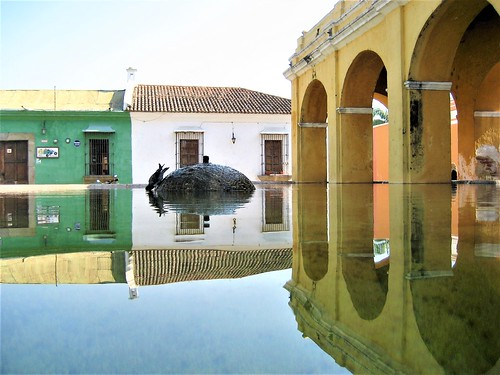
Tanque la Union Park, Antigua, Guatemala. April 2016.


My favorite place in Antigua, maybe.

Tanque la Union Park, Antigua, Guatemala. April 2016.


The "tanque" is the centerpiece. The curvaceous lines, the straight lines, the yellows, umbers, dusky grays, rusty reds, beat-up whites. The smooth, rough, exposed surfaces. The water, sometimes still and mirror-like, sometimes ripply.


Tanque la Union Park, Antigua, Guatemala. April 2016.


A video of life around the tanque's water below:


The park attracts lovers, vendors, families, schoolkids on breaks, church-goers, domestic and international tourists, birds. There are towering palms, all overlooked by the surrounding mountains.

Tanque la Union Park, Antigua, Guatemala. April 2016.


Sometimes it is noisy and clotted with people.

Tanque la Union Park, Antigua, Guatemala. April 2016.


Other times, especially in early morning and at dusk, very quiet except for birds.

A video of early-morning birdsong below:


How lucky I was to have this park on my daily route to school and back.


A slide show of Tanque la Union Park below:


Tanque la Union Park
Tanque la Union Park, Antigua, Guatemala. April 2016.


A couple of articles about Tanque la Union Park


Monday, July 4, 2016

Antigua, Guatemala: Casa Santo Domingo

Casa Santo Domingo, Antigua, Guatemala. April 2016.


I regret I only made the one visit to Casa Santo Domingo. I regret I didn't take more photos the one time I did go.

Casa Santo Domingo, Antigua, Guatemala. April 2016.


It was late when I returned on the shuttle from Santo Domingo del Cerro, and the museums inside Casa Santo Domingo were soon to close, so I wandered where I could.


Casa Santo Domingo, Antigua, Guatemala. April 2016.


Walking through the nooks and crannies that I could ... it's a cliche, but it was like walking into history.


Casa Santo Domingo, Antigua, Guatemala. April 2016.


Pocket gardens. Water features. Dim hallways, indirectly lit. Massively thick walls. Stairs calling you seductively upward. Candlelight. Paintings, sculptures, a marionette exhibit. Quiet, elegant dining spaces. A spa.


Casa Santo Domingo, Antigua, Guatemala. April 2016.


A video tour of the hotel below:


Sigh.


Friday, July 1, 2016

Antigua, Guatemala: A Moth

Rustic sphinx moth, Antigua, Guatemala. April 2016.


I was walking to Spanish class one morning, maybe, when I saw this moth on the sidewalk.

No, I didn't add it to my carcass gallery. Because I'm pretty sure it was alive.

A large moth. Best I can tell, it's a rustic sphinx moth.

Oh, I've met his cousins before.

My introduction to his family was on the back deck of my house, back when I had one. I blithely sauntered over to one of my potted plants one day, and saw this, this, this CREATURE from another galaxy, or maybe from a 1950s secret radiation experiment facility, or I don't know what, but it was jolly fucking GREEN and HUGE and MOVING.

I called my friend to come over immediately to look at this thing and to DO SOMETHING about it.

That's when I learned about the caterpillar youth of sphinx moths. Holy Christ.

A sphinx moth caterpillar. Credit: What's That Bug?


Later, I met a white-lined sphinx moth in Alamogordo, right outside my front door.

White-lined sphinx moth, Alamogordo, New Mexico.


And then, later, seeing a hummingbird moth (also of the sphinx family) at Bandelier National Monument.

Humming bird moth (aka sphinx moth), Bandelier National Monument, New Mexico.


These moths fall into that category of living things which have an awful/awe-ful beauty.