Showing posts with label matachines. Show all posts

Friday, February 3, 2017

El Paso: History's Long Reach: Oñate


"You will tell your grandchildren: I remember 9/11. Well, we remember Juan Oñate. Send him back to hell."


Soon after I arrived in El Paso, I watched a 2008 documentary called The Last Conquistador, by Cristina Ibarra and John J. Valadez. You can watch it in its entirety here and the trailer below:


The documentary, albeit 10 years old, is as timely today as it was then, particularly when we consider the national debate about keeping or removing monuments that glorify the Confederate Union.

Unless noted otherwise, all quotes below are from statements made by people featured in the documentary. 

The documentary is about some people's vision for a world-sized statue that honors a man who "brought the entire Hispanic culture to New Mexico," a man named Juan de Oñate.  Installed in 2008, the statue stands outside the El Paso Airport.

How to blow off another person's history entirely
  • In response to Native American concerns about the statue: "... [the Spaniards] did come; they're here; deal with it; get over it."


How to discount another person's history

By discount, I mean: to reduce its importance, its relevancy, its influence.
  • "It's time to let it go [history]."
  • "Everybody's been screwed, go back far enough, let's face it ..."
  • "Rightly and righteously, today, we condemn conquests, imperialism, colonialism, and human bondage of any form, but we shouldn't go about damning people four centuries ago, who were doing what society did... and especially the idea of Indians crying victim will bring you immediate attention and it also leads you to believe that you have attained the moral high ground, and then to use that club to beat up people who are descendants 15 generations later, seems to me, all wrong." 
  • "Of course, what happened to the Native Americans was very unfortunate. It happened here; it happened all over." 

How to whitewash the severity of the history
  • "I understand what the Indians are saying, but ...."
  • "There was an altercation." [between Oñate and the Acoma Indians]
  • "[Oñate] was not politically correct."


Blindness
  • "Oñate was a hero of the red man; he didn't come as a conqueror."

Listen
  • "We always see ourselves as bearers of good fruit; that fruit is poisonous to other people."
  • "[The artist] wanted everything to remain sort of Disneyfied, McDonalized, without really seeing the guts and the gore of history ... "
  • "I think the journey [Oñate led] north was heroic, but they had not come to till the soil themselves. They relied for shelter, for food, and virtually everything else on the people who were already there."
  •  "When you have someone coming in to your home [and demand scarce resources from you, then of course, you're going to fight back]."
  • "[The project] sounded very exciting until .... a glorification of Don Juan Oñate ... the Native Americans were devastated ... felt their roots don't matter ..."
  • "You're really commemorating that one group of white people took away the land of another group of brown people. Is that really the great mission, the great vision that America was founded upon?" .....so many of us are part Indian on one side and part Spaniard on another side. So which side are you going to take?"
  • "... by focusing completely on these notions that make a lot of sense to you, and making no attempt to see the other person's point of view, that's how evil comes about."

So about Juan de Oñate

The fact is, Juan de Oñate's actions were so egregious, even for his contemporary times, that he was charged, tried, and found guilty by the Spanish-American system in Mexico City for mismanagement and extreme cruelty to both Indians and colonists.

After the statue's installation, the sculptor and advocate and fundraiser, after absorbing so much painful testimony from Native Americans in Texas and New Mexico, said this:
"Art does have power. And with that power comes responsibility. The inhumanity of the period was unrecognized by the perpetuators of those crimes. And we brought it out in the same way that Oñate did. There was a certain blindness in society of that time. And that blindness is still with us today. I had neglected the depth of the injury that he had done to the Native American people. And that point, now, is too late to rectify. I have to suffer this, to carry this, because it's not what I intended for people to get out of this work. I think it's something I should have been able to anticipate, and I didn't. And I'm sorry."


"And that blindness is still with us today."


Related posts


Friday, August 30, 2013

Bernalillo, New Mexico: The 300-Year-Old Promise


Matchines, San Lorenzo Fiesta, Bernalillo, New Mexico


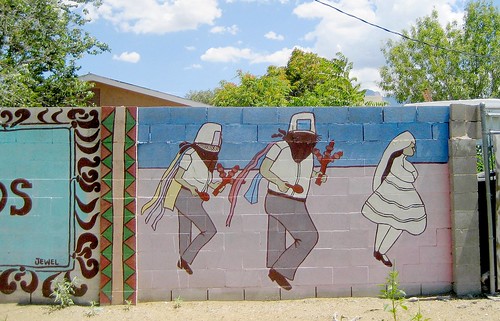
Matachines

I was taken by the matachines and their history as soon as I saw them in Tortugas at the Our Lady of Guadalupe Fiesta in December 2012.

Matachines are religious dancers. ... I hesitate to call them sacred dancers, as I don't know if their regalia is designed to transform the dancers into spiritual representatives, as is the regalia of, say, Apache crown dancers.


The matachine dances, with regional and ethnic variations, are an admixture of Moorish, Spanish, Mexican/Aztec, Pueblo, American, political, historical, social, and natural elements. The dance is a story of victory and loss, blood, divine intervention, respect for the dead, devotion, and promises to be kept.


Matchine headdresses, San Lorenzo Fiesta, Bernalillo, New Mexico


San Lorenzo Fiesta

When I read that Bernalillo is the home of a commemoration of a community's promise made to God after the Pueblo Revolt of 1680 (go here** for another perspective on the revolt), I knew I had to be there. 

Matchines shotguns, San Lorenzo Fiesta, Bernalillo, New Mexico


The commemoration occurs on San Lorenzo's feast day, and it is called the San Lorenzo Fiesta. A history
Los Matachines de Bernalillo is an integral part of Bernalillo's identity. Our story begins with the Pueblo Revolt of 1680. Because of intermarriage and strong ties between the Hispanos of Bernalillo and the Native Americans from Sandia, it is believed that Bernalillo residents were told of the impending revolt. Bernalillo residents were able to flee to "El Realito de San Lorenzo" (present-day El Paso). The Pueblo Revolt occurred on August 10, 1680. As a result of being spared and allowed to flee the area, Bernalillo residents thanked San Lorenzo. By learning the Matachines dance in El Realito, they brought the dance back with them in 1693, they expressed thanks to God and to San Lorenzo.

Diego de Vargas re-settled New Mexico in 1693. He vowed that anyone returning to New Mexico was to commemorate August 10 annually through celebration. The Matachines dance was now one of the central celebrations in Bernalillo and local residents take great pride in the dance being performed continuously since 1693.

Although the dance has changed throughout time, the Bernalillo mindset of the promesa remains true to the very first celebration in 1693. The promesa connects Bernalillo residents and danzantes to their past by worshiping God and honoring San Lorenzo for his intercession by performing the Matachines Dance.


Traditionally only men (as far as I know) danced as matachines. The Bernalillo matachines include men, women, boys, and girls. Where the matachines in Tortugas wore conservative sports coats and long-sleeved shirts, the Bernalillo matachines wear a white polo shirt and black trousers as the base of their regalia.

One long-time Bernalillo resident told me that he thinks some of the traditional gravitas of the matachine tradition has been lost in recent years, and that kids too young are now involved, mostly for their parents' bragging rights.

I can tell you the whip-carrying matachine members still pack a lot of gravitas, serving as walking sergeants-at-arms to keep tourists from getting out of line. On Saturday, I became a part of the fiesta when I walked with community members behind the saints and the matachines. Tourists with cameras who walked ahead of the saints, especially with their cameras out, were told firmly to stay behind the saints. One whip-carrying sergeant-at-arms threatened to take away one man's camera if he didn't get back behind the saints. (He was from New York. You know how they are.)

There're also the two men in red shirts, red flowery hat, bull horns, and two decorated canes. I think they, too, serve to intimidate wayward photographers a bit.

Note: There are explanations about the men with whips and the bulls in the essays here.

Matchines, San Lorenzo Fiesta, Bernalillo, New Mexico


The matachines walk before the saints, but regularly turn and bow to the saints, as they progress up or down the street to or from the church or the mayordomos' house. (The mayordomos are usually a husband and wife team.) In Bernalillo, there are two matachine groups that take turns turning and bowing to the saints.


Once upon a time, I read an article by a man who liked to travel to places where history was occurring in the moment. For example, when people started tearing down the Berlin Wall, he and his kids jumped on a plane and went to Berlin to be an eyewitness. (This idea has been taken to extremes in sci-fi literature, by Douglas Adams and Robert Heinlein, where time travelers book tours to see the end of a world. Quite a lucrative business.)

During one of the processions of the San Lorenzo Fiesta, I walked with community members behind the saints. It felt like walking in history, like being part of the history.

A slide show of photos from Bernalillo on this commemorative weekend, which included music, food booths, and a classic auto (and low-rider bicycle) show:

Bernalillo, NM


#30
 
** The current link for the alternative historic view is via the Wayback Machine, as the original site domain is now for sale, as of July 2023.

Sunday, May 12, 2013

San Francis de Paula Fiesta, Tularosa, New Mexico


Queen, knights, and bishop. San Francis de Paula Fiesta, Tularosa, NM.


Here's the story:

The Latino settlers of Tularosa and the Apache in nearby Mescalero land had skirmished for years. It came to a head in 1868, on Round Hill, when the Tularosans and a contingent of U.S. soldiers engaged in a brief battle with the Apache. The Tularosans prayed that if they won the battle, they'd build a church in St. Francis' honor and commemorate him every year in thanks for his intercession. 

San Francis de Paula Fiesta, Tularosa, NM.


The Tularosans did win the battle with the Apache and they did build the church, and thus has been celebrated every year the San Francis de Paula Fiesta. And also, the Apache and the Tularosa settlers pretty much got along fine ever after.

Like so many rituals in New Mexico, the layers of culture are many and rich, as demonstrated in the fiesta's music, dance, clothing, language, food, and rites.


In this one small fiesta in this one small town, were present:
  • Bishop
  • Queen and her court
  • Knights (of Columbus)O
  • Priest from Peru
  • Bilingual Mass in a church that honors North American and European saints
  • Indian-Mexican-American religious dance traditions through the matachines and danzantes
  • Mexican-American folklorico dance tradition
  • La Marinera, a Peruvian dance with indigenous Peruvian, African, and Spanish roots
  • Belly dancing
  • Hip hop dancing
  • Line dancing
  • Navajo tacos, hamburgers, enchiladas

Tepeyac Danzante from Hatch. San Francis de Paula Fiesta, Tularosa, NM.


In my opinion, a sustainable culture is one that keeps the traditional arts alive while continuing to create new expressions of its culture, based on contemporary realities of life. Which is one reason why I appreciated so much the variety of local talent showcased in Sunday afternoon's entertainment.

Note: The danzante and matachine dancers at the fiesta represented a recent revolution: women among the ranks. Both of these religious-dance practices, in the past - and still almost exclusively today - men only.


Folklorico dancers from Hondo. San Francis de Paula Fiesta, Tularosa, NM.

St. Francis observed all of it:

St. Francis observes. San Francis de Paula Fiesta, Tularosa, NM.


 One of my favorite moments - the new church priest, from Peru, dancing the La Marinera:


I also loved how many of the fiesta attendees joined one of the line dances. Notice the fiesta queen in white capris and peach top. One of the fiesta organizers, in black shorts and white/black t-shirt, used her force of personality to get people to join in - wonderful! I saw her give a particular someone a look that would be understood in any language: By God, you'd better get your ass out here and dance or I'm going to kick it into next week when this is over.


A great fiesta!

A slideshow:


San Francisco de Paula Fiesta, Tularosa, NM

 #30


Tuesday, December 18, 2012

Tortugas, NM: Our Lady of Guadalupe Fiesta, Part 3

Our Lady of Guadalupe Fiesta, Tortugas, New Mexico

In Part 1, Carol and I attended the Fiesta Mass, and I introduced you to historical resources about Our Lady of Guadalupe and the fiesta in Tortugas. (By the way, tortugas means turtles in Spanish.)


Our Lady of Guadalupe Fiesta, Tortugas, New Mexico


In Part 2, we enjoyed la comida and a day of dances. 


Our Lady of Guadalupe Fiesta, Tortugas, New Mexico

At about 3:30, all of the dance groups convened in front of the church except for one, which assembled just outside the church courtyard.

Our Lady of Guadalupe Fiesta, Tortugas, New Mexico


Presently, the procession began, with dance groups taking the lead, followed by the priest and la Virgen, accompanied by brothers, mayordomos (fiesta leaders), other fiesta or community dignitaries, and the onlookers. The priest sang. Sometimes the Pueblo dance group chanted. One or two gunmen escorted the procession, periodically firing into the air.

Our Lady of Guadalupe Fiesta, Tortugas, New Mexico


Here was the most interesting thing to me: The dance groups walked in front of la Virgen and the other processioners. But each dance group took turns to:
  1. Turn around to face la Virgen;
  2. Dance (in two columns) toward la Virgen
  3. Each row bow in front of la Virgen; and
  4. Then that row would go to the end of its column and face forward again (away from la Virgen and in the direction the procession was going), then the next row would bow and move out ... repeat ...
  5. When one dance troupe completed its homage, another dance troupe took its turn
This process occurred throughout the procession.

Below is a video that shows the process getting underway.  A lot is going on in this video. If you watch carefully, you'll hear the singing, hear the shotgun fires, hear the drumming, see the dance troupes approach to give their respects to la Virgen and make way for the next dance troupe.


It is a richly layered, beautiful process, I think.

And it's all a part of America.

Here's a photo slideshow of the day's events:


Wednesday, November 21, 2012

Las Cruces, NM: Mariachi Conference: Matachines


One of the things I love about New Mexico are the layers of culture that thrive here.

Las Cruces, New Mexico: Mariachi Conference, Mariachi Mass, San Jose matachina dancers. Credit: Mzuriana


They couldn't have been more evident than at the Mariachi Mass in Las Cruces on Sunday. I'll try to list the influences in motion at this event:
  • Pueblo
  • Aztec
  • Yaqui
  • Spanish (i.e. the country)
  • Moors (historically, northwest African Muslims)
  • Modern-day Mexican 
  • Modern-day New Mexican
  • Modern-day American (U.S.)
  • Roman Catholicism
  • Evangelical Christian
  • Spanish language
  • English language


Las Cruces, New Mexico: Mariachi Conference, Mariachi Mass, Azteca dancers. 2012.
Las Cruces, New Mexico: Mariachi Conference, Mariachi Mass, Azteca dancers. 2012. Credit: Mzuriana


At the entrance to the Mass venue, before the Mass began and after the Mass ended, were three dance troupes. Indian? And if so, which? There were commonalities to what I'd experienced thus far in various Indian dances, but there were differences, too.

Las Cruces, New Mexico: Mariachi Conference, Mariachi Mass, San Jose matachina dancers. 2012.
Las Cruces, New Mexico: Mariachi Conference, Mariachi Mass, San Jose matachina dancers. 2012. Credit: Mzuriana


I looked and looked for information on these dancers, to no avail, til - doh! - as a last resort, I thought to look at the printed Mariachi Mass program that I still had. And there they were, listed under "matachines."

Matachines? What? I was clueless. I soon learned more. Here is a meaty history and analysis of the matachina dance from New Mexico Arts. But in brief, per wikipedia:
The Matachina dance ... is explained by oral tradition amongst most Indian Tribes as "The Dance of the Moors and Christians" and is the first masked dance introduced by the Spaniards. The Moors were driven out of Spain in 1492 and the missionaries introduced the dance to show the superiority of the Christians. The dance was adopted by the people, and today many forms of this dance still exist. Though the dance steps vary amongst tribes the dance formations are all similar. Masks continue to be used, but the style changes from village to village, or tribe.

The introduction of the Dance of the Moors and Christians gave rise to a further range of masked dances, one of them recounting the Spanish victory over the Indians and their eventual conversion to Christianity. These dances are called conquest dances (also a Matachin tradition), and Cortes and La Malinche (his Indian mistress and translator) often appear in them. It's interesting to note that in many versions of this dance, the Indians wear lavish costumes while the Christians are played by children.

The Matachines dance for a deeper religious purpose, since most of them join to venerate either Mother Mary (Our Lady of Guadalupe, Our Lady of Lourdes, Immaculate conception, etc.), a saint (the group usually chooses the saint that pertains to the church they belong to), or simply to worship Christ or God the Holy Trinity, demonstrated by the three forked symbolized as a "Sword of the Holy a Trinity".

As I read the information on matachines (and the above wikipedia excerpt is only a superficial coverage of a complex inter-cultural allegorical dance), I thought: aha! The Indians in Cuzco, Peru, have a similar dance! In that case, the conquistadors are devils. From my journal entry of a long-ago trip to Cuzco during Inti Raymi:  
"Last night I danced with 2 gorillas and got bitten by the devil. It was lots of fun. I also tasted a little of the local liquor; tasted like coconut and was very good. There was a long procession last night through the plaza, with dancers and musicians. ... Annie and I danced with two groups. One group represented the devils and gorillas (with their claws?!). The devils' costumes had a strong similarity to the conquistador costumes. They all wore masks."   
(By the way, it ain't easy to dance at 11,000 feet!)

Here's a sampling of the matachina dance troupe San Jose:


You don't see him in this clip, but in other dances, there was a child dressed in black and charcoal, with a mask. Based on what I've read, I'm guessing he represented the Christian. He didn't dance when I saw him. He stood amongst the dancers.

There was an Aztec dance group also, and I don't know if it falls into the matachina category or is something else entirely. Unfortunately, I didn't get a good video of this group.

Now that I've learned a little about the matachines, I've got to find opportunities to see more.

Bernalillo, New Mexico, has a history of hosting a San Lorenzo Fiesta, which includes matachines. Last year, the event was August 10-11, so in 2013, August 11-12? I'm going to put it in as a tentative on my calendar.