In winter 2018, I spent a month in Mexico City. My accommodations, originally a Friends (Quaker) guesthouse, gave its third floor over to some refugees from the second caravan coming north from Central America.
In the sala, I talked with Patricio (a pseudonym) from El Salvador. He had received troubling news: the government had informed his family that it would take their land unless they built a house on it by a certain date. There is an issue with documents and a signature that I don't understand.
How does one take care of such family business when one is a refugee? Patricio and his wife have a four-year old son. With luck, they will join Patricio in February.
Patricio shared with me a photo of his son, along with phone recordings from conversations between him and his little one.
Nightmares awaken Patricio.
~~~~~~~~
My Spanish isn't good enough to understand the specifics of Patricio's situation, but below are relevant issues, any one of which could touch on his family's predicament:
In winter 2018, I spent a month in Mexico City. My accommodations, originally a Friends (Quaker) guesthouse, gave its third floor over to some refugees from the second caravan coming north from Central America.
Some women and men deported from the US also passed through the guesthouse. I've given them pseudonyms.
Some new folks arrived today.
A married couple came up with the first caravan from Guatemala. They'd been deported from Austin, Texas. They believed it best for their two young children, ages three and five, to leave them in safe hands in Austin.
Another man, Juan, originally from Chiapas, arrived. He'd been living in Chicago for a number of years, working for a landscaping company. Deported just last week. Instead of returning to Chiapas, he plans to stay in Mexico City for now, as there are more opportunities here.
A third man, Guillermo, who'd lived in Nevada for more than 20 years, was visiting New York when tapped. He's lived in Mexico City for almost a year now, and plans to move to his own place here in January. Originally from Jalapa in Vera Cruz, he says, smiling: "Yo soy jalapeño." Chuckles.
In winter 2018, I spent a month in Mexico City. My accommodations, originally a Friends (Quaker) guesthouse, gave its third floor over to some refugees from the second caravan coming north from Central America.
One of the asylum-seekers became ill, and I wrote this:
So when you are vomiting blood and have no money, what do you do?
In the case of one of my housemates, you go to a pharmacy for a consult - in some pharmacies free and in others, for a nominal fee (but even this is inaccessible if you have no money, so one of your housemates pays the consulting fee for you - about 35 pesos).
The pharmacist takes your vitals (blood pressure, pulse, temperature, and throat check), but no blood, stool, or urine tests.
The pharmacist takes a history from you, considers the possibilities, rules some out, and recommends an endoscopy. Which, of course, is outside your financial reach.
The pharmacist suggests there is an irritation in your esophagus or at another milepost along the gastrointestinal boulevard, and to eat fruits and vegetables, and avoid spicy foods. If still producing blood in two days, do what you can to get that endoscopy.
What could be the cause?
The violent blows to your torso, delivered 10 days ago by fellow caravanners from a different country than yours, who maybe took umbrage at your membership in the caravan's LGBTQI group? Or the cocaine you ingested yesterday evening, even though you've never had such a reaction before? Or stress? Or malnutrition? Or an ulcer? Or a pulmonary issue? Deadly? Or a passing health incident, self-repairing?
Does an affliction care if you are kind and amiable, that you sometimes engage in risky behaviors, are poor, have left all that is familiar to you, and your access to food, shelter, and employment is insecure? No, it does not; it is impersonal.
Maybe there's a biological tipping-point algorithm at play: stress+malnutrition+uncertainty+a beating+cocaine+compromised immune system from the cold virus that's been visiting the house = a crocodile crack on a corporeal byway = vomiting blood.
Yellow flowers and rain gutter near Campbell and Fort Lowell. Tucson, Arizona. May 2019.
Yesterday, as I lay on my airbed reading a young-adult science fiction novel, I was warm; the surface supporting my body, soft. If I had to go to the bathroom, the toilet and sink were literally around the corner of my bedroom. Hungry? Get up and walk a few steps to my refrigerator or pantry, in clean socks, on a clean floor.
In a parallel universe, in Mexico City, was a young guy who'd slept on the street last night. It dropped into the 30s. In the past 18 months, he'd survived:
Journey in one of the caravans from Honduras to Mexico City
Journey into the US, where he was detained in an "icebox" for some time
Illness and despair when he returned to Mexico City
Year, in all, in Mexico City, with food and shelter insecurities
Isolation from family and friends back home, and the friends and short-term security he'd held while at Casa de los Amigos
Faltering hope
Such long-term hardship - beginning before he embarked on a self-rescue mission, when he joined that caravan from Central America - has pushed his spirit into a crevasse, and this weekend, maybe he is on a bus to Chiapas, Mexico, headed back in the direction of Honduras. Honduras. Whose nickname from the Reagan era was: USS Honduras.
He told me: "I don't want to keep suffering."
Here's the thing. There will be suffering in Honduras, too. But maybe it will be closer to family and old friends, so perhaps a more familiar suffering, with people who love him?
I say this with a question mark because I really don't have a clue. I can have an intellectual grasp of his life in this moment, but not the gut understanding of one who has also lived through a war. Because a war, it is, for the usual things: power and greed, both in-country and from out-of-country, and where men, women, and children, individuals like my cheeky, charming young guy are just collateral damage.
Oh, right. The yellow flowers.
In the U.S., yellow flowers bespeak happiness and joy. In Central America, death and funerals.
Alvaro Enciso plants a Cross to honor a man who died seeking a decent life. Arizona. August 2019.
On a Humane Borders water run, I learned about Alvaro Enciso, an artist who has made it a mission to recognize the humanity of individual women, men, and children who have died in the desert in an attempt to claim a decent life.
Mr. Enciso honors the dead with painted wood Crosses that he plants into the Arizona soil.
Alvaro Enciso plants a Cross to honor a man who died seeking a decent life. Arizona. August 2019.
Each Cross has a round red disk.
Alvaro Enciso plants a Cross to honor a man who died seeking a decent life. Arizona. August 2019.
Each round red disk on the death map represents a woman, man, or child who died on their quest for a decent life. Each round red disk on the death map corresponds to a precise geographic point on the planet where the human remains of a dream were found.
Alvaro Enciso plants a Cross to honor a man who died seeking a decent life. Arizona. August 2019.
There are so many collapsed dreams in the desert, individual collections of bone, sinew, skin, empty clothing, shoes, bags, papers. Maybe plastic baggies with garlic, dissolved in putrescence, to protect one from rattlesnake bites.
Garlic bulbs in a baggie, abandoned by a group of migrants, along with backpacks and other items, perhaps after pick-up by Border Patrol. Arizona. August 2019.
Most Tuesdays, Mr. Enciso leads a one- or two-car pilgrimage into the
Sonoran Desert or adjoining highlands. He has selected the women, men, or children whose deaths he will
commemorate on a trip, and he brings the day's Crosses with
him. Sometimes he knows a fallen person's name, gender, and age;
sometimes not.
The
color of the painted Crosses vary according to the tint of the paint
that someone donated to him or that he picked up somewhere on sale.
On the Cross pilgrimage I joined, there were small crews for ABC's Nightline and a freelance documentary company, and, I believe, a print journalist.
Alvaro Enciso plants a Cross to honor a man who died seeking a decent life. Arizona. August 2019.
In all, there were at least 10 of us. Upon arrival near the first site, several of us carried something that was a part of the planting - a bucket, a shovel, quickset concrete. And the Cross. I carried the Cross, grateful to do so. It didn't weigh much, and it felt well-balanced. It rested lightly in the crook of my right arm. I occasionally smoothed the wood with my left hand.
We walked, and I held the Cross, and I thought about this man who had died, and when we arrived at the spot where his remains had been found, it was .... gosh, it was so pretty.
Alvaro Enciso plants a Cross to honor a man who died seeking a decent life. Arizona. August 2019.
Which doesn't surprise me like it might have long ago. When I think of the Rwandan Genocide, and my friend who survived that cycle of human madness, a question invariably comes to me: "Did birds continue to sing in the forest canopy above the screams of slaughter below"?
Of course they did.
The desert enchants and kills indiscriminately, thus a place for a pretty walk on a pleasant day for one is a place of death from heat stroke or thirst for another.
After Mr. Enciso planted the Cross in that grassy meadow, we embarked on a rather wild ride in the Samaritans' two SUVs up into the highlands, very close to the border. Mr. Enciso sought the last living place of another man, for whom he had brought a Cross.
A man died in the saddle between those two peaks, in the search for a decent life. August 2019.
But this was not the day it would happen. See that saddle between the two mountains? There's a wide valley between there and the rise where we parked. Volunteer Samaritans would come another day and hike to the man's death ground.
Samaritans left water for women, men, or children who might pass through. A man died in the saddle between those two peaks, in the search for a decent life. August 2019.
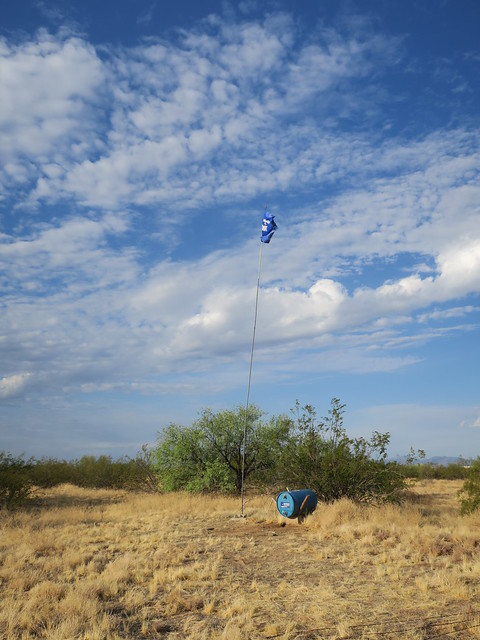
The group left jugs of water in and under the shade of a tree, which looked across that valley. Maybe they will save a life. These jugs and barrels of water. They are an act of faith, or maybe more accurately, an act of hope in a lucky roll of metaphysical dice, that someone who needs water will see it and have still the strength to reach it.
Below is a slide show with more photos from this trip with Mr. Enciso, plus the accumulation of photos from the water runs to the Sonoran Desert via Humane Borders and Samaritans.
Near Antelope Wells, New Mexico. US-MX border. March 2013.
Some notes I took
Note: Any errors that may exist below are mine and not the mistakes of the presenters
Clamping down
In the late 1990s is when the border clamped down.
The government started to prosecute people who gave rides across the border, when in the past, that had been a common practice, especially on and near the Tohono O'odham Nation: A Mexican national along the border might need a ride into Arizona, and when they finished conducting their business, they'd get a ride back home in Mexico.
It was during this time that people began to die because they had to walk through the desert.
Near Antelope Wells, New Mexico. US-MX border. March 2013.
In response to the rising death toll, humanitarian groups came to life along the border
One of the speakers said (and I'm paraphrasing): "You might wonder why a group of people, when they outnumber the Border Patrol agents who've detained them, don't resist or run away. This is because the Border Patrol employs techniques to ensure group compliance."
Verbal abuse was particularly common with 1,699 incidents being reported. It demeans and intimidates detainees and may compound feelings of confusion, helplessness and terror for those in custody. Verbal abuse includes racial and sexist epithets, in addition to threats of sexual violence, used to subjugate and degrade detainees. Furthermore, verbal abuse may include violent threats made credible by public examples of physical abuse and assault. Verbal abuse appears to aid in creating an environment of intimidation, fear and compliance among detainees. Typical forms of verbal abuse included: • Derogatory racial, ethnic, and sexual epithets • Profanity • Yelling and screaming for no apparent reason, both in the field and in processing centers
[I added the highlighted emphasis.]
An example of a public assault by a BP agent in front of a group: Throwing someone into cactus.
When encountering people on the move
No, we cannot "aid and abet" with transport "in furtherance of illegal presence."
No, we don't let someone use our phone, but we can get the number of the person's family so we can call the family when we return home, assuring them that we saw their family member alive
Yes, we can share water and food with people on the move.
But what if we encounter someone who is very sick or injured?
Let the person know where they are
Give them the best information we have re: likelihood of making it to their destination in their condition so they can make an informed decision about our calling for medical rescue
Border Patrol has a permanent presence in every ER in Arizona.
Some historical context that affect the borderlands
"American exceptionalism has replaced 'manifest destiny'"
American history is substantively different from other countries' histories;
America's mission is to transform the world; and
America's history and mission makes it superior over other nations.
Based on my limited research into this, it appears that our so-called exceptionalism presumes a starter yeast of White Protestant Christian and White Western European culture.
Ms. Castillo proposed that the strictures against migration are not just about color, but about class. "The borders are open if you are the 1% or the middle class."
History.com offers a succinct definition of manifest destiny: "... the United States was destined—by God, its advocates believed—to expand its dominion and spread democracy and capitalism across the entire North American continent."
Despite the bleakness of some of Ms. Castillo's history narrative, she ended with a powerful thought:
"These people who are in movement are the ones who are going to change the world."
Notice the absence of the word "the" before "movement." In other words, she refers to the people who are part of today's migration, not to an organized activist movement.
Counting deaths
The Border Patrol only counts the remains of those it finds, which is only about half the number that Pima County has had in its morgue.
The Border Patrol's accounting method reminds me of the controversy over the Vietnam War body counts.
Humane Borders water station. Near Tucson, Arizona. July 2019.
Being part of a water run for Humane Borders offers four-fold benefits:
Take an action that might save lives;
Give eyewitness testimony to friends and family about the effects of government decisions on the lives of individual women, men, and children;
Hear fresh perspectives on borderland issues from fellow water-truck passengers; and
Revel in the sensory gifts of the Sonoran Desert, which indiscriminately transfixes and kills.
On this day's run, we stopped at several water stations. In two cases, we swapped out two barrels for fresh ones, as the water pH was just at or a little above the threshold that Humane Borders accepts for safety.
This necessitates draining the barrels into the desert floor, and at one station, this really pissed off an ant town, as the water evidently flooded the community byways, resulting in irked ants storming up and out of a hole several yards away from the barrel.
Angry ants near Humane Borders water station. Near Tucson, Arizona. July 2019.
We saw a magnificent Harris hawk nest cradled in the arms of a stalwart saguaro. The HB driver of the day noted that this nest had been in use for at least two years. He even had photos of youngn's in the nest from a year ago.
Harris hawk nest. Near Tucson, Arizona. July 2019.
Whilst on a wilderpee behind some brush, I saw a really big bug. Eek. A palo verde beetle. Also called the "demon bug."
Palo verde beetle near Tucson, Arizona. July 2019.
It was dead. Are they edible? Quick research gave me nothing on this.
I also saw seedy poop.
Poop with many seeds, near Tucson, Arizona. July 2019.
As we bounced along a gravel-dirt road between stations, suddenly the driver stopped. He thought he might have run over a long snake, to his dismay, and he wanted to check. We all bounded out of the truck to look.
Long snake near Tucson, Arizona. July 2019.
The driver believed it was a rattlesnake. It was long. No apparent injuries, though it looked rather stunned to me. I say that because it didn't move other than to venture its tongue out of its mouth. I would have liked to have my key fob next to the snake so you could get an idea of the snake's length, but none of us volunteered to walk it over there. Look how elegantly camouflaged it is.
We saw two skeletal remains of animals. On one, a dragonfly perched alongside a spur.
Skeleton and dragonfly near Tucson, Arizona. July 2019.
Generally, four people go on the water runs. One of our companions on this trip was a university student from LA who'd come to Tucson for a week for the express purpose of volunteering. I have met a goodly number of people in Tucson who have done this. They are of diverse ages, genders, professions, and home bases.
A slide show of this and other Humane Border runs below:
The mail goes on. Roots n Blues in Columbia, Missouri. September 2007.
Many years ago, while attending university, I met an Ethiopian post-graduate student named Taye Woldesemayat. He was a TA and a student in the school's political science department, which is where I did my work-study job.
Taye made a big impact on me by way of a story he told while we shared a pizza one day:
In Ethiopia, as land was handed down to sons by their fathers, their descendants - subsistence farmers - owned smaller and smaller pieces of land as it was divvied up with their brothers. The plots of land were becoming too small to support cattle, the traditional livestock of choice. Some smart people, perhaps with USAID, had a great idea: Encourage the subsistence farmers to switch from cows to goats. The goats provide meat and milk like cows, but take up less space and consume fewer resources.
Upon hearing this, I said, "Hey, that is a great idea. Creative!"
And Taye said, "No, it's forcing the farmers to do all the changing. The oligarchy doesn't have to change anything. They keep their wealth and vast properties. What needs to happen is land reform."
Years after we both left the university, I learned that Taye had been imprisoned by the Ethiopian government. The government accused and convicted Taye of treason, which was just one of the usual covers that governments use to quash contrary citizens.
I began to write Taye monthly letters. My goals were to:
Offer a friendly voice to someone in an unfriendly situation;
Let Taye know that another person on the outside was thinking of him; and
Put the jailers on notice that Taye had another ally on the outside.
Penpals for people imprisoned in US detention centers
(including actual prisons with actual convicted felons, which immigrant detainees are not)
A primary goal of correspondence with detainees is to offset the isolation they feel due to the forced separation from their loved ones, their homes, jobs, communities, and from the routine of their lives outside the detention camps.
I can be a penpal regardless where I live, so this will be an ideal action for me to participate in.
In fact, before I left the training, AVID gave me a list of detained folks who'd expressed the desire for correspondents. I selected an individual who speaks English. He is from East Africa.
A small act for the cost of a little time, a stamp, some paper and printer's ink. But an act, nevertheless, and one which might shine a little light on both the sender and the recipient.
Mexico City. Flowers on stone wall. November 2018.
I said goodbye to "Sara" and "Esteban," the young parents of charming princeling, little "Edgar," and soon-to-be parents of the infant "Yasmina," due any day now.
As I left the guesthouse, this refugee family of the 2nd caravan was on the guesthouse stoop, along with their belongings, awaiting transportation to a new shelter.
Esteban is the man with the glorious voice, which he displays while showering. Once, he stood on the stairs that climb up into the open meeting room, where refugee women, children, and men sleep on the floor on mats. He looked down at me, at the dining table in our communal sala, and sang.
I hope this family finds the safety, health, food, shelter, and employment they seek. The basics that we all want.
Sara, Esteban, little Edgar, and the soon-to-see-light Yasmina - these are the souls who are "criminals"?
No, Edgar and Yasmina's parents are doing exactly what they can do to protect their children.
We in the US are ready to tear gas them out of fear.
One day, "Lina," a young married woman with two children, showed me photos of the rose bushes from her garden back home in El Salvador.
The photos are all that she has now of her garden.
El Paso Municipal Rose Garden. May 2017.
Lina showed me her roses while we stood in the communal kitchen of the guesthouse - the guesthouse where I had a tiny, but private room, and where her family of four slept on mats on the floor, next to strangers, in the meeting room above us.
Lina used to have her own kitchen, her own sala. She had the
garden. She and her husband and their two children used to sleep in
beds. Their own beds. Her children went to school.
Regardless
of your view about human migration - documented or undocumented - let's
always remember this: No one casually leaves behind everything of
comfort they knew before. No one casually pulls their children from
school. No one casually enters into a journey of thousands of miles into
an uncertain future, but with known dangers to themselves and
their children. No one casually gives up control over their own home
domain to enter into a temporary shelter to sleep on the floor with
strangers.
No one casually abandons the roses they tended in their personal gardens of Eden.
What
reality would be so dire that Lina and her husband would take their two
young children, abandon their home, school, neighborhood, and close
family, and flee into the unknown? To be imprisoned, en famille, in a Mexican jail before finding release into a Mexican shelter?
Death. Specific, detailed, written death threats against Lina's husband for something he saw.
A gathering of "l'eagles" in Mexico City. November 2018.
When I came to Mexico City, I didn't anticipate any intersection with the US morality test that is the Central American caravan.
Upon my arrival at the guesthouse, however, I discovered a lucky few caravan members had been given refuge here.
And then I encountered two women at my guesthouse: Rasha, a woman from Oman; and Katharine Gordon, an attorney with immigration expertise, affiliated with Al Otro Lado.
Rasha, the effusive, sparkly Omani; and Katharine, a mid-westerner; talked about going to Jesus Martinez Stadium the next day, where Katharine and other attorneys could deliver general information about seeking asylum in Mexico and the U.S.
Rasha has experience with giving succor to Syrian refugees who landed on the Greek island of Lesbos. I call her a "woman who loves." She reminds me of another woman who loves.
I asked if I could follow Katharine also, despite the fact I brought absolutely nothing to the table except my eyes and ears as a witness to a diaspora in action from Honduras, El Salvador, Nicaragua, and Guatemala.
Katharine generously agreed to let me tag along.
We agreed to meet at 8:00 the next morning, at which point we'd head to the stadium.
But the next morning, things had changed. Katharine learned that many of the refugees had left the stadium to begin the next leg of their journey to Tijuana, where they believed they would be met with a more law-abiding US border process (i.e. accepting asylum seekers in accordance with existing American law) than other port entries. In addition, even though Tijuana is father away from Mexico City than other ports of entry, it is a safer route than the more direct ones, which suffer under the weight of violent cartels.
A gathering of "l'eagles" in Mexico City. November 2018.
A gathering of US immigration attorneys who have flown to Mexico City laid a new plan for the morning: Get together for a brief training meeting at the Holiday Inn Express about a mile from the stadium. Katharine wondered if Rasha and I were still interested in going. We were and we did.
A woman named Gretchen Kuhner, who is the executive director of IMUMI (Institute for Women in Migration), shared some information about how Mexican law touches on asylum for humanitarian reasons.
Also present at the meeting was a team of US attorneys from CHIRLA (Coalition for Humane Immigrant Rights), in Mexico to offer realistic, general immigration information to the caravan refugees so they could make informed decisions about what to do, such as stay in Mexico or proceed to the US.
Katharine Gordon was present for Al Otro Lado.
A gathering of "l'eagles" in Mexico City. November 2018.
Atenas Burrolas, a human rights and immigration attorney in North Carolina, was on board. As was a New Orleans attorney, Graham Prichard.
With all of the bad press that attorneys get for their avarice and cynicism, I was mighty blown away by the attorneys at this meeting, leaving their homes to share knowledge and expertise with people in flight from their own homes.
A gathering of "l'eagles" in Mexico City. November 2018.
Our Lady of Guadalupe Church, Ferguson, Missouri. December 2017.
All of these wavelets lapped around me at the Spanish Mass I attended at Ferguson's Our Lady of Guadalupe Church.
Our Lady of Guadalupe Church, Ferguson, Missouri. December 2017.
Forefront in my mind was the St. Louis Public Radio story I'd read the day before about a parishioner, Jose Garcia. In November, the United States of America deported him to Mexico, yanking him from the arms of his wife, Ana, and his three little girls - Amanda, Julissa, and Dana.
Our Lady of Guadalupe Church, Ferguson, Missouri. December 2017.
Who benefited from this action?
Our Lady of Guadalupe Church, Ferguson, Missouri. December 2017.
No one, other than a pyramid scheme of ICE operatives to whom a man is a commodity for meeting quotas and adding ticks to a quarterly report.
Our Lady of Guadalupe Church, Ferguson, Missouri. December 2017.
A tiny little stat thrown into a virtual mass grave of thousands of other data blips, all denuded of their names, ties to families and communities -
their very humanity.
Our Lady of Guadalupe Church, Ferguson, Missouri. December 2017.
Marks on a report that will be covered by a fresh sediment layer when government operatives dump new nameless, faceless expendables into the ditch.