I was cleaning out a room at Casa Alitas. A family had passed a night or two there, and had since departed to a city somewhere in the United States, into the arms and home of a sponsor, a temporary-permanent place. Safe, presumably. A place to take some deep breaths, maybe get the kids into school.
Among the used bedding, the towels, an errant toothbrush, I saw atop the mattress a notepad.
On the cover, in a blend of letter styles: "Mi nombre es Elenita."
My name is Elenita.
I thought immediately of Hushpuppy, the valiant wee girl who lived in the drowning Louisiana community called The Bathtub, in the movie, Beasts of the Southern Wild.
Hushpuppy said:
I see that I'm a little piece of a big, big universe. .... In a million years, when kids go to school, they gonna know, once there was a Hushpuppy, and she lived with her Daddy in The Bathtub.
I thought, this little girl doesn't know it - though maybe she will one day - but she is a little piece of a big, big human wave of other little girls, and of boys, women, and men who are taking part in a natural process, eons old, to lay claim to their places on the planet, to survive and thrive as we all wish to survive and thrive.
Once there was Elenita, who passed through Tucson, Arizona, on her way to her future.
Alvaro Enciso plants a Cross to honor a man who died seeking a decent life. Arizona. August 2019.
On a Humane Borders water run, I learned about Alvaro Enciso, an artist who has made it a mission to recognize the humanity of individual women, men, and children who have died in the desert in an attempt to claim a decent life.
Mr. Enciso honors the dead with painted wood Crosses that he plants into the Arizona soil.
Alvaro Enciso plants a Cross to honor a man who died seeking a decent life. Arizona. August 2019.
Each Cross has a round red disk.
Alvaro Enciso plants a Cross to honor a man who died seeking a decent life. Arizona. August 2019.
Each round red disk on the death map represents a woman, man, or child who died on their quest for a decent life. Each round red disk on the death map corresponds to a precise geographic point on the planet where the human remains of a dream were found.
Alvaro Enciso plants a Cross to honor a man who died seeking a decent life. Arizona. August 2019.
There are so many collapsed dreams in the desert, individual collections of bone, sinew, skin, empty clothing, shoes, bags, papers. Maybe plastic baggies with garlic, dissolved in putrescence, to protect one from rattlesnake bites.
Garlic bulbs in a baggie, abandoned by a group of migrants, along with backpacks and other items, perhaps after pick-up by Border Patrol. Arizona. August 2019.
Most Tuesdays, Mr. Enciso leads a one- or two-car pilgrimage into the
Sonoran Desert or adjoining highlands. He has selected the women, men, or children whose deaths he will
commemorate on a trip, and he brings the day's Crosses with
him. Sometimes he knows a fallen person's name, gender, and age;
sometimes not.
The
color of the painted Crosses vary according to the tint of the paint
that someone donated to him or that he picked up somewhere on sale.
On the Cross pilgrimage I joined, there were small crews for ABC's Nightline and a freelance documentary company, and, I believe, a print journalist.
Alvaro Enciso plants a Cross to honor a man who died seeking a decent life. Arizona. August 2019.
In all, there were at least 10 of us. Upon arrival near the first site, several of us carried something that was a part of the planting - a bucket, a shovel, quickset concrete. And the Cross. I carried the Cross, grateful to do so. It didn't weigh much, and it felt well-balanced. It rested lightly in the crook of my right arm. I occasionally smoothed the wood with my left hand.
We walked, and I held the Cross, and I thought about this man who had died, and when we arrived at the spot where his remains had been found, it was .... gosh, it was so pretty.
Alvaro Enciso plants a Cross to honor a man who died seeking a decent life. Arizona. August 2019.
Which doesn't surprise me like it might have long ago. When I think of the Rwandan Genocide, and my friend who survived that cycle of human madness, a question invariably comes to me: "Did birds continue to sing in the forest canopy above the screams of slaughter below"?
Of course they did.
The desert enchants and kills indiscriminately, thus a place for a pretty walk on a pleasant day for one is a place of death from heat stroke or thirst for another.
After Mr. Enciso planted the Cross in that grassy meadow, we embarked on a rather wild ride in the Samaritans' two SUVs up into the highlands, very close to the border. Mr. Enciso sought the last living place of another man, for whom he had brought a Cross.
A man died in the saddle between those two peaks, in the search for a decent life. August 2019.
But this was not the day it would happen. See that saddle between the two mountains? There's a wide valley between there and the rise where we parked. Volunteer Samaritans would come another day and hike to the man's death ground.
Samaritans left water for women, men, or children who might pass through. A man died in the saddle between those two peaks, in the search for a decent life. August 2019.
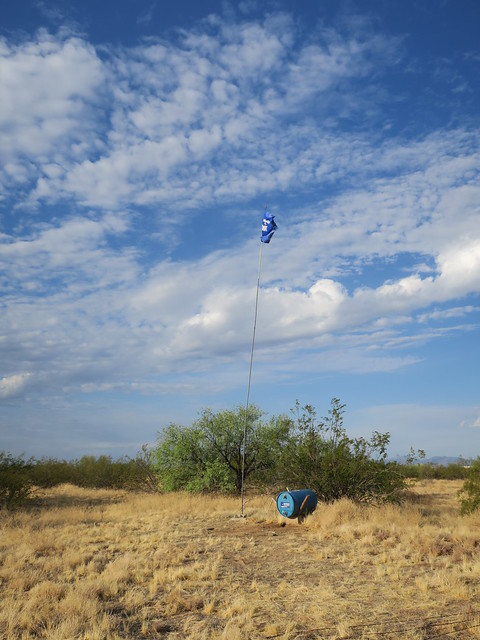
The group left jugs of water in and under the shade of a tree, which looked across that valley. Maybe they will save a life. These jugs and barrels of water. They are an act of faith, or maybe more accurately, an act of hope in a lucky roll of metaphysical dice, that someone who needs water will see it and have still the strength to reach it.
Below is a slide show with more photos from this trip with Mr. Enciso, plus the accumulation of photos from the water runs to the Sonoran Desert via Humane Borders and Samaritans.
Near Antelope Wells, New Mexico. US-MX border. March 2013.
Some notes I took
Note: Any errors that may exist below are mine and not the mistakes of the presenters
Clamping down
In the late 1990s is when the border clamped down.
The government started to prosecute people who gave rides across the border, when in the past, that had been a common practice, especially on and near the Tohono O'odham Nation: A Mexican national along the border might need a ride into Arizona, and when they finished conducting their business, they'd get a ride back home in Mexico.
It was during this time that people began to die because they had to walk through the desert.
Near Antelope Wells, New Mexico. US-MX border. March 2013.
In response to the rising death toll, humanitarian groups came to life along the border
One of the speakers said (and I'm paraphrasing): "You might wonder why a group of people, when they outnumber the Border Patrol agents who've detained them, don't resist or run away. This is because the Border Patrol employs techniques to ensure group compliance."
Verbal abuse was particularly common with 1,699 incidents being reported. It demeans and intimidates detainees and may compound feelings of confusion, helplessness and terror for those in custody. Verbal abuse includes racial and sexist epithets, in addition to threats of sexual violence, used to subjugate and degrade detainees. Furthermore, verbal abuse may include violent threats made credible by public examples of physical abuse and assault. Verbal abuse appears to aid in creating an environment of intimidation, fear and compliance among detainees. Typical forms of verbal abuse included: • Derogatory racial, ethnic, and sexual epithets • Profanity • Yelling and screaming for no apparent reason, both in the field and in processing centers
[I added the highlighted emphasis.]
An example of a public assault by a BP agent in front of a group: Throwing someone into cactus.
When encountering people on the move
No, we cannot "aid and abet" with transport "in furtherance of illegal presence."
No, we don't let someone use our phone, but we can get the number of the person's family so we can call the family when we return home, assuring them that we saw their family member alive
Yes, we can share water and food with people on the move.
But what if we encounter someone who is very sick or injured?
Let the person know where they are
Give them the best information we have re: likelihood of making it to their destination in their condition so they can make an informed decision about our calling for medical rescue
Border Patrol has a permanent presence in every ER in Arizona.
Some historical context that affect the borderlands
"American exceptionalism has replaced 'manifest destiny'"
American history is substantively different from other countries' histories;
America's mission is to transform the world; and
America's history and mission makes it superior over other nations.
Based on my limited research into this, it appears that our so-called exceptionalism presumes a starter yeast of White Protestant Christian and White Western European culture.
Ms. Castillo proposed that the strictures against migration are not just about color, but about class. "The borders are open if you are the 1% or the middle class."
History.com offers a succinct definition of manifest destiny: "... the United States was destined—by God, its advocates believed—to expand its dominion and spread democracy and capitalism across the entire North American continent."
Despite the bleakness of some of Ms. Castillo's history narrative, she ended with a powerful thought:
"These people who are in movement are the ones who are going to change the world."
Notice the absence of the word "the" before "movement." In other words, she refers to the people who are part of today's migration, not to an organized activist movement.
Counting deaths
The Border Patrol only counts the remains of those it finds, which is only about half the number that Pima County has had in its morgue.
The Border Patrol's accounting method reminds me of the controversy over the Vietnam War body counts.