Showing posts with label word of the year 2024. Show all posts

Tuesday, October 1, 2024

Word of the Year: Migration: Vietnam


Vietnamese refugees on boat, circa 1985. Credit: US Navy via wikicommons.
Vietnamese refugees on boat, circa 1985. Credit: US Navy via wikipedia.


I'm visiting Hanoi in November. I'll be there for a month.

Both boats and Vietnam are on my mind in recent days.

As an agnostic member of a couple of 12-step programs, I've had to fashion a higher power that works for me.

Many years ago, before I walked into the 12-step life, a quote by Thich Nhat Hanh spoke to me:

In Vietnam, there are many people, called boat people, who leave the country in small boats. Often the boats are caught in rough seas or storms, the people may panic, and the boats can sink. But if even one person aboard can remain calm, lucid, knowing what to do and what not to do, he or she can help the boat survive.

Thich Nhat Hanh, Being Peace


I envision my higher power as a sturdy little boat. (I aspire to being calm, lucid, and capable.) My sturdy little boat can't prevent, lessen the strength, or shorten the duration of inevitable storms, but its sturdiness imparts calm, confidence, and courage to me - as long as I trust in its seaworthiness. 

For much of my life I looked to birds as inspiration - and even now, their song, beauty of flight, nest-building skills, and yes, their "bird's eye view" of things - speak to me. 

But it's in the sturdy little boat where I can find calm and courage as family members, country, and the world convulse in painful spasms of confusion, helplessness, mistrust, horror, fear, loss, and grief.

I do not reduce Vietnam to static tropes of "boat people," the Vietnam War (aka the American War, as viewed by Vietnamese), or pho.  

No, it's the juxtaposition of my series on migration this year, and my distress (and on some days, despair) over the shameful lashes of verbal and mental abuse on the backs of women, men, and children who are only doing what rational, courageous people do to rescue themselves from untenable circumstances in their homes. 

Mere days ago, folks in the path of Hurricane Helene left their homes, household items held dear, neighborhoods, schools, houses of worship, vegetable gardens - not because of any frivolous reasons - but because they felt they had to leave. For their security. They were/are migrants themselves, even if only for a short time. If they are among the fortunate.

Monday, April 1, 2024

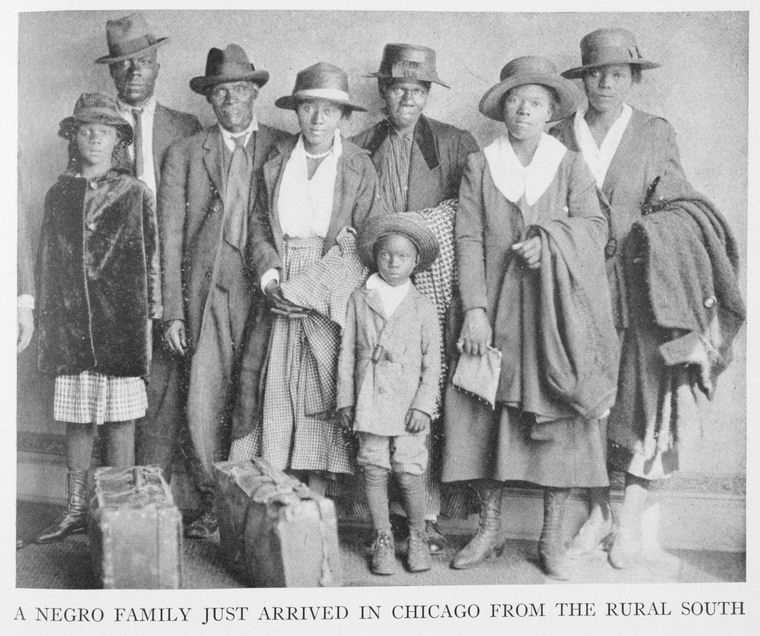
Word of the Year: Migration: The Warmth of Other Suns


Schomburg Center for Research in Black Culture, Jean Blackwell Hutson Research and Reference Division, The New York Public Library. "A negro family just arrived in Chicago from the rural South." The New York Public Library Digital Collections. 1922. 


The post I wrote back in 2011 fits perfectly in this year's word of the year series. I haven't yet read Ms. Wilkerson's newer book, Caste, but it rests beside me as I type.


Saturday, May 28, 2011

Rootless Lit: The Warmth of Other Suns


"Rootless lit" - Literature that speaks to travel, migration, displacement, exploration, discovery, transience, divesting of stuff, or portability. 

Rootless lit book review: The Warmth of Other Suns, by Isabel Wilkerson.

Summary from Publisher's Weekly: "... Pulitzer Prize–winning journalist Wilkerson's ... study of the     "great migration," the exodus of six million black Southerners out of the terror of Jim Crow to an "uncertain existence" in the North and Midwest."

Credit: Amazon


I thought I "knew" what it was like to be black in the American South before institutionalized segregation ended. I "knew" it was bad.

But as I moved through the book, I realized:

  • Even though I had never articulated it to myself, I must have held the untested belief that black Americans had somehow acclimated to the reality of Jim Crow repression in the South.   
  • As much as I thought I "knew" of atrocities such as lynching, mortal beatings, and being dragged behind vehicles til dead, there were even worse monstrosities.
  • I knew nothing about the aggressive actions southern states took to keep black Americans from leaving.

Ms. Wilkerson tells the story of the Great Migration through the voices of three people who migrated north in three separate decades. Reading their stories, it really hit home that one never gets acclimated to daily humiliations, whether petty or grand. There is anger, bitterness, frustration, fear, despair - most of which could not be expressed during the Jim Crow years because the consequences of doing so might mean terrorism, brutalization, or death, for even the slightest infraction of the "rules."

I like how Ms. Wilkerson framed the Great Migration in the context of other migrations, such as the Eastern Europeans to the U.S. She made a good case for identifying the South as the Old Country and the North as the New World, noting differences in speech, customs, food, education, etc.


The author made the matter-of-fact and consistent choice of the word "escape" to describe what motivated, in full or in part, the immigrants' journey from the South. This kept the profundity of the Great Migration in front of me throughout the book.

She also used the phrase "caste system" to describe the realities in the South (and the North, as well). I found this helpful, too, because it made the point that even though the Great Migration was a story about black Americans, it wasn't "just" about race. The Great Migration was a universal story of people who fled from oppression and caste assignment and who sought better lives for themselves and their children.

I liked, too, that Ms. Wilkerson didn't sanctify or otherwise glamorize the three people she chose to tell their stories. They were ordinary, flawed individuals.

The Great Migration ended circa 1970. That is only yesterday, sociologically, and its effects continue to unfold.


Friday, March 1, 2024

Word of the Year: Migration: The Devil's Highway


Below is a reprise of my 2011 post on Luis Alberto Urrea's book, which impacted me deeply. 

The book affected me so much, I uploaded the stories of the volunteers who delivered water to the desert into my brain's cloud storage, knowing that some day - some day - I would be one of those volunteers. And so I was, when I took up my tourist-in-residency in Tucson in 2019-2020.


Rootless Lit: The Devil's Highway: A True Story

"Rootless lit" - Literature that speaks to travel, migration, displacement, exploration, discovery, transience, divesting of stuff, or portability. 

Rootless lit book review: The Devil's Highway: A True Story, by Luis Alberto Urrea


Credit: Amazon


This is the story of the desert passage undocumented immigrants make between Mexico and the U.S. Many die en route because of lack of water and the heat. More specifically, it is the story of the Yuma 14, when fourteen men from one group died in 2001.

There were parts of this book, especially at the end, where it was painful to read. Mr. Urrea described the final hours of the dead in vivid, personal detail. One description particularly stands out for its horrific sadness. A survivor reported: "One of the boys went crazy and started jumping up and down. He started screaming, 'Mama! Mama! I don't want to die!' He ran up to a big cactus and started smashing his face against it. I don't know what his name was." The boy was 16 years old.

About another who died, Mr. Urrea wrote: "Nobody knows the name of the man who took off all his clothes. It was madness, surely. He removed his slacks, folded them, and put them on the ground. Then he took off his underwear, laid it neatly on the pants. He removed his shirt and undershirt and squared them away with the pants. As if he didn't want to leave a mess. ...He lay on his back and stared into the sun until he died."

I like how Mr. Urrea spoke for the dead as they rode in their body bags in the air-conditioned hearses.

Mr. Urrea's description of the Border Patrol's activities seemed nuanced and even-handed to me. He offers thoughtful notes in the last chapter regarding the financial costs and benefits of undocumented immigrants, of other violences perpetrated in and around the desert border.

It's difficult to describe Mr. Urrea's writing style other than to say it is personal, often in second person narrative. His portrayal of almost all of the players in the undocumented migrant universe is empathetic. Exceptions are the drug gangsters and the coyotes they run, plus certain aspects of the Mexican government machine.

Whatever one's position on migration, this book forces the reader to acknowledge the immigrants' humanity. At least for a day or two.


Thursday, February 1, 2024

Word of the Year: Migration

The Long Walk, by C Ortiz. Bosque Redondo Memorial, Fort Sumner, New Mexico


So, yes, it came to me that I do have a word for this year: Migration. 

There is a massive human migration on our planet today. 

Millions of women, men, and children are leaving their homes, their families, their friends and neighbors, their rose gardens, their languages, their neighborhood sounds and smells, their food, their favorite shops, their local houses of worship - all that they know, moving toward a future they hope is worthy of this outrageous price they pay. Knowing, too, that the people at the endpoint of their journeys may greet them, not with welcoming arms, but stony resentment. 


Columbus - Puerto Palomas port of entry, New Mexico. April 2013. Credit: Mzuriana.


Some migration is forced, in the sense that oppressors intentionally push people out, escorting them out, even, with arms or threat of arms. 

  • The Alhambra Decree of 1492, which expelled all Jews from Spain unless they denounced their faith, for example. 
  • The 18th century Acadian Expulsion in Canada, for example. 
  • The 19th century forced removal of American indigenous to reservations, for example. 
  • The Long Walk, for example. 
  • The 1940s concentration camps, mostly but not exclusively for Jewish people, in 15+ European countries, for example. 
  • The 1940s concentration camps ("relocation centers") in the United States for Japanese-Americans, for example. 
  • The "Negro Removal" in St. Louis in the 1950s (and since), for example. 
  • The Israeli threats to Gaza residents to abandon their homes or suffer the consequences for imminent Israeli military attacks, for example. 
  • Rwanda. Burundi. Bosnia. Brazil. Guatemala. The list seems endless. 

Since mass migration is, if one looks at history, inevitable, it would seem wise if nations through which the tides of humans passed: 

  • Recognized such movement as an inevitability - as inevitable as the seasons that come and go - and did not treat each migration as a crime to be quashed or a one-off disaster that ends in forgetfulness until the next one-off disaster that ends in forgetfulness until the next one-off disaster ... 
  • Built flexible systems that expand and contract as the forces ebb and flow, like the rise and fall and rise of seasonal floods, to work with the migration instead of constructing river channels that may control a stream in typical seasons, albeit with constant vigilance for cracks in the walls, but which will collapse like a child's little pile of stones when the inevitable 50-year or 100-year or 300-year flood comes. 
  • Accepted that the mighty weight of human desperation to rescue ourselves and our children from the drowning waters rushing behind us will break through walls of wire, steel, stone, concrete; of desert heat, and killing thirst.

There is migration within our country today, a domestic demographic rearrangement as the pandemic and lack of affordable housing and "trauma tax" pushes or pulls Americans away or toward new home bases. 

The pandemic and the resulting bloom of remote work has expanded the choices of where to live, possibly breathing fresh life into small cities and towns in areas that are/were moribund as a consequence of decades-long brain drain to larger urban areas.

There is migration occurring in my internal map, as well. Will I redefine rootlessness for myself? Or en-root myself again?

 This is the year of migration, both literal and figurative. Both macro and micro.


La Virgen of El Paso and Juarez, mural in Segundo Barrio. October 2016. Photo credit: Mzuriana.