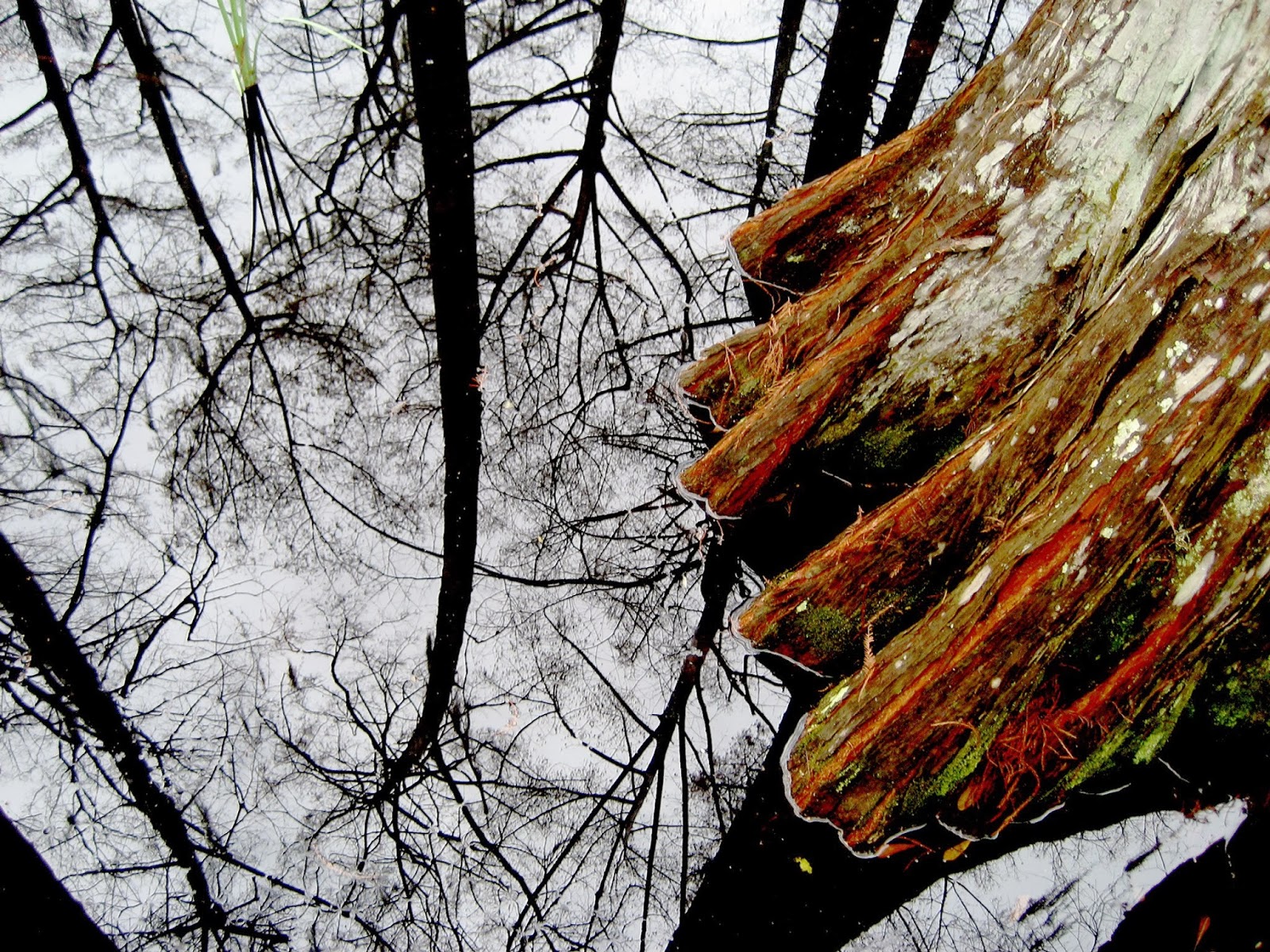
Showing posts with label swamp. Show all posts

Monday, March 7, 2016

Henderson, Louisiana: McGee's Landing, Terroir, and Joy


Atchafalaya Swamp from McGee's Landing, Henderson, Louisiana. February 2016.


I first heard the word "terroir" in its usual context, the description of a wine. Terroir is the character -  the overall sensory experience of a wine - contributed to by "the specificity of [birth]place, which has come to include not only the soil in a region, but also the climate, the weather, the aspect of the vineyards and anything else that can possibly differentiate one piece of land from another."


Atchafalaya Swamp from McGee's Landing, Henderson, Louisiana. February 2016.


Some South Louisianans like to say their DNA is in the dirt here. The music here - the creole, cajun, zydeco, and heck, yes, even the swamp pop - has its DNA in the dirt as well, and in the swamps and the bayous.

To be in a local place, listening to and dancing to local music, looking out the door onto the Atchafalaya Basin, in this day's example, or out onto sugar cane field in another day's example, or onto a bayou-fed pond on another day, it is to experience the terroir of this music.

It is a joyous thing.

Here is the talented Steve Adams Trio at McGee's Landing:


Tuesday, July 22, 2014

Morgan City, Louisiana: Swamp Bells


Brownell Memorial Park, Morgan City, Louisiana


The privately-owned Brownell Memorial Park is packaged in a small box, but inside are multiple micro-adventures.


Brownell Memorial Park, Morgan City, Louisiana


First, there were the devil's horses.
Then there were the spooky bleating swamp lambs.


And then  ....

Brownell Memorial Park, Morgan City, Louisiana


... and then as I walked on the path between the bodies of water, the cypress knees, the strong trees draped with moss, the sounds of the birds and the 'lambs,' I heard:


Claire Brownell founded this park as a testament of her love for the area and a desire to share its beauty with visitors. She had the carillon bells cast in Holland and brought here.

Brownell Memorial Park, Morgan City, Louisiana


Ms. Brownell's gift, which she shared with so many, reminds me of the couple in Rustavi who had fled their homeland in Abkhazia.  In the midst of stark cement towers in New Rustavi, they created a tiny paradise and built a tiny church, both open to any who entered.


Abkhazian-Georgian woman on far right created miniature garden with her husband, Rustavi, Georgia (Caucasus)


It reminds me of something a friend told me years ago - that the flowers that Ladybird Johnson had planted on the Texas highway meridians brought joy to thousands of drivers when they were in bloom, and how can you measure the pleasure we receive by looking upon natural beauty? -  does not an endeavor like hers, like Claire Brownell's, like the Abkhazian couple's - have just as much merit as other good works?   

Ladybird Johnson amid bluebonnets. From 100 Ingredients.


Friday, April 11, 2014

Lafayette: The Campus Swamp


Cypress Lake, UL campus, Lafayette, Louisiana

The University of Louisiana - Lafayette campus is compact and pretty.  Live oaks drape the main promenade, St. Mary's Street. Bright flowers leaven the seriousness of red brick buildings. Much-loved Girard Park anchors a corner of the campus.

Cypress Lake, UL campus, Lafayette, Louisiana


You'd never know that in the heart of the campus lies a petite swamp. With alligators, turtles, cypresses and Spanish moss, an array of fishes, and fat squirrels. It's surrounded by an attractive black metal fence to protect residents both within and without the habitat.

 
Cypress Lake, UL campus, Lafayette, Louisiana


 People visit and feed bread to the fish and turtles.


Cypress Lake, UL campus, Lafayette, Louisiana


The "swamp" is more technically Cypress Lake. If one really wants to get technical, I'd propose it was more a large pond than a lake, but historically, the swamp-lake-pond originated as a depression caused by two-stepping buffalo who liked to party in the cypress grove. The depression, which later filled with water, was here before UL was.

Cypress Lake, UL campus, Lafayette, Louisiana


If you look closely at the photo above, you can see turtles sunning themselves on a log. .... or is it a log?


Cypress Lake, UL campus, Lafayette, Louisiana


Tuesday, January 21, 2014

The Disappearing of Louisiana, Part 2: Water Words


The Zen of Flowers and Refineries, by Raina Benoit. Lafayette, Louisiana. 


To get a handle on the disappearing of Louisiana, I need to educate myself on water words. Unless quoted by an attributed source, everything below is based on my (flawed) understanding of water terms. 

Wetlands

1.      "Wetlands" is the parent category for these subcategories:
  • Swamp
  • Marsh
(there are more, but I'm trying to keep it simple)

2.      Wetland
An area that is inundated or saturated by surface or groundwater at a frequency and duration to support ... a prevalence of vegetation typically adapted for life in saturated soil conditions
3.     Swamp
 a wetland that is forested ... Many swamps occur along large rivers where they are critically dependent upon natural water level fluctuations. Other swamps occur on the shores of large lakes. [I added the boldface for emphasis.]
4.     Marsh
A type of wetland that is dominated by herbaceous rather than woody plant species ...
Marshes can often be found at the edges of lakes and streams, where they form a transition between the aquatic and terrestrial ecosystems. They are often dominated by grasses, rushes or reeds


Wetlands are important because they: 
  • Help mitigate the effects of river flooding and hurricane-led coastal surges
  • Protect water quality by trapping contaminants on the wetlands floor
  • Protect shorelines from erosion


Cypress swamp, Natchez Trace, Mississippi.


Bayou

A bayou is a slow-moving creek or a swampy section of a river or a lake. They are usually found in flat areas where water collects in pools. Bayous are often associated with the southeastern part of the United States.

Bayous are usually shallow and sometimes heavily wooded. They can be freshwater, saltwater, or a combination of both. This combination is called "brackish water."
Source: National Geographic Education

The Bayou Teche may be south Louisiana's most prominent bayou. Thousands of years ago, it was the main channel (see below) of the Mississippi River. Bayou Teche is 125 miles long and feeds into the Atchafalya River.


Tributaries v. distributaries

  • A tributary is a freshwater stream that feeds into a larger stream or river
  • A distributary is a stream that branches off and flows apart from the mainstem of a stream or river. 
 Source: National Geographic Education

Another description Rivers are connected together in vast networks of tributaries, which feed water into the main river channel, and distributaries, which pull water out of the main channel.


Channel

The channel isn't the water; it is the container of the water - the bottom and sides of the river, for example. The banks of a river are part of the channel.

The above is a neutral definition of a channel. Some channels are man-made. Canals and ditches are man-made channels.

A man-made channel is a double-edged sword. It can control the passage of water and can prevent some floods. On the other hand, water moves through a man-made channel faster (thus stronger) than a natural channel. Consequently, when water does top the channel banks, it is a more dangerous flood because its force is stronger than it would have been in a natural channel. And if there are no wetlands to absorb the brunt of the flood, there is more erosion, more property damage, more loss of life.

A movie short

Below is a five-minute video by Kael Alford called Bottom of 'da Boot: Louisiana's Disappearing Coast:


Related posts

Disappearing Louisiana, Part 1: Stumbling on History
Disappearing Louisiana, Part 2: Water Words
Disappearing Louisiana, Part 3: Paradise Faded: The Fight for Louisiana
Disappearing Louisiana, Part 4: Revetments, Rip-rap, and Other Exotica
Disappearing Louisiana, Part 5: The Control of Nature: Atchafalaya

Friday, January 3, 2014

Louisiana: Palmetto Island State Park: Pigs and Swamp

Palmetto Island State Park, Louisiana


Some of the Louisiana parks participated in the First Day Hike program, and Palmetto Island State Park was one of them.

Feral pigs at Palmetto Island State Park, Louisiana


A hiking companion and I, and her kiddos, were the only ones to do go on the park's First Day Hike. (It was a little rainy today.)

Feral pigs at Palmetto Island State Park, Louisiana


I saw my first feral pigs. Smaller than I expected, but these were the sows, their little 'uns, and adolescents. I guess the boars can get pretty large (100-400 pounds) with tusks. The boars are loner types. The sows and young ones form groups called "sounders."


Pleasant Road, which leads to the park from State Road 82, has a stretch of swamp that's very pretty.


Did you notice the pretty yellow flowers? In January!

Pleasant Road near Palmetto Island State Park, Louisiana


There's a guided canoe trip at the park on the first Sunday of every month. I signed up for the next one.

Palmetto Island State Park, Louisiana