Showing posts with label racha. Show all posts

Tuesday, February 26, 2013

Teach and Learn in Georgia: Back in Business

A supra in Kardanakhi, Georgia
 
After a hiatus during "regime change," Teach and Learn in Georgia (TLG) is back in business.

Tamar making borshi


Go here for a list of (or links to) blogs by current and past TLGers, packing items, and cultural notes.


Nely holding up her farmlet's green grapes, Kardanakhi, Georgia


Go here for the official TLG page.


Making churchkhela, Georgia


On my right sidebar is a link to a current TLGer - one who started under the old regime and continued under the new, so he may have a unique perspective to offer you.


Tia serving Kinkhali in Rustavi, Georgia


My second favorite Georgian dance video:


And my favorite, Xorumi or Khorumi, performed by Erisioni. Doesn't matter which gender you are, it gets the blood a-movin'.


 Ah, what a place.

Friday, November 30, 2012

Georgia: Traditional Dance: Racha

Racha, Georgia

As part of a Dance Friday series, here's the first of the regional dance videos from Caucasus Georgia - from the region of Racha.

I defy you to watch this video without smiling.


I think the dance from Racha is my favorite of the traditional Georgian dances. It's so vigorous, and the women's role is as interesting as the men's. 

And here's a reprise of my trip to Racha.

To read about a year in Georgia from its start, go here.  


Sunday, July 15, 2012

Georgia: Dance Racha!

Jennifer, a TLG colleage, shared this video with me recently. It's brilliant.

Traditional Racha dance with a modern twist. Really is a happy piece; makes me very glad for my time in Georgia.  


Wednesday, May 23, 2012

Svaneti, Part 4: An Aside on Preservation v. Reconstruction, et al

Mestia, Georgia.


The hype

Georgians swoon over two things Georgian: Barbecue pork (mtsvardi) and Svaneti.  I estimate only 15% of Georgians have actually been to Svaneti, but that doesn't take away from the legend. It is the Land of Beauty, the Strong, the Valiant, the Wild, the Tradition.

Yes, there are hundreds (perhaps thousands) of Svani jokes that poke fun at the presumed dunce-headedness of Svanis. But at the same time Georgians admire how Svans thrive in their harsh climate (and culture). One man I know refers to Svans as "our wild Georgians."


The reality


Svaneti is beautiful. So are Racha, Kazbegi (Stepantsminda), Shatili, and other Georgian mountain locations. Svaneti is not more beautiful than any of these, but it enjoys the greater hype. My point is this: If you're a person visiting Georgia and can't make it to Svaneti, know that if you can get to any of these other locations, you'll see stunning panoramas.


Preservation v. Restoration v. Reconstruction

Mestia, the default Svani village destination, is undergoing massive construction. It seems destined to become what some (including me) call the Disneyfied version of historic Georgian structures, a reproduction of An Authentic Georgian Village.

It is disconcerting to see a building that looks brand new, but which is purportedly ancient. St. Nino's Church in Mtskheta is an example. For me, there is something missing when a building is over-restored. It loses the dignity of its age. 

St. Nino's Church in Mtskheta, Georgia

I don't know enough about the fine points of the terms "conservation" ("preservation" in the U.S.), "restoration," "renovation," and "reconstruction," but from what I do understand, it seems that Georgia's approach is on the pushing-the-envelope end of "restoration" and on into "reconstruction." This site about Kutaisi uses the terms "restoration" and "reconstruction."

From this site, here are some bare-bones definitions: 

1.6

Preservation means maintaining the fabric of a place in its existing state and retarding deterioration.

1.7

Restoration means returning the existing fabric of a place to a known earlier state by removing accretions or by reassembling existing components without the introduction of new material.

1.8

Reconstruction means returning a place to a known earlier state and is distinguished from restoration by the introduction of new material into the fabric.

I don't know the answers. Perhaps Georgia needs to reconstruct (including replicate), but then distress the finished, reconstructed products to make them look older. It's still all smoke and mirrors, but at least it will appear more Authentic.

In Part 5, I'll get back to the actual visit to Mestia.

Tuesday, October 4, 2011

Racha, Part 5: Return Home

Sunday morning, we were ready to leave for home by the appointed time.

Oh, then .... groan. The inevitable group shot. I hate them. What is it that Queen Victoria allegedly advised her daughter prior to her wedding night? Oh yes: "Close your eyes and think of England."

That being done, we climbed into our marshrutka with a promise of a panoramic view, a surprise, a lunch stop, and then home.

Racha, Georgia
First stop ... a new footbridge with a satisfying sway when you walked on it. We then began to climb up the side of a mountain, me assuming our destination was the panoramic view. When I was within sight of the summit, but tired, I encountered Mariami, where I learned the destination was that blue gazebo up there that housed a mineral spring. She gave me a small bunch of wild mint, which I pocketed to bring back to my hostess.

Racha, Georgia
And I began the descent back to the footbridge because I already had a bottle of healing sulphurous mineral water back on the marshrutka. Yet another lesson on the importance of asking one's destination before blindly following the herd.

We drove through other Racha towns that I'd like to explore further some day, if I have the opportunity. There's some really interesting Soviet-era artwork. The colorful "comrades unite" mural sorts of work - not like the anti-beautiful works such as the collection of sticks wrapped in cellophane structures on a roundabout in Tbilisi. Or the rusty, about-to-tip-over mangled shapes of metal in Rustavi next to the big Vejini supermarket on Chatava Boulevard.    

The marshrutka made a turn onto a gravel road and we began a climb that taxed both the marshrutka and our driver's skills. Finally, Tengo had to give it up because of boulders in the road, so we couldn't make it to the end of the road as he'd wished. So we popped out and walked up the road, through a tunnel and to the edge of a bluff. There, we saw for many miles - and if the day had been clear, we would have seen all the way to the Black Sea. It was very cold.

Racha, Georgia

We walked back to the marshrutka and saw that Tengo had successfully turned it around in what must have been a series of difficult maneuvers. He is a talented man.

Drove on we did, with the goal of a restaurant with the best khachapuri in the region. It was a roadside diner of the sort I usually like very much. Too bad the latrine, which one accessed by walking down rusting-through metal steps to a two-stall, but open door structure where one did one's business, was disgusting. Worst latrine I've seen in Georgia so far. You don't want to think too carefully about what the cooks and servers do after they use this toilet.

We dropped Sandy off in Gori, and delivered others near their homes in Tbilisi, and I was dropped off at a marshrutka station that brought me to Rustavi.

Racha isn't Svaneti. But it is very pretty. I was glad to have made friends with the strong Mariami, to have seen that ghostly mountain border, and experienced some of the charms of Racha. I hope Mariami's vision for a prosperous Racha comes to pass.

Monday, October 3, 2011

Racha, Part 4: To the Border

Special ham on board, we began our upward journey in earnest.

Georgia, the home of the oldest humanoids outside of Africa, has millennia of experience in territorial expansion and contraction, sometimes acting as conquerors and sometimes as the vanquished. Currently, Georgia feels vulnerable with the de facto loss of former national jewels, Abkhazia and Ossetia, to Russia or its proxies. Georgians also have mixed feelings about the growth of the Azerbaijan-Georgian, Armenian-Georgian, and Turkish-Georgian populations in the country.

Russia, that hungry bear, rumbles 24/7 outside Georgia's fence, wanting nothing less than to gobble it up.

Borders are important to Georgia. 


Racha, Georgia
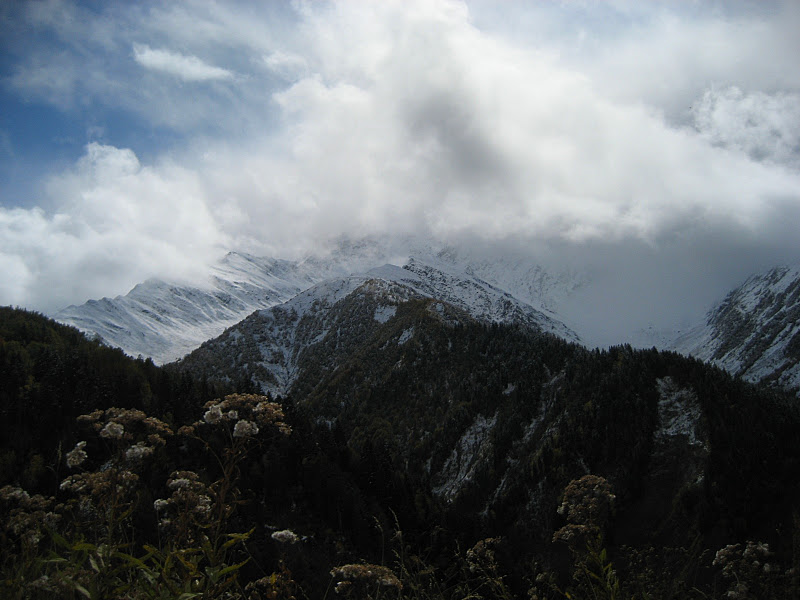
Up we went on a paved road that changed into a gravel road. Clouds stubbornly obscured the highest snow-capped (rumored) mountains.


Racha, Georgia


Eventually, we arrived at a border post, signified by a pole hut wrapped with a blue tarp.


Racha, Georgia
Several dogs did their sentry duty as they have done for thousands of years - barking to alert the police to oncomers. The sun burned through the cloud cover temporarily, revealing a heartening blue sky.


We looked through some majorly serious binoculars, tried to suss out exactly where the border was, only to learn we were in the border "zone," and relished the sun and blue for a bit. And then it was time to continue our upward journey, so we piled back into our police vehicles.

Racha, Georgia
We passed beautiful yellow foliage framed by mountain hollows.


The heavy cloud cover had returned, crowding the road.


Racha, Georgia
Our driver/escort was Gia (pseudonym), a border police commander who checks on his men regularly up on the pass. He doesn't speak English, so Mariami served as our translator. I asked what kinds of things the border police looked for on their patrols, other than seeing Russians sauntering down the road. Mariami, that proud woman of the Caucasus, replied immediately, "Of course, they look at everything they should look at and take appropriate action. They know what they are doing." I proclaimed my utmost confidence in the patrol's abilities, and asked the question in a different way - were there particular signs the men looked for that suggested suspicious activities?  And, would she mind asking Gia this question? Mariami asked Gia something, and he replied, and Mariami said, "Of course, they look at everything they should look at and take appropriate action. They know what they are doing."

Taylor and I could not help but make up our own response between ourselves: "We look for spoor on the road, examine it, and determine if it is Russian spoor. We sniff it to check for signs of vodka and if there is such a sign, we know when the Russians drank it, from which factory it was produced, and in what village the Russian drank it. We know when the Russian last had intercourse and with whom. All this we determine from the Russian spoor."

While we giggled in appreciation at our own wit, Mariami looked over and glared a little. "I know what you are saying. I want you to know that we, as Georgians, have suffered many centuries of battles and we don't find what you say humorous at all. We have moved past such immaturity." Or something along those lines.

Feeling only slightly dashed, Taylor and I sought to tell Mariami that in the U.S., along the Mexican border especially, there are special border-patrol trackers who look at all kinds of things as evidence of illegal border crossings, including the most minute trace of someone's passage on the earth. And that it was this kind of thing we wondered about in the question. "Yes, yes, of course we know of such things!"

Taylor and I continued to chuckle at ourselves, but more quietly.

We continued upward. ..... and wow.

Racha, Georgia

Racha, Georgia

Racha, Georgia
Racha, Georgia

Racha, Georgia

It was a cold, quiet world. The cloud wrap was so low and thick at times, I could see how one could get lost in a whiteout. The little bit of sun that pierced the cover spotlighted the snow on the nearby mountains.

On our return below, we passed this:

Racha, Georgia

It was getting nigh on time for lunch, and we had same at another abandoned resort in Racha. We picnicked there and weirdly enough, found it chillier at the resort than up in the mountain pass. One of the police escorts shot this bird.

Racha, Georgia


I thought it was something mildly exotic, but when I showed the photo to my hostess, she said it was a chicken. I wonder what it tastes like.

On the way back to the guesthouse, Mariami turned to me and asked, "Have you been to Svaneti yet?" I could only smile, and reply, "Why, no, I haven't, but I hope to go some day."

We returned to the guesthouse satisfied with our day in the mountains. Mariami was so relieved that the sun came out, at least for awhile, so we could appreciate - as she does - the beauty of her beloved Racha. 

In the evening, neighbors came by with accordian, guitar, and drum. They sang and played traditional Georgian songs, our guesthouse hostess and our marshrutka driver danced (very well!), and some of my colleagues joined in. We drank hot coffee or tea to warm ourselves. It was a nice end to the day.

Sunday, October 2, 2011

Racha, Part 3: Resorts, Cousin's House, and the Best-Designed Turkish Toilet in Georgia

Mariami had told us we'd leave for the mountain pass at 10:00 a.m. Saturday.  We'd be accompanied by border police.

Plenty of time, yes? Uh, oh. By the time we got downstairs to the kitchen for warmth and coffee, then eating and talking over a farmer's breakfast, we suddenly ran out of minutes. At precisely 10:00, the police arrived. Such punctuality is decidedly un-Georgian, so I can only imagine what Mariami must have said for this to happen.

Mariami gave us 10 minutes to get our shit together and be in the vehicles. I asked her if these were 10 Georgian minutes (which would translate to about 20 clock minutes), and she replied very firmly, "No! Ten minutes!"

 (Mariami and I were already on delicate ground after a .... vivacious .... discussion at dinner the day before regarding the sale of souvenir items in the guesthouse and in town. She argued .... passionately .... that it was not the right time for souvenirs and that rural tourists were not interested in items such as home-made jams or traditional crafts, while I argued ..... ardently .... that tourists were almost always susceptible to impulse buys and that the guesthouse, for instance, could easily have wares sitting passively on shelves to catch the eyes of tourists.)  

Somehow we 15 or so people crashed down to the waiting police vehicles. The marshrutka was not up to our intended route, so one group of us crowded into an enclosed truck onto wooden benches and stools, while another group of us had the luxury of being in an SUV.  I was in the latter group.  Mariami was one of my seatmates.

Our first stop was at a resort, now defunct, but once very popular with tourists seeking the healing properties of Racha's mineral waters, in addition to beautiful scenery. Mariami comes from Racha, and she has a vision of Racha's restoration as a booming tourist destination. If anyone can make this happen, I think Mariami can.

Below are photos of Mariami and Tengo, our marshrutka driver. The white building is an old resort lodge. The gorgeous gigantic tree, the white statue, the stone building with bells - these are all at the defunct resort. The blue outbuildings are places to get spring water. The house and rainy street are in the village of Oni. 


Affixed to the lodge, we noticed a loudspeaker, which we learned used to issue a morning wake-up call to guests, to prepare them for the day of healthful activities.

Mariami gathered us cats and herded us back into the police vehicles. Our next stop: Mariami's cousin's house, where we'd pick up some ham that Mariami had asked her cousin to prepare in traditional Racha-style for our lunch later in the day.

At first the plan was for us SUV passengers to just wait in the vehicle while Mariami ran in to get the ham, but another seatmate (Taylor) felt a little under the weather, and Mariami offered her some mineral water; then offered me and Marie, our other seatmate, bathroom facilities .... and I'd learned one never turns down an opportunity to go to the bathroom, so I piled out along with Taylor, then Marie joined us later.

Mariami's cousin's farm was an agricultural gem -  giant splashes of color from farm-garden flowers; autumn squashes; a pretty path from house to outhouse; tidy outbuildings - set amidst forested mountains. I entered the traditional Georgian farm house through the enclosed, window-walled front porch, directly into a large living room-kitchen with a big wood-burning stove.

Taylor had in her hands a two-liter, brown plastic beer bottle filled with mineral water to soothe her complaining innards. Mariami looked into a plastic bag filled with specially-prepared ham goodness, provided by her cousin. She and her cousin then contemplated a large ham bone with some affection. 


I walked down the pretty path to the outhouse. A Turkish toilet. But, oh, what a beautiful design! Instead of requiring the squatter to face toward or against the door, which irrationally pisses me off every time because it forces a woman into an attitude of submission for even the most trivial of purposes while a man can stand and do his business, this toilet was set up so the squatter's side faces the door. Such an aspect is more dignified than the usual orientation.

And --> The sideways orientation allowed for a bar to be placed on the wall in front of the user! Listen. If all you're going to do is take a leak, then it's no big deal to crouch down and then get up. But if you're going to be there for awhile, contemplating the universe or whatever, sometimes it's awkward to rise again. Gracefully, anyway. A bar - such a simple and humane touch. The toilet paper sat prettily on a little shelf built for the purpose.

Variously replenished and relieved, we left Mariami's cousin's house and headed up to the mountain pass.

Next: Racha, Part 4: The Mountain Border

Saturday, October 1, 2011

Racha, Part 2: We're Going to Need Another Turkish Toilet

Proprietor's mother and Tengo, our marshrutka driver

About 5:50 p.m., we arrived at the guesthouse in Oni, whereupon Mariami informed us that dinner would be ready at 6:00, and we must be there promptly.

Just prior to our arrival, we passed an old farmhouse that Stalin may or may not have slept in.

The guesthouse is large. The dining room is out on the enclosed front porch (unheated). There are three bedrooms on the main floor, a central living room, and a kitchen in the rear. The kitchen is small, but it is both literally and figuratively the "hearth" of the home, as this is where the wood-burning stove is. After dinner, we all crowded in there along with family members, which seemed to include Shorena and her husband (the proprietors), the husband's mother (presumably), a couple of children in late adolescence or early adulthood, and maybe a neighbor or sibling.   


Upstairs are two wide and long corridors, walled on one side by windows; three bedrooms, and a central living room - a parlor, really. A pair of twin metal beds in each bedroom, pushed together in traditional Georgian style. Duvets atop each. Each room was cold.

In the corridors were tidy rectangles of drying corn still on the cob. 

There was one Turkish toilet to meet the needs of some 15 guests. It is outside in a neat building at the other end of a muddy, slippery path between the house and same. I discovered later there is an older outhouse on the opposite side of the house, presumably for family members.

After dinner, as I said, we crowded into the kitchen for warmth. But eventually, we had to make our ways to bed. After some scrounging around, we found blankets to supplement the duvets. I wore my hat to bed. Sandy, in the bed next to mine, wore not only her hat, but her jacket to bed
 
We laughed so hard before we fell asleep as we recounted to each other the differences between our trip expectations and the cold, cloudy, cold, wet, cold realities!


Next: Racha, Part 3: Resorts, Cousin's House, and the Best-Designed Turkish Toilet in Georgia

Friday, September 30, 2011

Racha, Part 1: You Will Have A Good Time

"Mother Georgia."
 

Preface

Some Georgian women are very strong.

"Strong" is a Georgian euphemism for "I know what you should want, and the sooner you accept that, the sooner I'll be back smiling and we all know what happens when I'm not smiling, don't we ....?"


A few weeks earlier

A colleague called me and asked if I'd like to participate in a trip to Svaneti. Would I?! Hell, yes!! She explained we'd take the night train from Tbilisi to point A, then a six-hour marshrutka ride to Svaneti, and stay at a lodge. We'd go the end of September to beat the snow because once the snow flew, the roads might be closed until spring.


Several days later

My colleague called me again. Great news! A Georgian colleague had a connection with a tour company and she was excited to arrange everything for us! Marshrutka from Tbilisi to Svaneti! Lodging! Meals! English guide up into the mountains! A picnic lunch alongside a lake! Svardi cooked over an open fire up in the mountain pass! All for 150 lari for the weekend!

Wow. My cup runneth over. The legendary Svaneti!


A day or so later
   
My colleague called again. By the way, it wasn't a problem, was it, that our destination wasn't quite Svaneti ... it was actually Svaneti-Racha?  We'd be visiting the highest village in all of Europe. The area was just as beautiful as Svaneti, really, and was unfairly ignored by tourists.

Sure! Sounds fantastic! Svaneti-Racha is almost like Svaneti!


A few days before the trip

The village "Oni" will be rainy and cold, so dress accordingly. Oni? I didn't remember seeing the name of that village when I googled on highest village in Europe. I was thinking Ushguli. Oh well, no mind. Svaneti-Racha!


The big day

We met at 7:00 a.m. in Tbilisi in front of the Radisson Hotel near Rustaveli Square. And that's where I met my colleague's colleague. Mariami. A strong Georgian woman.
 
And somewhere along the way on this Friday, I learned that Svaneti did not enter the equation at all. Racha was our destination.

It was rainy. Cold. Cloudy. Gray.

The marshrutka seats were jammed together so tightly that even though I have short legs, my knees scrunched against the seat in front of me.

Another colleague, Sandy, lives in Gori. Mariami and the tour company had kindly agreed to pick her up "outside" of Gori, saving Sandy a one-hour trip to Tbilisi the night before. The only catch was - where exactly was "outside" Gori?

Sandy and I had been told the answer would be revealed the morning of our departure, thus when, on the marshrutka, I asked Mariami about picking up Sandy, she said, "Yes, we will now call Sandy to let her know we are leaving Tbilisi."

"But she doesn't know where you will be picking her up yet."

"Don't worry, we have been doing this for a very long time. We have done this many times."

"Yes, but Sandy has never done this and she doesn't know where to go."

With some exasperation, Mariami had our learned tour guide, David (degrees in physics, history, and music - a former violinist in the symphony) call Sandy to let her know we'd pick her up "on the highway by Gori" in about an hour. Sandy and I were given to understand that somehow the precise location would become known to Sandy.

I surrendered to the higher power upon the marshrutka, at least for a time. But as the kilometers ticked under us, I began to look for a sign about the upcoming distance to Gori, figuring to give Sandy a heads-up. When some distance passed and I didn't see any signage, I asked David how much farther to Gori, so I could give Sandy a call.

"Oh, I will call her when we are 15 minutes away. Then I'll talk to the taxi driver who will take her to the pick-up point."

"Taxi driver? What taxi driver?"


It all ended up quite beautifully - we swung by and picked Sandy up at her flat in Gori. Georgian hospitality triumphed. 

So on we went on this dreary day in which there were no mountains to be seen due to oppressive cloud cover.

Mariami, that strong Georgian woman, was valiant in her determination for us to enjoy this gray day. No sun? No lake to picnic by? Not a problem! We "picnicked" at a roadside picnic table under a blue tarp, all of us standing, shivering with cold and wetness, while Mariami and her colleagues unpacked lunch from boxes. And you know what? Mariami had made everything herself - the potato latkes, the khachapuri, the sweet cakes, and even the cognac. And they were good, dammit, even through the wretched conditions.

After some of us revolted at the idea of slip-sliding down a rocky, wet path to the outhouse (myself included), we got back on the bus after lunch, and were delivered to a nicer service-station WC.

We continued our journey to the most-beautiful-place-in-Georgia-that-is-not-Svaneti-goddamit-it, which looked not undifferent from Colorado in mining-town regions, by which I mean to say, I felt a little discouraged, despite the good company on the marshrutka.

We stopped at a couple of churches. Georgian churches are nice. They look especially picturesque from a distance. Close up, most are less prepossessing. Almost all have the same architectural design.

The really old churches have had their iconography stripped by various tides of invading barbarians.

What entrances me the most right now are the Georgian cemeteries. Must explore more of these.

The photos below show a collection from two churches, one cemetery, and one synagogue in Racha.