Showing posts with label mine. Show all posts

Friday, September 6, 2019

Arizona: Bisbee: Copper Mine


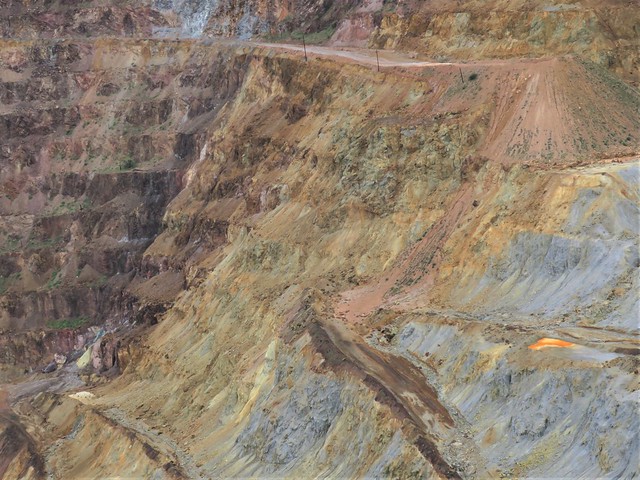
Lavender Copper Pit, Bisbee, Arizona. August 2019.


The colors and symmetrical planes of copper pits please my eye.

They gleam in hues of wet clay, spices, and semi-precious stones: Umber, saffron, cinnamon, caramel, amethyst. Ridged shelves rest on the mine's sloped sides like Andean terrace farms.

Lavender Copper Pit, Bisbee, Arizona. August 2019.


But they are mines, and over my entire life, from middle school through this very moment, I have been messaged that mines are bad. Environmental destruction and contamination. Company stores. Black lung. Miners trapped in collapsed or flooded mine shafts. Draconian responses (often with the assistance of law enforcement and local, regional, and national government bodies) against workers who demand sustainable, equitable compensation and safe working conditions. Corruption. The lack of meaningful oversight for environmental and social justice by entities outside of the mining industry. 


Lavender Copper Pit, Bisbee, Arizona. August 2019.


Nevertheless, we want to pull from the Earth substances we can fold into our lives. People want employment, too, to feed, clothe, and shelter themselves and their families.


Lavender Copper Pit, Bisbee, Arizona. August 2019.


Can we say that "fair trade" applies not only to us humans and our social communities, but also "fair trade" to the Earth - our water, soil, air, our brother-and-sister fauna and flora?


Lavender Copper Pit, Bisbee, Arizona. August 2019.


Here is a video on the importance of copper mining in the state's history:


The closing credits of the video acknowledge the contributions of two copper mine companies, Arizona State University, and a miners' story project housed in the University of Arizona. It is a video that addresses only the rosy attributes of copper mining, like a 1950s propaganda newsreel in a movie theater. A pity, as such a one-dimensional presentation disrespects the viewers, the taxpayers, and the dignity of women, men, and children who live and work around mines.

Is there such a thing as ethical mining?

Maybe.


The International Council on Mining and Metals purports to be about responsible mining, about mining with principles, for a "safe, fair, and sustainable mining industry."

The Mining Association of Canada adopted written principles to:
  1. Engage with communities
  2. Drive world-leading environmental practices
  3. Commit to the safety and health of employees and surrounding communities


Lavender Copper Pit, Bisbee, Arizona. August 2019.


The PEW Campaign for Responsible Mining (an "archived project" - circa 2009?) noted:
Mining of hardrock minerals—gold, uranium and other metals—on U.S. public lands is governed by the General Mining Law of 1872. Virtually unchanged since it was signed by President Ulysses S. Grant to promote development of the West, this frontier-era statute is no match for today’s modern mining. Under the 1872 law:
  • Mining companies—even those that are foreign-owned—are allowed to take approximately $1 billion annually in gold and other metals from public lands without payment of a royalty.
  • There is scant regulation of the nation’s top-polluting industry and few resources to clean up abandoned mines. The Environmental Protection Agency has documented more than $2 billion in taxpayer spending over the past decade on mine cleanup.
  • Mining is given priority status, on most public lands, making it nearly impossible to prohibit or restrict it, even near national parks and other iconic places, like the Grand Canyon.
The Pew Campaign for Responsible Mining is a national effort to educate and encourage the public and policy makers to adopt a modern framework for mining in the West. Today:
  • Taxpayers lose a conservatively estimated $100 million a year because, unlike with the coal, oil and gas industries, mining companies can extract valuable resources from public land essentially for free.
  • Taxpayers face a multi-billion dollar mining cleanup bill. According to the Environmental Protection Agency, the mining industry releases more toxic pollution than any other.
  • Federal agencies give hardrock mining on public lands priority status over other uses. It remains nearly impossible to restrict mining near national parks. Important water sources, wildlife and local communities are also vulnerable.
  • The law allows claim holders to buy public land for $5 an acre or less, and to use it for anything from condominiums to casinos. Congress has temporarily halted the practice.
Worse yet, a new rush is on in the West. In recent years, mining claims for uranium, gold and other metals on public lands have increased dramatically. Many of these new claims lie near treasured national lands, as well as highly populated urban areas and tribal lands.


Proposed Rosemont Copper Mine Near Tucson

In August 2019, a US District Court delivered a ground-breaking decision related to the proposed Rosemont Copper mine in the Santa Rita Mountains by the Canadian company, Hudbay Minerals:

For decades, the U.S. Forest Service has said it can’t say “no” to a mine on its land.

Now, the recent federal court ruling overturning approval of the Rosemont Mine on service land near Tucson will make it harder for the Forest Service to say “yes.”


... The ruling could chill the hard-rock mining industry that has lived under a generally favorable legal climate since Congress passed the 1872 Mining Law to encourage mineral exploration of public lands. .... 
Source: Tucson.com


A consortium of entities filed the motion against the Rosemont Copper mine.


Arizona Public Media attempted to explain some of the conflicts around the Rosemont Copper mine proposal in this May 2019 interview with a long-time, local journalist:


Related posts


Below, a slide show of my copper mine photos in Arizona, Texas, and New Mexico:
Copper mines


Saturday, December 31, 2016

El Paso: A Celebration of the Desert


September 2016


On a warm Saturday, I attended the Chihuahua Desert Festival at the Tom Mays Unit in Franklin Mountains State Park.

I bought some cool earrings from a group of high school students who belonged to a club related to desert conservation. These earrings feature Kenya's Tusker beer, with its signature yellow, black, and white palette.

Tusker Beer earrings.


They replace earrings I bought a bajillion years ago in Seattle, also made from Tusker beercaps. Those earrings eventually fell apart over the years.

Prince had died recently, and this young musician gave a tribute performance at the festival, choosing Purple Rain:


Made me think about a whomp-ass, zydeco interpretation of Purple Rain by Corey Ledet at Vermilionville one Sunday afternoon. Unforgettable.


Later, I joined a small group to walk to an old copper mine near the Tom May Unit. We went into the mountain.

Between you and me, the mine itself was rather anti-climactic, but the visuals of climbing in and out of the mine were all very birth-womb-mother-Earthy, which was cool.


El Paso - Franklin Mountains State Park, Tom Mays Unit Copper Mine. September 2016.

El Paso - Franklin Mountains State Park, Tom Mays Unit Copper Mine. September 2016.

El Paso - Franklin Mountains State Park, Tom Mays Unit Copper Mine. September 2016.

El Paso - Franklin Mountains State Park, Tom Mays Unit Copper Mine. September 2016.

El Paso - Franklin Mountains State Park, Tom Mays Unit Copper Mine. September 2016.

El Paso - Franklin Mountains State Park, Tom Mays Unit Copper Mine. September 2016.

El Paso - Franklin Mountains State Park, Tom Mays Unit Copper Mine. September 2016.

El Paso - Franklin Mountains State Park, Tom Mays Unit Copper Mine. September 2016.


Above is a good image of the instability of the hiking surface in the Franklin Mountains. As I learned here, even a flat terrain demands some attention.


Saturday, January 26, 2013

Grant County, New Mexico: A Revolution in the Middle of Nowhere


Mural about the Mine-Mill Strike by the Local 890 and the 209. Bayard, New Mexico


You're driving down a road. You pass through a small, rather despondent town by the name of Bayard. The only thing of interest that catches your eye is a mural on the side of a long, low building. You turn around, go back. Get out of the car, take the pics, get back in the car and zoom off. Nice artwork.

But when you get home and go through the pics, get ready to post them, you do a little due diligence on the ol' "Local 890" cited in the mural. Maybe there's a little blurb in a local paper about the mural, its artist, and a bit of history of a union group that used to be, and that probably is no more.

You google on "Hurley, NM" and "local 890." Nothing of interest comes up. So you broaden the search to "local 890" and "new mexico." (Update 11Feb2013: Note comment below from Anonymous. I had the town wrong, which explains why nothing much came up in my original search. Doh!

Goddamn. What a story!

Mural about the Mine-Mill Strike by the Local 890 and the 209. Bayard, New Mexico


The primary story

Back in the early 1950s, a lot of folks in Grant County worked at the Empire Zinc Mine in Hanover, New Mexico. Americans of Mexican descent were paid less than other Americans working in the mine - there was a two-tiered wage structure to ensure that. Furthermore, regardless of ethnicity, the company didn't pay for the time getting down into or up out of the mine - the clock didn't start until the miners were in place. Mining families living in company housing suffered poor living conditions - no hot water, for example. The company was not responsive to the miners' complaints about any of these issues, and they and the miners reached an impasse.

The miners' union, the Local 890, decided to go on strike. They kept the mine closed for eight months, with neither side budging from their positions. Finally, the company obtained a court injunction forbidding the miners to strike.

In a creative twist, some of the wives of the miners, affiliated with the Ladies' Auxiliary 209, suggested that they form the picket lines instead of the miners. The miners agreed.

The women stood fast against arrests, threats, and intimidation by union scabs, local law, and community members. In one narrative:
"The women’s picket was carefully organized, militant, and successful. Not only did wives of Empire strikers, such as Henrietta Williams and Virginia Chacón, walk the line; many women from other towns in Grant County also participated. When County Sheriff Leslie Goforth ordered 53 women arrested on June 16, another 300 women took their places!"

Furthermore, in response to intimidation:
"Not only did women push cars, drag men out of them, and maintain their lines; they also jumped on cars, threw rocks at strikebreakers, and deployed various “domestic” items as weapons: knitting needles, pins, (rotten) eggs and chili peppers."

So who was back home taking care of the kids and house? The jobless miners, who had eye-opening experiences at home.
"For the next seven months, the women held the line in the face of violence from strikebreakers, mass arrests by the sheriff, and opposition from many of their own husbands, who were suddenly faced with the responsibilities of caring for children, washing clothes, and doing the dishes. In January 1952, the strikers returned to work with a new contract. They had failed to win their major demands, but did obtain significant pay increases that, in effect, undermined the Mexican wage. Several weeks later, Empire Zinc installed hot water plumbing in Mexican American workers’ houses--a major issue pushed by the women of these households."

Mural about the Mine-Mill Strike by the Local 890 and the 209. Bayard, New Mexico


The secondary story

Three filmmakers who were members of the Communist Party made a movie about the miners' strike. They were Herbert Biberman (director), Michael Wilson (screenwriter), and Paul Jarrico (producer).

Mr. Wilson wrote or collaborated on screenplays for, among others: Lawrence of Arabia, Planet of the Apes, Bridge Over the River Kwai, It's A Wonderful Life, A Place in the Sun, and Border Patrol. In some, such as Lawrence of Arabia, he was uncredited because he had been blacklisted during (and after) the McCarthy Era.

The movie was Salt of the Earth, and it included experienced actors and individuals who actually participated in the strike. Filmed on site, the movie production was beset with harassing actions by politicos fraught with commie fever.
"On February 24, 1953, as filming proceeded in Grant County, U.S. Representative Donald L. Jackson (Rep-Calif.), a member of the House Committee on Un-American Activities (HUAC), delivered a speech on the floor of Congress that portrayed Salt as a dire threat to the nation. 'This picture,' Jackson charged, 'is deliberately designed to inflame racial hatreds and to depict the United States of America as the enemy of all colored peoples.' 'If this picture is shown in Latin America, Asia, and India,' he warned, 'it will do incalculable harm not only to the United States but to the cause of free people everywhere.' 'In effect,' he concluded, 'this picture is a new weapon for Russia.'”

To harass the making of the movie,

"The Grant County American Legion post distributed printed copies of Jackson’s speech to local residents. Anti-Mine-Mill residents formed a vigilante committee that carried out physical attacks on the film crew and cast. And the day after Jackson’s speech, Rosaura Revueltas [one of the professional actresses] was arrested on immigration charges, based on the technicality that she had failed to get her passport stamped when entering the U.S., and was deported before filming ended. (The last shots of her in the film were done in Mexico and the film had to be smuggled back into the U.S.). Finally, due to collaboration between Jackson, studio executives such as Howard Hughes, the American Legion, as well as the conservative Hollywood technicians’ union--the International Association of Theatrical Stage Employees (IATSE)--few Americans saw Salt of the Earth in the year of its release. In 1954, there were 13,000 movie theaters in the U.S. Only thirteen of them showed the film."
In addition, shots were fired nearby and planes buzzed the production in order to interrupt film making.

"Grandpa Walton," Will Geer, played the town sheriff in the movie. Mr. Geer was also on the blacklist for his alleged un-American activities.


Mural about the Mine-Mill Strike by the Local 890 and the 209. Bayard, New Mexico

 
The tertiary stories


Women's rights. Carl R. Weinberg, a historian and the author of this article, which as served as my main resource on the Local 890 strike, proposes that the women's role in this strike was one of a series of events that informed the modern-day women's movement.

Communism as scapegoat. The socio-political environment in which the strike and movie occurred used communism as a handy shield to maintain the status quo for the mining company and its employees.


Mural about the Mine-Mill Strike by the Local 890 and the 209. Bayard, New Mexico. 


So here's to the mural artist(s) in little Bayard, New Mexico, whose work compelled me to pause for a moment on my way home from Silver City. And to the people of the Local 890 and the 209, whose story is still so moving, more than 50 years later.