Friday, July 19, 2019

Tucson, AZ: Mt. Lemmon Recon Trip


Going up Mount Lemmon, outside Tucson, Arizona. July 2019.


One of my Tucson cultural informants took me up to Mount Lemmon for a recon mission.

Mount Lemmon is very attractive to Tusconans during the summer oven season, as its air can be 30 degrees cooler than the desert floor.  

Mount Lemmon is within the Coronado National Forest, which I first encountered here and here in 2013.


On our way to the summit, we pulled into one of the picnic areas for lunch at a picnic table shaded by coniferous trees:
  • Lightly spiced cold shrimp
  • Three kinds of cheese, sliced in small squares
  • Small red peppers stuffed with, yes, cheese
  • Slender crisps
  • Cream cheese wrapped in ham
  • Thick cuts of smoked bacon
  • Montes chardonnay
  • Dried mangoes

Picnic lunch, going up Mount Lemmon, outside Tucson, Arizona. July 2019.


A blue and gray mountain bird eyed us in the hopes of an invitation, which we pretended to ignore.


Picnic lunch hopeful, going up Mount Lemmon, outside Tucson, Arizona. July 2019.


While exploring the miniature village of Summerhaven, we came upon a Byzantine Catholic church devoted to Our Lady, Undoer of Knots.

Our Lady, Undoer of Knots, Summerhaven, Mount Lemmon, Arizona. July 2019.

 
At this point, I must surrender to my middle-school alter and confess that the first thing that came to mind when I saw the name of this church was: knots ==> ropes ==> bondage games. OK, now with that sophomoric detour out of the way ....

Our Lady, Undoer of Knots, Summerhaven, Mount Lemmon, Arizona. July 2019.


The story of how this church came to be is here.


Our Lady, Undoer of Knots, Summerhaven, Mount Lemmon, Arizona. July 2019.


My companion and I were lucky enough to arrive while one of the church creators was on the property and available to give a tour. Another couple joined us as well.


Our Lady, Undoer of Knots, Summerhaven, Mount Lemmon, Arizona. July 2019.


I am enchanted by stories of ordinary folks who have a vision for creating something beautiful, something of emotional or spiritual sustenance, to share with their community. I saw this in Caucasus Georgia. I saw it here and here in the United States.

Our Lady, Undoer of Knots, Summerhaven, Mount Lemmon, Arizona. July 2019.


The owners bought a Paul Revere bell for the church. Well, the bell was actually cast by Paul Revere's son.

Our Lady, Undoer of Knots, Summerhaven, Mount Lemmon, Arizona. July 2019.


From the church, my companion and I moved up to the summit. You can still see the evidence of the 2003 Aspen Fire.


Mount Lemmon, Arizona. July 2019.

Mount Lemmon, Arizona. July 2019.

Mount Lemmon, Arizona. July 2019.


The air? Deliciously cool. I even shivered once.


Mount Lemmon, Arizona. July 2019.

The aspens made me nostalgic for the aspens in the Sacramento Mountains above Alamogordo.


Sunday, July 14, 2019

Tucson, AZ: Humane Borders Water Run: July

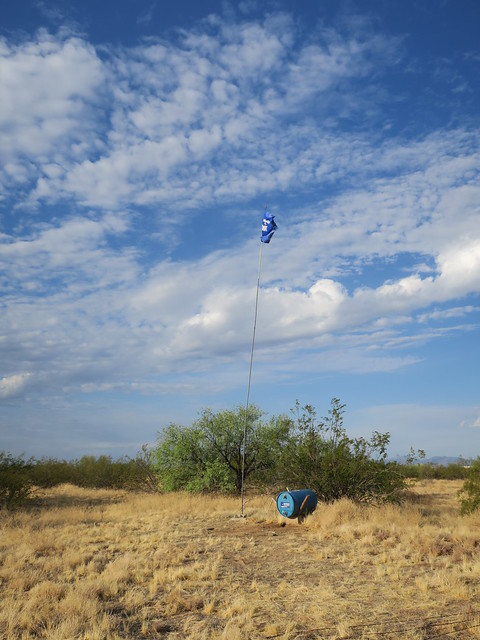
Humane Borders water station. Near Tucson, Arizona. July 2019.


Being part of a water run for Humane Borders offers four-fold benefits:
  1. Take an action that might save lives; 
  2. Give eyewitness testimony to friends and family about the effects of government decisions on the lives of individual women, men, and children;
  3. Hear fresh perspectives on borderland issues from fellow water-truck passengers; and
  4. Revel in the sensory gifts of the Sonoran Desert, which indiscriminately transfixes and kills. 

On this day's run, we stopped at several water stations. In two cases, we swapped out two barrels for fresh ones, as the water pH was just at or a little above the threshold that Humane Borders accepts for safety.

This necessitates draining the barrels into the desert floor, and at one station, this really pissed off an ant town, as the water evidently flooded the community byways, resulting in irked ants storming up and out of a hole several yards away from the barrel.

Angry ants near Humane Borders water station. Near Tucson, Arizona. July 2019.


We saw a magnificent Harris hawk nest cradled in the arms of a stalwart saguaro. The HB driver of the day noted that this nest had been in use for at least two years. He even had photos of youngn's in the nest from a year ago.

Harris hawk nest. Near Tucson, Arizona. July 2019.


Whilst on a wilderpee behind some brush, I saw a really big bug. Eek. A palo verde beetle. Also called the "demon bug."

Palo verde beetle near Tucson, Arizona. July 2019.


It was dead. Are they edible? Quick research gave me nothing on this.


I also saw seedy poop.

Poop with many seeds, near Tucson, Arizona. July 2019.


As we bounced along a gravel-dirt road between stations, suddenly the driver stopped. He thought he might have run over a long snake, to his dismay, and he wanted to check. We all bounded out of the truck to look.

Long snake near Tucson, Arizona. July 2019.


The driver believed it was a rattlesnake. It was long. No apparent injuries, though it looked rather stunned to me. I say that because it didn't move other than to venture its tongue out of its mouth. I would have liked to have my key fob next to the snake so you could get an idea of the snake's length, but none of us volunteered to walk it over there. Look how elegantly camouflaged it is.

We saw two skeletal remains of animals. On one, a dragonfly perched alongside a spur. 

Skeleton and dragonfly near Tucson, Arizona. July 2019.


Generally, four people go on the water runs. One of our companions on this trip was a university student from LA who'd come to Tucson for a week for the express purpose of volunteering. I have met a goodly number of people in Tucson who have done this. They are of diverse ages, genders, professions, and home bases.

A slide show of this and other Humane Border runs below:


HB Water Runs


Wednesday, July 3, 2019

Arizona: Sasabe: Humane Borders: July


View of sacred mountain, Baboquivari, through the Wall. Sasabe US and MX. July 2019.


Being part of a water run for Humane Borders offers four-fold benefits:
  1. Take an action that might save lives; 
  2. Give eyewitness testimony to friends and family about the effects of government decisions on the lives of individual women, men, and children;
  3. Hear fresh perspectives on borderland issues from fellow water-truck passengers; and
  4. Revel in the sensory gifts of the Sonoran Desert, which indiscriminately transfixes and kills.
Water being transferred in Sasabe for Grupo Beta, Sasabe, Sonora, Mexico. July 2019.


On this day's run, the beginning of July, we went to Sasabe in the US, and Sasabe in Mexico. Whether north or south of the border, Sasabe is a village.

The Wall between the Sasabes, Arizona and Sonora. July 2019.


A handsome US Customs compound sits on the US side of the border.


The Sasabe run has only one stop: Just over the border in Sasabe, Sonora, Mexico. Humane Borders delivers a tank of water to a receiving tank in the yard behind the Mexican Customs facility. Grupo Beta uses the water to give humanitarian aid to trekking migrants on the Mexican side of the Sonoran Desert.

It takes a little over half an hour to transfer the water from one tank to the other. During this operation, there's not much to do other than observe the community affairs of bi-national ants and to gaze thoughtfully at the United States from Mexico through the metal bars and gulag-style razor wire of the Wall.

The Wall between the Sasabes, Arizona and Sonora. July 2019.


On the way back to Tucson from Sasabe, we stopped on a desolate stretch of the road to visit the Crosses. The still, red Crosses speak in their inanimate silence of the individual life forces who let go their last breaths in these spots. Each Cross represents one woman, man, or child who left behind family, friends, home, school, the favorite corner store, the house of worship, the garden with the mango tree.

Alvaro Enciso Crosses to mark people who died crossing the desert. Look how close to the road they were when they died. July 2019.


I learned from my fellow water-truckers that artist Alvaro Enciso makes these Crosses, and most Tuesdays, under the auspices of the Samaritans, he heads up a group to plant the Crosses in the location, as marked with GPS, where the remains were claimed by the Border Patrol, ICE, or the Pima County Sheriff's or Medical Examiner's Office. If a deceased person's family is ...... lucky? ..... there is identifying information on the remains that allow Pima County to notify the family of their loved one's death.

Alvaro Enciso Cross to mark people who died crossing the Sonoran Desert, Arizona. The sweet purse that belonged to a girl or woman. July 2019.

Through his Crosses, Mr. Enciso calls attention to the human dignity of each person who died. That each soul breathed, ate, loved, feared, and had the same rights and desires that our Declaration of Independence says are inalienable - that which cannot be taken from us - to life, liberty, and the pursuit of happiness.


Not long before our visit, someone had vandalized some Crosses.


Alvaro Enciso Crosses, one vandalized, to mark people who died crossing the Sonoran Desert, Arizona. July 2019.


A cumulative slide show of desert water runs via Humane Borders and Samaritans below:

Desert Water Runs


Tuesday, July 2, 2019

Flashback: Louisiana: Sabine National Wildlife Refuge

For no particular reason, I am drawn to this flashback of Louisiana's Sabine National Wildlife Refuge, which I visited twice, once in 2014 and again in 2015.

I wrote three articles about Sabine, and this 2015 piece was the last of the three, and with links to the previous two.

Wednesday, June 3, 2015

Sabine National Wildlife Refuge, Louisiana: Late Spring Visit

Sabine National Wildlife Refuge, Louisiana


Poo-yai! Those are some blood-thirsty yellow flies at the Sabine National Wildlife Refuge! I first experienced these varmints when I visited the Sabine National Wildlife Refuge in July 2014 here and here.


Sabine National Wildlife Refuge, Louisiana


On this year's visit, my group of visitors and I saw an alligator, a turtle nest, various engrossing (hahaha! "Engrossing," get it?) carcasses, many examples of poop, and birds. And the yellow flies.


Sabine National Wildlife Refuge, Louisiana


A slideshow here:


Sabine National Wildlife Refuge


Monday, July 1, 2019

Word of the Year 2019: Action: Escaping Despair


Benson Sculpture Garden. Loveland, Colorado. May 2016.


It seems unreasonable to confess the despair that pulls me out to the deep water sometimes, like a riptide; hard to escape, easy to drown in.


Benson Sculpture Garden. Loveland, Colorado. May 2016.


After all, I have sufficient food, clothing, and shelter, income, and a general expectation of predictability in what will happen in my life tomorrow and the day after, inshallah. I am healthy. 


"Long Walk," by Shonto Begayl. Bosque Redondo Memorial, New Mexico. September 2013.


Fortunately, the despair hits only sporadically.


"Long Walk," by C Ortiz. Bosque Redondo Memorial, New Mexico. September 2013.


What is almost a constant, though, is this new-to-me chronic anxiety that pulses as it sips at my thought life, a surreptitious leech.


Child of slavery, by Woodrow Nash. Slavery Museum, Whitney Plantation, Louisiana. March 2015.


Have I grown more sensitive to caffeine? Not eating enough kale? Eating too much wheat? A part of the natural aging process? Maybe I'm dehydrated? Am I yoga-deficient? Delayed reaction to vaccines of my childhood?

No. I know from my research into and delivery of burnout and stress management seminars that we, as humans, tend to deny, discount, and dismiss the contributing factors, the extent, and the effects that prolonged stress has on our mental, emotional, and physical health.


"Coming Home," by Rod Moorehead. Slavery Museum, Whitney Plantation, Louisiana. March 2015.


There are those among us in the United States - some of our own family members, neighbors, colleagues, faith leaders - who want to justify crimes against humanity, both domestic and international. These folks want to blame the women, men, and children who seek to rescue themselves from danger, who want to claim their unalienable rights to liberty, justice, and the pursuit of happiness.


Dia de los Muertos, Mesilla, Las Cruces, New Mexico. November 2012.


The Americans who stand at the bridge and block escape or who actively hunt down children, men, and children to imprison or expel them, or who criminalize people who are using their good sense and courage to save themselves and their children from untenable conditions .... these Americans think their actions affect only those they block, grab, detain, or expel.


The Wall, Columbus, NM-Puerto Palomas, MX. April 2013.


But these actions by our fellow Americans are toxic clouds that rain poison upon all life, including themselves, their mates, their children.

These actions change us, whether we are perpetrators, collaborators, bystanders, or upstanders.

So. Sometimes I get pulled into despair.

Action is necessary to escape despair and to alleviate chronic anxiety

The riptide model


I borrow from this fine video on riptides, which offers a summary about surviving a rip current:
  1. Stay calm. 
  2. Conserve energy. "If you attempt to fight the current, you will just expend all your energy and strength. Which will lead to tragic consequences."
  3. Just relax and go with the flow. (Note: In the context of these dark days, I translate this as it being my role to walk alongside those who suffer - not to "save" or "solve," but to take actions as an ally to support others' self-determination.) 
  4. Keep afloat, weigh your options, and don't exhaust yourself.

"The 187," by Carlos Flores, Chamizal National Monument, El Paso, Texas. October 2016.


Remember my place

It is an action of mindset to honor others' self-determination and self-rescue. It fixes my role.

In El Paso, I learned from a group of Catholic sisters that:

As sisters (they said):

  • It is our job to go where no one else wants to go and do what no one else wants to do.
  • We work on the margins.
  • We try to live as though there is no border. Those of us who can cross, should cross and behave as if there is no border.
  • We need to tell the stories to those people in the country who don't have the privilege to live here, on the border.
  • It's not important to [the mothers at the Santo Niño Project] that we solve a problem; it's important that we accompany them. 


Recently, I received this open letter from the IFCLA in St. Louis. It came on a day of despair. Excerpts from the text:
I know that many of you are worried, scared, angry, confused, and eager to take action in light of all of the news and information circulating regarding threats of increased immigration enforcement. .....

It is important that we actively work together against the fear and hatred that are already traumatizing our communities. ....We must not contribute to fear, panic, chaos, or trauma. We must remember that immigrants and their families are the ones who should make decisions for their own lives. Whatever those decisions may be, as allies, accomplices and people of faith and good will, we are called to honor their integrity and liberty in ways that are supportive, respectful, and selfless. This is how we honor the dignity of all, especially in times where our own drive to be saviors, fixers, helpers and healers can misshape our good intentions into harmful impacts.

In the St. Louis region during the last several decades, immigration enforcement has not stopped, waned, or ceased to impact immigrants and their families, loved ones, colleagues and friends on a daily basis. Raids are not new. Targeting immigrant families is not new. Threatening massive deportations is not new. ICE (Immigration and Customs Enforcement) is present in St. Louis, in Missouri and in Illinois. Local police regularly collaborate with and facilitate immigration enforcement in our region every single day. The latest flurry of public statements, news articles and social media turmoil regarding the Administration’s call for mass deportations in the coming days may be indicative of a new wave of enforcement operations in select cities, but this is a continuation of everything we have been fighting against for decades .....

..... Please be prepared to show up, support, interrupt, and disrupt whatever may happen. .... make sure you are spreading accurate information about your rights and the rights of immigrants. Trust your relationships, trust your colleagues, and trust the individuals and organizations that are in deep relationships with immigrant communities in St. Louis. Trust that if there is a need and an opportunity for allies and accomplices to show up, you will be informed and instructed, and that call will be rooted in the needs and demands of our immigrant neighbors.

As we consistently have done for years, we still urge you to speak out against ICE, against all immigration enforcement, and all actions that violate our shared values. Please call your elected officials at all levels of government to denounce the targeting of immigrants and their families. Please call your members of Congress (210-702-3059) and demand they cut all funding from the Deportation Force. Please call the national office of ICE (888-907-6635) and denounce the Administration’s statements, any operation that would destroy families and individual lives in our communities. .....

Please do not spread fear. Please do not sensationalize tactics that are always present in our communities - regardless of when the news, the President, or other leaders speak of it directly. Stay the course, my friends. Our community needs our calm, non-anxious presence now and always. Our community needs you to commit to changing the systems every single day, not just at the moment of chaos.....

I read a quote from Scott Warren, in which he referred to "self-rescue." That the women, men, and children trekking into the United States are rescuing themselves from insupportable conditions at home. The moment I read this, it solidified further what the sisters and IFCLA say.

It confers full respect and dignity in the individuals and families making the best decisions they can based on the information and the resources they have on hand.

My bouts of despair and worry do nothing to serve others. To paraphrase a quote I hear via 12-step meetings:

"It's easier to act myself into new ways of thinking than to think myself into new ways of acting." 


Friday, June 7, 2019

Tucson, AZ: S'Early Sunrises


Sunrise, Tucson, Arizona. April 2019.


I don't know when I first noticed it, but. Damn. I get up wake up so early in Tucson.


Sunrise, Tucson, Arizona. April 2019.


When I first noticed this pattern, I figured I'd go back to my usual natural waking-up time of 6:00 or 6:30 after I acclimated to the time difference between here and Central Time, but no. I wake up at FIVE. Sometimes 4:30.
 

Sunrise, Tucson, Arizona. April 2019.


This morning, the sun rose in Tucson at 5:16 a.m. The rising business does not fuck around in Tucson. The sun is up and ready for business for the day.

The sun rose in St. Louis at 5:35 Central Time this morning. So it's not all that different from Tucson. But I didn't have this issue in St. Louis. Or El Paso. Or Lafayette. Or Opelousas. Or Alamogordo.

Maybe it's not the time so much as the fact that my bedroom window faces almost due east, and I have my blinds open to catch the breeze through my window screen. So the sunshine bounds in like a big ol' retriever pup, wanting to trounce on my bed.

 An entertaining conversation here: Phoenix: The City of Early Risers


Sometimes I do rise at 5 or 5:30, just to make coffee, and go back to bed for another half hour. But many times, I just get up for the day.

There are repercussions. I get up so early, then get sleepy during the day, and I go to bed early. Like super early. Think 9:00 p.m.

So far, my conclusion is that I don't like this getting-up-so-early business.


On the bright side (get it?), I do have the privilege of witnessing some spectacular rays.

Wednesday, June 5, 2019

Tucson, AZ: Sunset at Hacienda del Sol

Sunset, Hacienda del Sol, Tucson, Arizona. June 2019.


I climbed to Hacienda del Sol for a mood-elevating, compound prescription of: one sunset, one live music set, one glass of wine, my silence among the ambient conversation of others, and cool evening air on my skin and in my hair.


A video, featuring a cameo hummingbird visit:


What the terrace musician did to one of my top 10 favorite songs of all time - House of the Rising Sun - deserves jail time for his perversion of it. But perhaps one could say the same of my yellow-blown sunset photo at the top of this page. So. Live and let live.


Hacienda del Sol, Tucson, Arizona. June 2019.


Two pleasing memories emerged when I entered the premises. One was of the venerable Casa Santo Domingo in Antigua, Guatemala. The other was of the lakeside Lewi Resort (the "new new Lewi") in Awassa, Ethiopia. The flowers, the soft-lit niches for solo or coupled quiet spaces, the graceful curves of archways, the warm structural surfaces. Softscapes balancing hardscapes. Solicitous, but not too solicitous, staff.

Hacienda del Sol, Tucson, Arizona. June 2019.


If I visit Hacienda del Sol again, I'll seek a better view than the terrace, either at a window table in the restaurant or on the plush grass that is in front of the restaurant-bar entrance. That lawn looked very inviting for a bite or beverage.


Hacienda del Sol, Tucson, Arizona. June 2019.

Hacienda del Sol, Tucson, Arizona. June 2019.


Monday, June 3, 2019

Tucson, AZ: Sunset at Unity


Unity on Third Avenue and Grant, Tucson, Arizona. June 2019.


On Sunday evening, I examined the imposing sculpture on the corner of Third Avenue and Grant. Having driven past a number of times previously, it had struck me as a grand piece of public art on a prosaic bit of real estate in midtown Tucson.


Unity on Third Avenue and Grant, Tucson, Arizona. June 2019.

It's called Unity. The artists are Ben Olmstead and Simon Donovan.

Unity on Third Avenue and Grant, Tucson, Arizona. June 2019.


It was a lagniappe to investigate the art work as sunset approached. Whereas the moon adores El Paso and Juarez, the sun enjoys making flamboyant exits in Tucson.

Unity on Third Avenue and Grant, Tucson, Arizona. June 2019.


I admire Tucson for installing a beautiful - and large! - work of art along a rather ordinary stretch of street, but through which so much traffic flows.

Art that is accessible to most, irrespective of income, lifts all of our spirits. It walks our talk of the unalienable right to the pursuit of happiness.

Below is a slide show of more Unity photos:


Unity on Grant


Sunday, June 2, 2019

Flashback: Rootless Lit: The Devil's Highway

Near Antelope Wells port of entry, New Mexico. March 2013.


One of the reasons I chose Tucson as my tourist-in-residence this year is The Devil's Highway, by Luis Alberto Urrea. I was still rooted when I read this book, but it planted a seed.

It is so especially difficult to read again, in today's shameful time, as refugees flee to the United States from Central America and other areas, about what it's like to die from thirst.


"Rootless lit" - Literature that speaks to travel, migration, displacement, exploration, discovery, transience, divesting of stuff, or portability. 

Rootless lit book review: The Devil's Highway: A True Story, by Luis Alberto Urrea


Credit: Amazon

This is the story of the desert passage immigrants make between Mexico and the U.S. Many die en route because of lack of water and the heat. More specifically, it is the story of the Yuma 14, (Washington Post, Thursday, May 24, 2001, by Giovanna Dell'orto) when fourteen men from one group died in 2001.

There were parts of this book, especially at the end, where it was painful to read. Mr. Urrea described the final hours of the dead in vivid, personal detail. One description particularly stands out for its horrific sadness. A survivor reported: "One of the boys went crazy and started jumping up and down. He started screaming, 'Mama! Mama! I don't want to die!' He ran up to a big cactus and started smashing his face against it. I don't know what his name was." The boy was 16 years old.

About another who died, Mr. Urrea wrote: "Nobody knows the name of the man who took off all his clothes. It was madness, surely. He removed his slacks, folded them, and put them on the ground. Then he took off his underwear, laid it neatly on the pants. He removed his shirt and undershirt and squared them away with the pants. As if he didn't want to leave a mess. ...He lay on his back and stared into the sun until he died."

I like how Mr. Urrea spoke for the dead as they rode in their body bags in the air-conditioned hearses.

Mr. Urrea's description of the Border Patrol's activities seemed nuanced and even-handed to me. He offers thoughtful notes in the last chapter regarding the financial costs and benefits of undocumented migrants, of other violences perpetrated in and around the desert border.

It's difficult to describe Mr. Urrea's writing style other than to say it is personal, often in second person narrative. His portrayal of almost all of the players in the undocumented migration universe is empathetic. Exceptions are the drug gangsters and the coyotes they run, plus certain aspects of the Mexican government machine.

Whatever one's position on migration, this book forces the reader to acknowledge the immigrants' humanity. At least for a day or two.


Columbus - Puerto Palomas port of entry, New Mexico. April 2013.