View of Central Park from Cafe Barista, Antigua, Guatemala. April 2016.
Parque Central. Also known as Central Park.
View of Central Park from rooftop terrace of a cafe, Antigua, Guatemala. April 2016.
It's not the only public gathering place in town, but it's the main one. It's got the classic plaza arrangement in which the church, city hall, courthouse, and market anchor each side of the square.
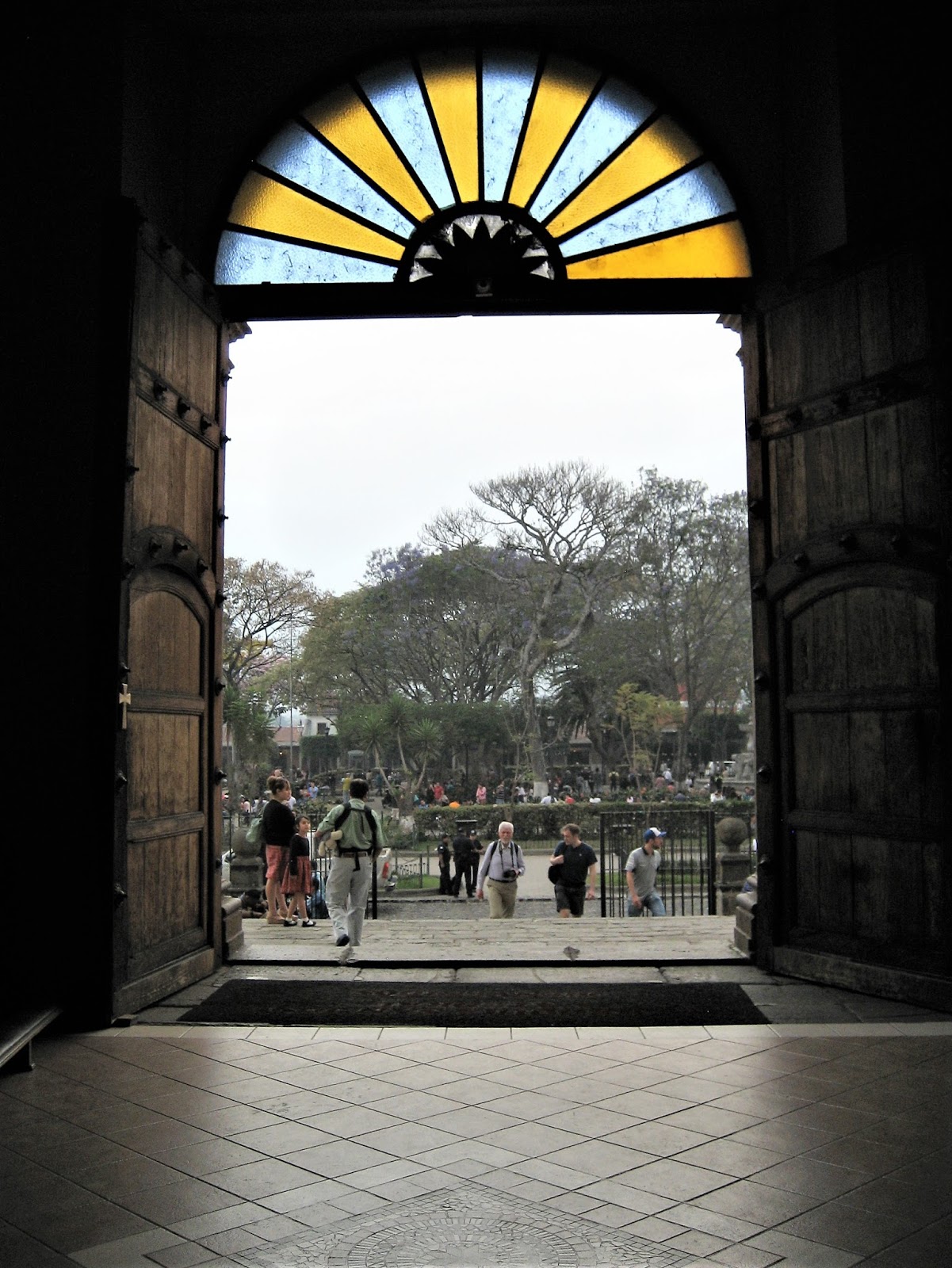
View of Central Park from within the Cathedral, Antigua, Guatemala. April 2016.
Central Park is bound by the:
Cathedral
Palace of the Captains
City Hall
A line of cafes
Within Cathedral on Central Park, Antigua, Guatemala. April 2016.
Most days, I cut through or around Central Park on my way to Spanish class.
View of Central Park from rooftop terrace of a cafe, Antigua, Guatemala. April 2016.
Early in the mornings, men sweep the plaza. I liked hearing the sound of the brooms and the birds, like in the video below:
On many evenings, there's music. Often on the veranda of the Palace of Governors. Other times, on a stage in front of city hall. A few dancers.
Music and dancing in front of Palace of Governors, Central Park, Antigua, Guatemala. April 2016.
Music and dancing in front of Palace of Governors, Central Park, Antigua, Guatemala. April 2016.
Music and dancing in front of Palace of Governors, Central Park, Antigua, Guatemala. April 2016.
Music and dancing in front of Palace of Governors, Central Park, Antigua, Guatemala. April 2016.
The Cathedral is imposing.
Behind the Cathedral on Central Park, Antigua, Guatemala. April 2016.
Within Cathedral on Central Park, Antigua, Guatemala. April 2016
Within Cathedral on Central Park, Antigua, Guatemala. April 2016
Omnipresent on the plaza are women and girls selling textiles and other items to domestic and international tourists. The women and girls wear traditional dress. Some men sell tourist items, as well.
View of Central Park from rooftop terrace of a cafe, Antigua, Guatemala. April 2016.
There are vendors who sell nuts and other festival-type foodstuffs.
In early, early mornings, you might encounter inebriated local folks, solo. A little later, but still early, you see individuals sitting on benches, often alone, sometimes in pairs, part of their daily routine, taking in some fresh air, enjoying the beauty of the park and the people-watching as the town wakes up.
There are people who sleep on the park perimeter. Some of the vendors, who come in for part of each week from their villages.
View of Central Park from rooftop terrace of a cafe, Antigua, Guatemala. April 2016.
I took a chicken bus to and from Lake Atitlan. The experience was similar to what I had in Ethiopia (here and here are two examples) in that the bus driver has a helper to:
Hang out the door and call for potential passengers;
Collect money;
Load luggage;
Generally maintain some order on the bus; and
Run speedily to streetside vendors to get himself or the driver something to drink or eat.
Chicken buses, Antigua, Guatemala. April 2016.
Yup, the bus goes pretty fast and the bus seats are slippery, so as the bus takes hairpin turns, passengers slide from one side of the bench seat to another, depending on the direction of the curve. The fun of this wears off quickly.
Chicken buses, Antigua, Guatemala. April 2016.
I did not experience the packed-til-overflowing situation described in the scenarios above. Maybe Guatemala has a similar situation as in Ethiopia, where the "class" of the bus, i.e. 1st or 2nd class - and the price of the ticket - brings certain expectations of how many people are allowed in the bus, the conditions of the interior, and the number of stops.
Chicken buses, Antigua, Guatemala. April 2016.
Below is a video I took outside Santa Lucia Church in Antigua, in which chicken buses and tuk-tuks star:
OK, now don't get me wrong on what I'm about to say. The chicken buses - the camionetas - are part of what makes Guatemala Guatemala. They are beautiful - like tropical birds of paradise. The camioneta system seems to meet the needs of Guatemalans and visitors. And what an elegant way to recycle school buses.
But damn, these buses hurtle through the narrow cobblestone streets of Antigua, farting great black odiferous clouds of exhaust, and being generally noisy.
San Lázaro Cemetery, Antigua, Guatemala. April 2016.
Is it the ultimate irony to name a cemetery after Lazarus? It would seem so to me, but maybe there's a nuance I'm not getting, or maybe Antigueños are an optimistic people.
I probably would have wandered over to the cemetery at some point during my Antigua stay, but what drove me to put it on my must-see list was a provocative conversation with my Spanish teacher.
San Lázaro Cemetery, Antigua, Guatemala. April 2016.
One day, during a lesson, I don't remember how the topic came up, but she casually mentioned formerly-interred bodies being thrown into the garbage dump if the deceased's descendants failed to pay the annual cemetery bill.
Internal squealing of brakes in my head, backing up. "Wha?"
At first I thought she was talking about tossing the cadavers into the city dump, about which I was incredulous, but after some refinement of terms and my understanding of same, I got that there was a garbage area in the cemetery itself. I am deliberately using the word "garbage" - or "trash" if you prefer - because that is the term my teacher used, i.e. "basura." Not that this was any less startling to me.
San Lázaro Cemetery, Antigua, Guatemala. April 2016.
So, really, this is how it works in Guatemala. You've got to pay recurring cemetery fees if you want your deceased loved one to remain in his eternal resting abode. My impression is that at San Lázaro Cemetery, there's a grace period of sorts, where maybe your loved one's body can stay in situ for awhile past the payment-due date, but then it's moved to another "resting area" to give the family more time to find the funds for (newer, but less stately?) digs, but once that period ends, the corpse is chucked into what one person might call a mass grave and what another might call a garbage dump.
Indeed, an article on the Guatemala system here: Evicted From Their Own Graves (2014) - Caution, disturbing photos included.
San Lázaro Cemetery, Antigua, Guatemala. April 2016.
So I went to the cemetery so I could see this for myself, but in talking to the cemetery workers, who confirmed the practice, I was told visitors weren't allowed to go to that spot because of "safety" concerns.
I did note that at least one crypt, possibly that of a delinquent "renter," is used as a work shed of sorts. If so, perhaps that is a kindness, forestalling eviction.
San Lázaro Cemetery, Antigua, Guatemala. April 2016.
As with all cemeteries, there are the chi-chi neighborhoods and the more humble ones.
Overall, the cemetery is gracious, serene, and beautiful. The public area, that is.
I don't like to cook, and I'm not a foodie. But I love to watch the Food Network Channel'sChopped and The Next Food Network Star. The food in these shows are simply the medium used to deliver artistry,
beauty, adventure, suspense, and human drama to the viewers. It is
ridiculous how much stressful suspense I feel while watching sweating
contestants struggle to "plate" their food before the final-seconds
countdown ends. Sometimes I have to cover my eyes or even flip the
channel for those last seconds, it feels so intense. But what I find most intriguing are the life lessons I see in these shows:
Radiate confidence in yourself and your abilities. Confidence is, in fact, part of your "product."
You will make a mistake. When you do, own it, fix it if possible,
and move on. Beating yourself up avails nothing but pain for yourself
and those around you.
Your plan will go awry. When it does, take a breath, then move to a different plan.
Remain calm.
There will be criticism. Accept it with grace. Acceptance does not necessarily equal agreement.
Be professional: You don't need to push others down to raise yourself up.
When I was doing my CELTA course a few months ago in Playa del Carmen, there were a couple of particularly challenging days. In one, I'd felt really good about a class I did, and felt dashed when
the tutor told me I'd left out a very important piece of the assignment,
which affected her assessment of my overall performance for that
lesson. I allowed this to rattle my confidence in a big way. The very next class I did,
I experienced a technical glitch that rattled me in a way that was
disproportionate to the problem. Once that got fixed (with the help of a
colleague), I saw to my dismay I'd made an error on one of my handouts,
which compounded my sense of dismal failure. At the time, it was just a
horrible, sick experience, again, out of proportion to the grand scheme
of things. During the afternoon critique session, I gleaned two things:
If I make a mistake, don't dwell on it in front of the class - just
fix it and move along or, if there actually isn't any substantive impact
on the day's lesson, don't even mention it (as doing so adds nothing of
value to the students).
Lack of self-confidence is a real performance killer. (And to the
"audience," it is immaterial if the projected self-confidence is real or
acted.)
So come Sunday evening, I'll be settling in to watch another installment of The Next Food Network Star.
Tia serves khinkali. Rustavi, Georgia. August 2011.
Santo Domingo del Cerro, Antigua, Guatemala. April 2016.
Here is a flashy video of Santo Domingo del Cerro that the hotel produced. It's pretty.
Santo Domingo del Cerro, Antigua, Guatemala. April 2016.
In addition to the angel, maybe my favorite experience at Santo Domingo del Cerro was with the birds.
Santo Domingo del Cerro, Antigua, Guatemala. April 2016.
Santo Domingo del Cerro, Antigua, Guatemala. April 2016.
Santo Domingo del Cerro, Antigua, Guatemala. April 2016.
It felt special to have one hop onto my finger then waddle up my arm to my shoulder. It was good to focus all of my attention on what this small bird was doing, to be mindful of nothing else.
Santo Domingo del Cerro, Antigua, Guatemala. April 2016.
I wasn't able to capture its quality with my camera, but the light shone through the chairs' muslin covers like soft candles. The chairs glowed where the sun struck them.
Santo Domingo del Cerro, Antigua, Guatemala. April 2016.
Outside the chapel, a large foot. Don't ask me; I don't know.
Santo Domingo del Cerro, Antigua, Guatemala. April 2016.
You might be surprised, but I've seen a few celebrity toilets. Such as Stalin's. So coming across the toilet used by the late Pope John II, well, I'm just adding it to the list.
Santo Domingo del Cerro, Antigua, Guatemala. April 2016.
Santo Domingo del Cerro, Antigua, Guatemala. April 2016.
All in all, Santo Domingo del Cerro is a must-see in my book. Mostly because of the diversity of things to entertain all of the senses.
Poet Miguel Ángel Asturias. Santo Domingo del Cerro, Antigua, Guatemala. April 2016.
There are sights and sounds to see up close and far away.
Santo Domingo del Cerro, Antigua, Guatemala. April 2016.
There are things to touch, flowers to smell.
Santo Domingo del Cerro, Antigua, Guatemala. April 2016.
There are whimsical works and contemplative works. Much of the artwork is by Guatemalan artist, Efrain Recinos.
Santo Domingo del Cerro, Antigua, Guatemala. April 2016.
Although I didn't find my lunch entree or coffee to be particularly remarkable, both were perfectly OK and besides, pairing food and drink al fresco is a good in itself.
Getting ready for a party. Santo Domingo del Cerro, Antigua, Guatemala. April 2016.
Santo Domingo del Cerro, Antigua, Guatemala. April 2016.
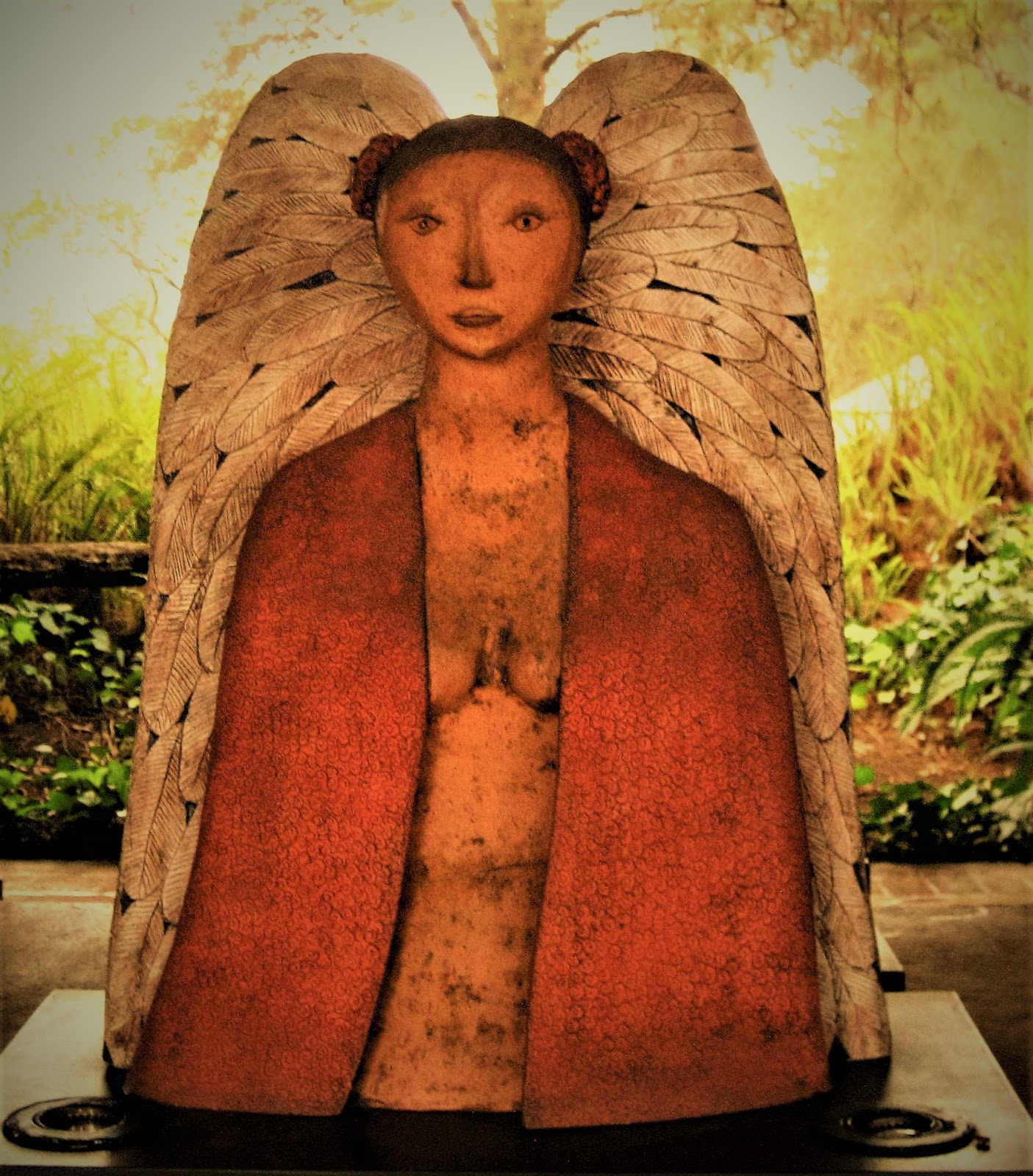
Angel of Santo Domingo del Cerro. Antigua, Guatemala. April 2016.
Santo Domingo del Cerro, atop a mountain near Antigua, includes a sculptural garden, a restaurant, a coffee bar, and an event venue for weddings and the like. Oh, and a zipline concession.
Angel of Santo Domingo del Cerro. Antigua, Guatemala. April 2016.
I'll write more in another post, but for now, it's all about the angel. Although I can say now that I did have lunch at the restaurant and it was OK. Ditto for the coffee that I got at the coffee bar after lunch. Alas, the sky was hazy, but I'm sure on clear days, the view from the restaurant terrace is marvelous.
Angel of Santo Domingo del Cerro. Antigua, Guatemala. April 2016.
I was really taken with her, as you can see.
Angel of Santo Domingo del Cerro. Antigua, Guatemala. April 2016.
Some day, I'll get in the proper habit of looking at the artist's name so I can give credit. My research thus far has not unearthed this information.
I learned something in Antigua that was gobsmacking.
Antigua, Guatemala. April 2016.
Men's habit of peeing on the exterior building walls in Antigua is damaging the buildings. Antigua is a UNESCO World Heritage Center, so this is serious business.
Peeing on the limestone walls of the 250-year-old Alamo in Texas is a serious crime because of the damage it does to the historic structure.
In Berlin, the city created a force of "urine police" to protect historic buildings. "Human urine is so abrasive and corrosive that, over time, it acts like a sandblaster," said a scientist.
It's also a problem in Chester, England, which sits atop Roman ruins.
There is apparently a Facebook page that has photos of men caught in the act of peeing on walls in Antigua. It's a shaming page. I haven't been able to track it down.
Mermaid fountain, Central Park, Antigua, Guatemala. April 2016.
There is a fountain in Antigua's Central Park in which there are stone women who hold their breasts aloft so that the fountain's water can soar forth through their nipples.
Mermaid fountain, Central Park, Antigua, Guatemala. April 2016.
When I look at this statue's facial expression, I imagine her thoughts: "There is no dignity here. And I have a bird on my head."
Mermaid fountain, Central Park, Antigua, Guatemala. April 2016.
Cerro San Cristobal, Antigua, Guatemala. April 2016.
My airbnb hostess told me about two mountaintop destinations. I was a little confused about which was which and how to get to them and what I'd see at each; it was all kind of a jumble of information. If I'd done any kind of research at all, I'd have got it figured out, but I didn't. Instead, I chose the stumbling-through-almost-cluelessly touristic plan. I don't particularly recommend this strategy, but it worked out reasonably well.
Cerro San Cristobal, Antigua, Guatemala. April 2016.
One of the two mountaintops I visited was Cerro San Cristobal. It's the site of an organic farmlet and a restaurant.
Cerro San Cristobal, Antigua, Guatemala. April 2016.
When it's not hazy out, the view must be magnificent.
Cerro San Cristobal, Antigua, Guatemala. April 2016.
I enjoyed my tequila and lime.
Cerro San Cristobal, Antigua, Guatemala. April 2016.
And I enjoyed walking about some paths in amongst the organic goods.
Cerro San Cristobal, Antigua, Guatemala. April 2016.
You get to Cerro San Cristobal by going to Antigua's fair-trade artisanal market called Nim P'ot. From there, you'll be escorted around the corner to a waiting shuttle van, which will take you up the mountain.
Cerro San Cristobal, Antigua, Guatemala. April 2016.
The meal offering was over my budget, so I didn't partake.
The good thing about the shuttle is that it's almost free, it gets you to your destination without any muss or fuss. The not-so-good thing is that you've got to wait til there's a down-going shuttle before you can return.
In my case, I had wrung every util of pleasure out of Cerro San Cristobal I wanted, and found myself cooling my heels for quite awhile waiting for the shuttle to return to Antigua. In all fairness to Cerro San Cristobal, they are a relatively new operation, so they are still in the process of developing the experience.
An alternative is to hitchhike back to town with an independent visitor to the restaurant, something I'd probably do if I were to return.
Cerro San Cristobal, Antigua, Guatemala. April 2016.
Blue tortillas, San Felipe de Jesus, near Antigua, Guatemala. April 2016.
The sight of girls and women making and selling tortillas all day, every day, in Antigua, is ubiquitous.
My airbnb hostess explained that some - many? - of the girls are lured from the countryside to the cities, such as Antigua, with promises of a better life than can be had in their impoverished rural villages. Often, the girls' parents willingly send their daughters off with the tortilla head hunters, so to speak, believing the promises.
Too often, the girls end up working for miserable earnings, living in miserable, crowded quarters, making and selling tortillas. All day, every day.
The making of tortillas all day, every day results in:
The girls' and womens' skin permanently damaged from chronic exposure to the lime in the masa, the corn dough that is the basis for the tortilla.
Tendon injuries due to the repetitive hand and wrist movement involved in shaping and flattening the tortilla.
It looks picturesque, it looks quaint, it looks "cultural."
Is that girl on that corner, selling tortillas, a girl trapped in servitude? Or is she an entrepreneur, or the daughter of an entrepreneur, with a promising future?
I barely glance at her when I walk by; she barely glances at me while she sits by her cloth-covered basket of tortillas. She's an extra in my movie as I am in hers.