El Sido's hurricane fundraiser, Lafayette, Louisiana. September 2017.
September 2017
The famous (might we even say "historic"?) El Sido's hosted a hurricane fundraiser on the Sunday following my return to South Louisiana.
El Sido's hurricane fundraiser, Lafayette, Louisiana. September 2017. C.J. Chenier and Louisiana Red Hot Band.
By the time I left the event, it was as if a reservoir inside me, almost dry from the long absence of live zydeco, had been refilled to almost-overflowing.
El Sido's hurricane fundraiser, Lafayette, Louisiana. September 2017. Horace Trahan and the Ossun Express.
As is too often the case in South Louisiana, we few in the audience received far more than we deserved from the musicians, who - every one of them - delivered performances as if there had been a crowd.
El Sido's hurricane fundraiser, Lafayette, Louisiana. September 2017. C.J. Chenier and Louisiana Red Hot Band.
Roddie Romero and the Hub City All Stars, Lafayette, Louisiana. September 2017.
September 2017
A suburban lawn concert fronted by Roddie Romero and the Hub City All Stars opened the door into my September 2017 South Louisiana visit.
Roddie Romero and the Hub City All Stars, Lafayette, Louisiana. September 2017.
A high-energy, skilled band. Roddie's band played the classics and some contemporary pieces. Below is the traditional Joe Pitre a Deux Femmes (Joe Pitre Has Two Wives). The older couple, with the woman wearing the red blouse, is always a pleasure to watch; I've seen the two dance at other venues.
Sadly, I didn't dance.
Roddie Romero and the Hub City All Stars, Lafayette, Louisiana. September 2017.
This last in a summertime concert series took place at the new development called Couret Farms. A pretty enough suburban neighborhood, but the glorification of a plantation nostalgia in the developers' ad copy does not sit well with me. I wouldn't attend another event here unless the advertising approach changed.
Roddie Romero and the Hub City All Stars, Lafayette, Louisiana. September 2017.
Image: “Plaque from a Casket with a Dancing Woman” by Coptic via The Metropolitan Museum of Art is licensed under CC0 1.0
A phone was stolen from a child by a child. A couple of videos created by the young thief. Unbeknownst to this child-director-actor, they were automatically uploaded. Seen by the owner of the phone, someone I know. Reported, same day as the discovery, to four child-protection or law enforcement agencies in two states. Persevered over several days to push an investigation. Not about the theft - who cared about that? - no, about the obviousness of child abuse, both current and, inferentially, the recent past.
The videos: Graphic, disturbing, alarming, no ambiguity at what occurred.
Responses by the agencies: Indecisive, vague, incomplete. Dismissive, even.
I think about this young girl, age unclear. Ten? Twelve? Fourteen? She is a girl of color. There is zero doubt that she has been exposed to things that no child should be exposed to, and the same holds true for at least one young child in her circle. When I say zero doubt, I mean that. The videos make that clear.
The sheriff's office referred the caller to the city police although the video was filmed in the parish. The city police tried to refer the caller to the sheriff. The child protection agency in Louisiana determined insufficient cause - without even looking at the videos - for investigation. The child protection agency in the reporter's state referred the reporter to Louisiana. The city police assented to look into things, but there was a delay until the appropriate detective could talk to the caller about it. There was a further delay while the city detective decided how to accept or view the videos.
It all ended up so ambiguously. The child would get counseling, apparently. Or maybe the family. Or both. For what, one wonders. Unknown.
Everybody seemed to have missed the point.
This girl, albeit the actor on a superficial level, was clearly in an environment of abuse, present or past.
One person, among the numerous consulted during the reporting chronology, made a throw-away comment about the sexual precociousness of girls these days. Like them being the aggressor with the boys, etc. This, despite the fact that I had described graphically what was on the video. That this girl is a child.
Here are some perspectives about the vulnerability of young girls of color:
"This same officer body slammed Ms Corley, stuck her head underneath
the vehicle and completely pulled her pants off, leaving her naked and
exposed in that Texaco parking lot," he added, saying that her treatment
amounted to "rape by cop".
"They then took Ms Corley and placed
both ankles behind her ears spread eagle position and started to search
for something in Ms Corley's cavity in her vaginal area."
This young girl in South Louisiana, whose life intersected with mine, briefly. What is she doing today?
2014 Church Point Mardi Gras Parade. Church Point, Louisiana.
In my first year in South Louisiana, once I cut my Mardi Gras teeth on the equivalent of a "bunny slope" at a ski resort - the Carencro Mardi Gras Parade - it was time to have a go at a big-time spectacle.
2014 Church Point Mardi Gras Parade. Church Point, Louisiana.
2014 Church Point Mardi Gras Parade. Church Point, Louisiana.
The parade starts around 1:00 p.m. I'm no novice to parades, and I like to find decent parking, scope out my parade-watching spot, put a claim on it, and then go wander. I arrived at Church Point, I don't know, about 9:30 or 10:00 a.m.
Hohohoho, what a neophyte I was! At first, after I'd parked my car (wasn't too terrible finding a place), and walked over to the main drag, I thought maybe I had my times wrong. I saw one older woman sitting in a chair right next to the main street. Just sitting. I asked her when the parade was going to start, and she said, "Oh, about 1:00." I asked how long she'd been there. "About 9:00," she replied. Holy moly.
I walked down the street, away from the commercial area and toward a more residential area. I saw a line of decorated Mardi Gras trailers, with people walking between and around them. Maybe some of them, to describe it more accurately, were weaving a bit between and around the trailers. They all seemed very happy.
Some people had parked flatbed trailers along the parade route and populated these with chairs.
2014 Church Point Mardi Gras Parade. Church Point, Louisiana.
2014 Church Point Mardi Gras Parade. Church Point, Louisiana.
More than one had a personal porta-potty.
I found a decent spot, and as time passed, pleasant neighbors joined me. I would discover later that one of my woman neighbors was gifted in the ways of cajoling jello shots from the parade participants.
Before the parade began, a headache invaded my good vibes. At first, I fretted about this because I rarely get headaches. But then I remembered.
2014 Church Point Mardi Gras Parade. Church Point, Louisiana.
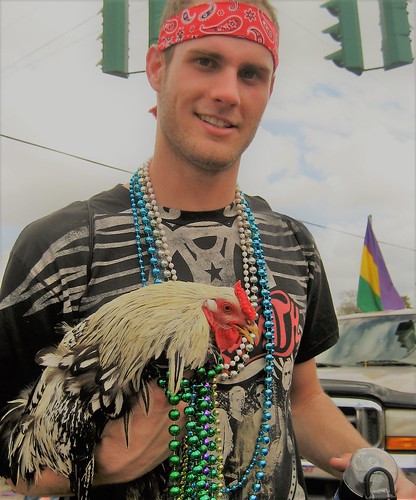
The parade start time is "around 1:00 p.m. because it depends on the return of the courir de mardi gras riders from their traditional countryside search for chickens. (I posted this introduction to the courir de mardi gras a few years ago. Unfortunately, Pat Mire's excellent Dance for a Chicken, which is a documentary about the origins and traditions of the courir de mardi gras is no longer available for public viewing).
2014 Church Point Mardi Gras Parade. Church Point, Louisiana.
Drinking mass quantities of alcohol on horseback is part of the tradition.
2014 Church Point Mardi Gras Parade. Church Point, Louisiana.
The Church Point Mardi Gras Parade is long, long, sha. But so entertaining.
2014 Church Point Mardi Gras Parade. Church Point, Louisiana.
A slide show of the parade below:
2014 Church Point Mardi Gras Parade. Church Point, Louisiana.
Mr. Charlie, Rig Museum, Morgan City, Louisiana. March 2014.
This is Part 2 of Louisiana: Morgan City: Rig Museum. Part 1 is here.
The Rig Museum in Morgan City is a good "museum" and tour. Know that the rig called "Mr. Charlie" is not (to my knowledge) accessible to folks in a wheelchair or people with other mobility issues. It'd probably be outside of the "readily achievable" standard required to make it accessible unless the owners were to do some remodeling for other reasons. Also, it's not child-proof; it's a working training facility. Littl'uns could get into all kinds of trouble here. It's the nature of the place.
Mr. Charlie, Rig Museum, Morgan City, Louisiana. March 2014.
The tour guide was congenial and endlessly patient in answering questions.
We walked through living quarters, the lounge, and the kitchen. The rig's chef had just made cookies! We tourists could have at them, fresh from the oven.
Mr. Charlie, Rig Museum, Morgan City, Louisiana. March 2014.
We poked our heads into the sleeping quarters.
Mr. Charlie, Rig Museum, Morgan City, Louisiana. March 2014.
Mr. Charlie, Rig Museum, Morgan City, Louisiana. March 2014.
While in the lounge, the tour guide told this joke:
Guys working on an oil rig spend weeks at a time together.
A new guy joined an oil rig crew; it was his first gig.
Every night, all the guys would hang out in the lounge and talk and laugh.
The new guy noticed that one man would call out a number, like - "349!" - and all the others would laugh like crazy. They'd spend hours doing this. One man would yell out a number and all the others would roar with laughter.
Finally, the new guy asked: "What's happening here? What's so funny about a number?"
An old-timer explained: "Son, we've worked together for so long, we know all the jokes that are possible to tell. Finally, we started numbering them to save time."
The new guy nodded, understanding, and asked, "Say, can I try one?"
The old-timer said, "Sure!"
The new guy said: "274!"
Silence.
The new guy asked: "What happened? Why didn't anyone laugh?"
The old-timer replied: "Some people just don't know how to tell a joke."
Mr. Charlie, Rig Museum, Morgan City, Louisiana. March 2014.
Mr. Charlie, Rig Museum, Morgan City, Louisiana. March 2014.
Highway 190, west Opelousas, Louisiana. October 2015.
On a sunny day in October 2015, I explored a bit the part of Highway 190 that's on the west side of Opelousas.
Club 190 West, Opelousas, Louisiana. October 2015.
The structures there told a story of a time back in the 1950s, for the most part, when there was a line of happening little nightclubs, like Club 190 West and the Southern Club, and other small businesses.
The Southern Club, Opelousas, Louisiana. October 2015.
The Oaks Motel and Lounge, an Opelousas landmark for decades, is going away.
" ... It was an icon,” ....“Man!
I can still taste that red draft in those frozen mugs. ...."
Colver Lafleur built the club and adjoining apartments. They opened at 218 S. Liberty St. in Opelousas on Sept. 13, 1957.
If you were a young person looking for a good time, it was the place to be. The Oaks was famous for its red draft beer. “It
was about two fingers of tomato juice then topped off with draft beer
and served in an ice cold mug straight out of the freezer,” remembers
Lainey Prejean Smith, Lafleur’s granddaughter. “We also had cherry Coke
with real cherries for those not old enough to drink.”
[When The Oaks opened in 1957], [r]ock ‘n’ roll was in its infancy, and the joint had a jukebox that played all the hits of the day. “I danced many nights away in front of that jukebox, cher,” Smith said. And
by nights, she meant all night. “Until the blue laws were passed in the
1970s, the Oaks was open 24 hours a day. You would start the evening
with a draft beer and end the morning with the big, hot cup of coffee
and a hot sausage,” Smith said.
Sports writer Bobby Ardoin
remembers the place always had a card game going on in the back room.
“There was always a big black pot of stew or gumbo cooking. You would
grab a bowl and just sit down and play,” Ardoin said. “Many a bourré game was played there,” posted Cindi York Cooper.
Randy Herpin remembers those all-night card games well. "Dr.
(S.J.) Rozas was a regular. He was one of those doctors who still made
house calls and would take chickens as payment,” he recalled. The
club and its iconic neon sign reached an audience beyond Opelousas when
they surfaced in the music video of Sammy Kershaw’s 1994 chart topper
“Third-Rate Romance.”
Vine and Liberty, Opelousas, Louisiana. October 2015.
Someone received a public warning.
Off Highway 190, Opelousas, Louisiana. October 2015.
I went again in 2015. Today's post is all about the Holy Ghost Creole Festival Parade.
Holy Ghost Creole Festival Parade, Opelousas High School Marching Band, Opelousas, Louisiana. November 2015.
I just smile thinking about this day, looking at these photos. A beautiful, proud-ful day of gladness to be alive. How can you not be happy when there are marching bands?
And soft smiles?
Holy Ghost Creole Festival Parade, Opelousas, Louisiana. November 2015.
Here's a slide show with kickin' music from the United States Army Fife and Drum Corps:
Ah, Louisiana, how endearing it is to run across these photos of buggies - grocery carts - shopping carts - lolling about your parking lots so wantonly.
From the New York Times: BAYOU CORNE, La. — It was nearly 16 months ago that Dennis P. Landry and
his wife, Pat, on a leisurely cruise in their Starcraft pontoon boat,
first noticed a froth of bubbles issuing from the depths of Bayou Corne,
an idyllic, cypress-draped stream that meanders through swampy southern
Louisiana. They figured it was a leaky gas pipeline. So did everyone
else....
Just over two months later, in the predawn blackness of Aug. 3, 2012,
the earth opened up — a voracious maw 325 feet across and hundreds of
feet deep, swallowing 100-foot trees, guzzling water from adjacent
swamps and belching methane from a thousand feet or more beneath the
surface.
Oil-industry-related actors caused the collapse of the natural infrastructure.
Well, oil-industry-related actors were the immediate causal agents.
Indirect actors were (are) local, regional, state, and national officials with mixed interests; men and women whose livelihoods currently depend (directly and indirectly) on the oil industry; and all of the rest of us - including me - who, for so many reasons, don't ask questions.
What caused the sinkhole is important.
And what's just as important, in my opinion, is how we interpret such events and their consequences, and that's what this post is about.
First, the anti-climax
I didn't see much of the sinkhole. But I did have other adventures on my journey here, here, here, and here. Not to mention the giant dead snake in the road outside of Pierre Part.
Dead snake outside Pierre Part, Louisiana. July 2014.
I was reminded of some life lessons
Lesson #1: Getting truly informed on an issue takes a lot of time and effort. When I was a college student during the Reagan Era, I had a project in which I needed to study the US military relationships in Central America, specifically Honduras. It was a revelation how difficult it was to get a full picture (if I even ever did) of what was going on there at the time.** I discovered that it takes a concerted effort, looking at multiple information sources, to learn about just one issue. Not many of us have the time to do this. No wonder we tend to rely on one-note news sources and take black-white positions on certain issues.
Bayou Corne, Louisiana. July 2014.
Lesson #2: We humans have messy motivations. In the abstract, we want a clean environment or human/civil rights or peace ... but when it comes to our own wallets and back yards, then the abstract ideals become more difficult to sustain. Heck, even within altruistic communities, there are competing interests. My past work with trails showed me that hikers, cyclists, equestrians, and OTR vehicle riders all love trails and the Great Outdoors - but they don't necessarily agree on how to build, maintain, share, and use trails.
Bayou Corne, Louisiana. July 2014.
Sinkhole. Bayou Corne, Louisiana. July 2014.
Sinkhole. Bayou Corne, Louisiana. July 2014.
Two people look through the same window, and see different things
To wit, below is a loving, lovely visual story of Bayou Corne, filmed in 2014, two years after the sinkhole opened in 2012:
The same woman, "rainbeaudais," published this video a year earlier, in May 2013, titled Sad, Ironic Contrasts Seen at Bayou Corne Today:
When I moved to South Louisiana and readied myself for a visit to Bayou Corne, my internet research revealed that "Rainbeaudais" spoke with a strong voice in the telling of the Bayou Corne story.
When I entered the tiny village that is Bayou Corne, I saw a newish-looking subdivision of houses that lined the bayou. I wondered if this gathering of houses was where Rainbeaudais might live, so I turned in to check it out. Incredibly, I saw a house that looked just like hers, and I parked my car, got out, mustered together some chutzpah, and knocked on her door.
She kindly allowed me to go out on her back deck with her and answered a few questions.
The serene beauty of the bayou was just as she depicted it in her videos. Off her deck, or maybe her neighbor's, I saw this basket of fish - and a snake! - freshly pulled from the water.
Bayou Corne, Louisiana. July 2014.
Bayou Corne, Louisiana. July 2014.
It's hard to look at such a bucolic scene, such as off of Rainbeaudais' deck, seemingly flush with animal and plant life, and reconcile that with unseen toxins or structural instability below our feet.
Back in mid-2014, when I visited Bayou Corne, Rainbeaudais was confident enough in the safety of her village that she took a huge financial risk. Before the Big Suck, Rainbeaudais owned a lot next to her current home. When her neighbor fled the town, Rainbeaudais bought her neighbor's house with the full understanding that she waived any future right to claim damages if Bayou Corne should sink, explode, or succumb to lethal gases. ... At that time, villagers were still under an evacuation order.
When making such colossal decisions like this, what data do we use?
Way back in the day, when I worked with a couple of agencies that touched on the lives of young single mothers, I read some research on how said women chose a childcare provider. Above all else - with costs and location being equal - it was the vibe, the impressions, the emotive gut instinct that drove the mothers' decisions. Did the potential caregiver seem kindly? Did she look nurturing? Did she feel safe?
Then there's the day I touristed to the Trinity Site - ground zero of an atomic bomb - and saw how normal everything appeared. Hundreds of folks troop to this site twice-yearly. I still have the question I had then:
"... [I experienced] some cognitive dissonance in the low levels of radiation
that exist there today (apparently) versus what we've had pounded into
our psyches about how many eons it takes for radiation from an atomic
bomb to go to 'safe' levels. Does this mean I take away a sense that
atomic weapons are "not that bad"? No. The take-away is my inability to
reconcile two alleged realities."
A few months after BP's Deep Horizon spill, I met a friend for lunch. She averred that all of the hoopla about the spill damage was over-wrought and it had unfairly harmed the Gulf Coast's tourism industry and put oil-rig workers out of work.
In the case of the Bayou Corne Sinkhole, gosh, how does a resident make an informed decision about whether or not to stay or go (or, if complying with the early-on mandatory evacuation, to return)? To hold on to one's property or participate in a buy-out?
Being how it's Louisiana - with its willingness to sacrifice fellow Louisianans who are low-income, low-influence, and low-visibility - and which is the butt of jokes about the pervasiveness of its government corruption - would I believe what officials tell me about the risk of danger to myself and my family? Were they over-playing the risk? Or under-playing it?
Once the immediate shock of the Bayou Corne's suck was over, could I believe what my eyes told me about the apparent return to my heretofore idyllic paradise, with the fish still biting, the birds still swooping gracefully, the water still rippling peacefully, the sky still blue, the trees still shading and sheltering?
I couldn't see what was - and wasn't - below my feet. Couldn't feel what was - or wasn't - there. Who could I trust to tell me the truth?
A massive sinkhole that went viral in 2013 swallowing trees in
Assumption Parish and forcing more than 300 residents from their homes
has quieted down as officials slowly allow residents to come home. ... Previous tests have indicated that there are no further voids that would
cause another hole in the area. Other scientific modeling has suggested
the hole will not reach the nearby highway or the Bayou Corne waterway. .... it's that stability that has led the parish government to slowly drop mandatory evacuation orders to voluntary evacuations.
An October 2016 update, as reported in the Baton Rouge Advocate, offers heartier reassurances:
More than four years since the Bayou Corne sinkhole appeared, Assumption
Parish officials declared on Friday that the once growing, burping,
oily swampland hole that made worldwide headlines had settled down
enough to no longer pose a risk to the public.
Below is the trailer of a movie about the Bayou Corne Sinkhole - and the community - released in 2016, titled The Forgotten Bayou: