Showing posts with label segundo barrio. Show all posts

Sunday, April 30, 2017

El Paso: Bowie Bakery: Sweet Insanity


Bowie Bakery, El Paso, Texas. March 2017.


Don't you just want to stick out your tongue and lick the photo?


Bowie Bakery, El Paso, Texas. March 2017.

Bowie Bakery is an El Paso icon.

It's in Segundo Barrio.


Bowie Bakery, El Paso, Texas. March 2017.


I bought a biscuit. Its massive size and handsome, golden-brown flakiness hooked me. Alas, it was a little dry, but even now, thinking back, I'm willing to forgive the lack of moisture in memory of its hunky good looks.


Sunday, February 26, 2017

El Paso: Segundo Barrio: The Turtle and the Treasure


Felhaber turtle, Segundo Barrio, El Paso, Texas. October 2016.


October 2016

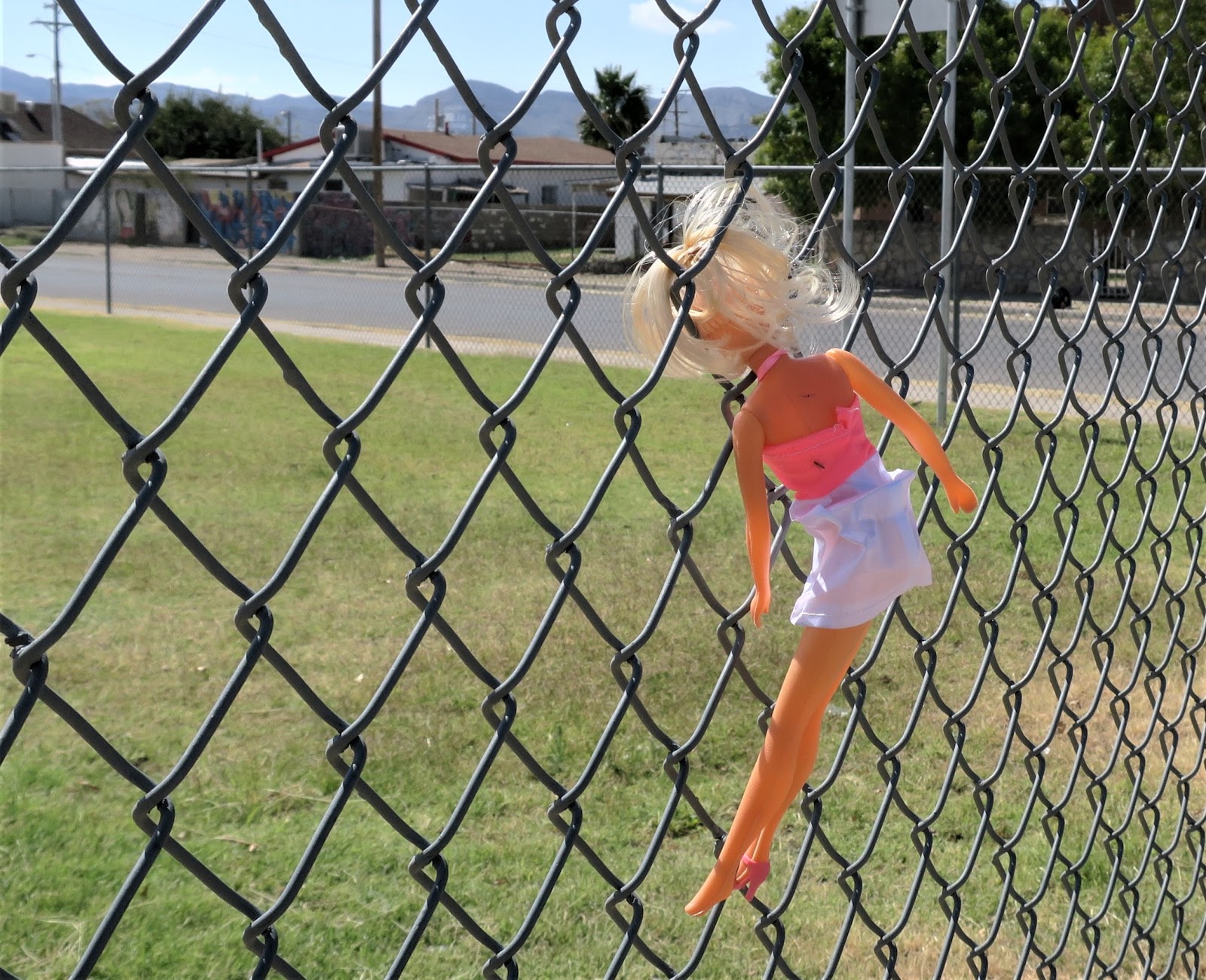
Well, I am laughing as I write this. Because you just never know what incredible story lives behind a picture, a discarded item on the street, a tiny altar, a ribbon tied onto the desiccated branch of a dead tree, a half-clothed Barbie doll stuck through a chain link fence. 

So it was with the militant turtle-dinosaur(ish) on the wall above.

I snapped the turtle (heheheh) because I had a language student affiliated with a company that has a turtle logo. I planned to show him the image and we'd consider the messages it conveyed.

But I also looked up the business that shared the wall.

Holy tortoise shells!

The headlines burst at me:

The story opens like an action movie that glues you to your seat for the next two hours: The businessman arrived at the Treasury Department carrying a suitcase stuffed with about $5.2 million. The bills were decomposing, nearly unrecognizable, and he asked to swap them for a cashier's check. (Associated Press)


You can watch the real-life trailer here, in this AP video:


And people ask me why I moved to El Paso.

Saturday, February 25, 2017

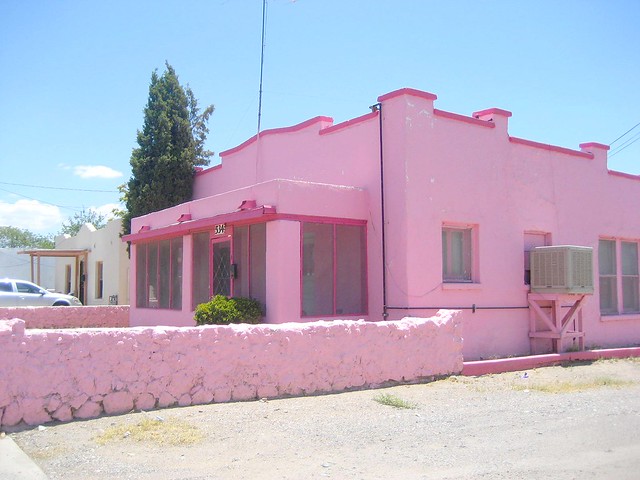
El Paso: Segundo Barrio: The Pink House

Pink house, Segundo Barrio, El Paso, Texas. October 2016.


I covet this pink house. 

Pink house, Segundo Barrio, El Paso, Texas. October 2016.


I love the cheeky attitude of it within sight of El Paso's downtown seriousness.

Pink house, Segundo Barrio, El Paso, Texas. October 2016.


I smile every time I pass it, and think how nice it would be to live right there, in all its pink glow.

Sharing this pretty with you gives me a chance to revisit my Pink House Collection from New Mexico, in the slide show below:

Pink Houses, New Mexico


Friday, February 24, 2017

El Paso: Segundo Barrio: The Community


Segundo Barrio, El Paso, Texas.


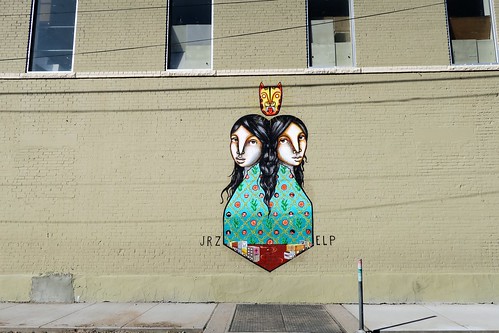
El Paso's Segundo Barrio (Second Ward) isn't just about artistic murals, such as here and here.

There is a living community here, a historic one. Earlier, I posted about a walk through Segundo Barrio, an encounter with a sensory garden.

The PBS station in Austin, KLRU, has a series called One Square Mile, in which it zeroes in on one square mile of a community, and tell stories about it. One episode is about El Paso's Segundo Barrio.


You can watch it in its entirety here. It's only half an hour long.

Sacred Heart is one of Segundo Barrio's cultural anchors. I attended Mass here one Sunday.

Sacred Heart Church, Segundo Barrio, El Paso, Texas.


 Below is a slide show of Segundo Barrio, which includes my Sacred Heart photos:

Segundo Barrio, El Paso


"My mom and my dad we always had in the glove compartment a salt shaker." So reminisced (in the documentary) a Border Patrol officer born in Juarez, but who grew up in Segundo Barrio. (His family and I - we are from the same tribe.)

He alludes to Segundo Barrio as "a way to connect, it's an opportunity, an opening, a gateway, to both countries."

From a 2013 article in Texas Monthly, The Other Ellis Island:
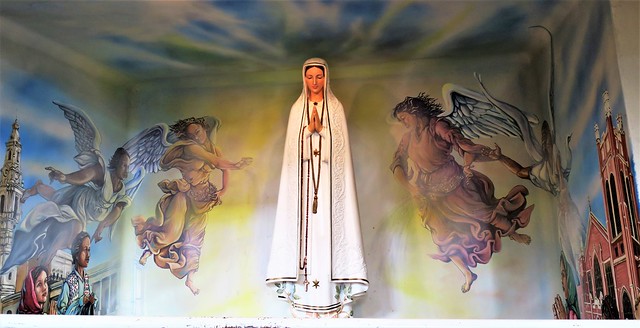
Segundo Barrio, with its turn-of-the-century tenement buildings and dozens of brightly colored murals, is one of the most historic neighborhoods in the country. As the first community that immigrants encounter after crossing the Rio Grande from Juárez, it is known as the Ellis Island of the border, and over the years it has played a role in the Mexican Revolution, the zoot-suit pachuco counterculture, and the Chicano civil rights movement. A mural celebrating this history ... depicts well-known residents of the barrio past and present and, instead of the Statue of Liberty, shows the Virgin Mary welcoming newcomers from across the river with a flashlight and a towel.

Virgin Mary welcoming immigrants, Segundo Barrio, El Paso, Texas.


A young teacher in a Segundo Barrio school: "We have students who have never been to the inside of El Paso, who have never gone to the west side, and so sometimes that's part of my job when we take [my robotics students] to competitions, to [show them] there's more than downtown El Paso. Go and see what's out there and see how their lives are different than ours."

There are, as one Segundo Barrio resident explains in the documentary, families who've lived in Segundo Barrio for three and four generations.


A muralist in the documentary explains the cultural importance of the murals - they preserve the memories of the neighborhood's cultural experience. They remind the neighborhood residents of their shared history. A sort of family album where the pictures are on walls instead of inside a bound book. He further suggests that "We, in a way, created El Paso" by dint of the Segundo Barrio's residents who went into the larger reaches of the city to clean the houses of those more wealthy, those who went out to work in the fields that produced the food for El Paso, and those who went out to work in homes to repair and maintain and build structures.


El Paso's rebirthing of a trolley system will go through Segundo Barrio. The tracks have been laid. Streets previously in casual disrepair are now new and white. How will this affect the community, I wonder. Build it, deepen its richness of community? Or begin a process of gentrification, in which the neighborhood suddenly catches the eyes of speculators who hearken back to conquistadores of old in search for those streets paved of gold? Or somewhere in between, a place that honors the families and neighbors who've been in Segundo Barrio all along and which invests wealth and opportunities?


Tuesday, February 7, 2017

El Paso: Segundo Barrio: The Murals


Segundo Barrio murals, El Paso, Texas.


The mural above is across the street from the Sacred Family Catholic Church, one of the cultural anchors of Segundo Barrio in El Paso.

The juxtaposition of the intentional art plus the prosaic scene of freshly-laundered jeans draped over a banister plus the loudness of that #619 - it pleases me.

Segundo Barrio murals, El Paso, Texas.


The murals of Segundo Barrio are a draw for internal and external tourists to El Paso. There is a brochure you can get with a neighborhood map and numbered locations on the map, which match mural titles and descriptions.

Segundo Barrio murals, El Paso, Texas.


I can't help but compare the influence of the murals in humble Segundo Barrio with the immense Equestrian (fka The Last Conquistador, Don Juan de Oñate) by the El Paso Airport. NOT from a perspective of holier-than-thou, reverse-elitist, "real people" versus the affluent.

Segundo Barrio murals, El Paso, Texas.


No, I wonder about the comparison between the two in real, number-crunching terms. How many people actively seek out the Segundo Barrio murals; how many seek out the statue? How many tourist photos are there of the murals (as a group) versus how many of the statue?

Segundo Barrio murals, El Paso, Texas.


If I move to a comparison of intangibles - what messages do visitors glean from the statue? The murals? Emotions? Lingering effects, if any? Which of the two say "El Paso" more loudly to the internal or external visitors?

Segundo Barrio murals, El Paso, Texas.


Segundo Barrio murals, El Paso, Texas.


For some visual reference, below is a map that shows some of El Paso's neighborhoods, which I saw at the El Paso History Museum:

El Paso neighborhoods. El Paso History Museum.


And a slide show of Segundo Barrio murals below:

Segundo Barrio murals, El Paso


Related posts:

Saturday, February 4, 2017

El Paso: Segundo Barrio: A Graffiti Gathering

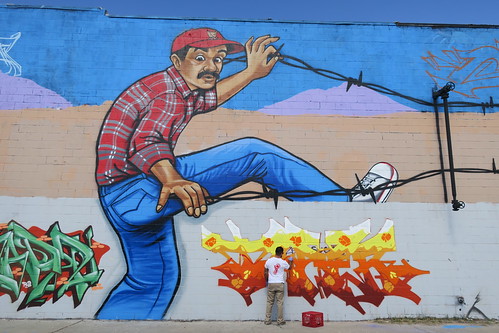
Borderland Jam, graffiti weekend, El Paso, Texas. October 2016.


October 2016.

The day came for me to do the self-guided mural tour of Segundo Barrio. A sunny Sunday in October. 'Course, most days in El Paso are sunny.

Borderland Jam, graffiti weekend, El Paso, Texas. October 2016.


Anyhoo, I'll publish the results of that visit soon, but first I want to share about the graffiti gathering that a Segundo Barrio resident turned me on to while I was walking around. He said if I really wanted to see some art on the walls, to check out the sumthin'-sumthin' happening right now up thataway and then take a left and then up-aways.

Borderland Jam, graffiti weekend, El Paso, Texas. October 2016.


I'd kind of had my mind on lunch, but I didn't want to miss the sumthin'-sumthin' about which I wasn't entirely clear, but sounded interesting and time-limited. So I scurried my directionally-impaired self over to the general direction of where the neighborhood gentleman sent me.

Hoo boy.

Borderland Jam, graffiti weekend, El Paso, Texas. October 2016.


What is graffiti, anyway? 

The Urban Dictionary offers a selection of thoughtful definitions of graffiti, all of which have in common the statement of graffiti as an art form.

Here's one sample:
Graffiti is a commonly misunderstood form of illegal art. Graffiti is done on walls, buses, trains, and other forms of private and public property, often without permission (thus the 'illegal' part). Ink, paint, scratches, and other ways can be used to do graffiti; spray paint cans with special tips being the favored way, since they are easily carried and do not require brushes and other equipment. Note that not all things sprayed/written on a wall are graffiti! Gang markings, crude bathroom writings, and other less artistic forms of wall-markings are NOT graffiti.
Graffiti (also called Graf) is a form of self expression, and while it is illegal, is NOT vandalism.

Borderland Jam, graffiti weekend, El Paso, Texas. October 2016.


Graffiti gatherings

Back in 2009, El Paso was one of the hosts of a nation-wide graffiti gathering tour - the Pieced Together tour, on which Texas graffiti "all stars" worked their art on 15 unused silos on West Paisano. Two El Paso graffiti artists, David "Grave" Herrera and Nathan "Sloke" Nordstrom, are two of the all stars.

Borderland Jam, graffiti weekend, El Paso, Texas. October 2016.


The graffiti weekend event I stumbled into was the Borderland Jam. Another notice about it here. And a fellow blogger was there at the first Borderland Jam in 2015.

Borderland Jam, graffiti weekend, El Paso, Texas. October 2016.


In this interview, "Grave" talks about the art of graffiti in El Paso. An excerpt:
El Paso's climate is heated by the passion behind the people. You get a real sense of modest, humbleness here. The work is packed with a heavy dose of aesthetics only known to our area. It's an El Paso /Juarez thing. You can feel it. No words are necessary. During an 8 year tour as a 48 state driver and artist you learn to appreciate your home town for all the distinctive qualities that make it special. ...

Borderland Jam, graffiti weekend, El Paso, Texas. October 2016.


This article, about a graffiti gathering in Connecticut, notes the communion of the visual art, music, and tattoo work. Graffiti is an art that one can watch as the artist creates it, as explained by an aficionado:
For local writer and bookseller Ken Anderson, who came out to see the artists and watch their process, graffiti art is about not just the art as a record, but about the activity of creating it as well.
Furthermore:

"What I like about it is that it's so dynamic. It keeps changing," he said. "T. S. Eliot said, 'Fine art is the refinement, not the antithesis, of popular art. Some of the things we are seeing here today are approaching fine art."

Borderland Jam, graffiti weekend, El Paso, Texas. October 2016.


 A slide show of El Paso's 2016 Borderland Jam:

Borderland Jam-Graffiti, El Paso


Thursday, January 5, 2017

El Paso: Segundo Barrio: A Sensory Art Garden


Art garden, Segundo Barrio, El Paso, Texas. October 2016.


October 2016

I did a self-guided walking tour of murals in Segundo Barrio one Sunday. I came upon an older man taking in the sun, sitting in a plastic molded chair in his yard. Right next to him was this art garden. I asked him if I could photograph it and he said yes.


Art garden, Segundo Barrio, El Paso, Texas. October 2016.

October 2016


I love outsider art, especially outside outsider art. There's a line where, on one side, such a garden is just right, and on the other, it explodes into a cacophony of visual noise. The artist of this garden is getting it so right. There are the Christian references, the Native references, utilitarian inspirations by way of pulleys and chains, for example, and a paeon or two to beer. There is movement and there is natural sound. Some colors pop like blooms from statuettes, a set of chimes, a colorful plastic bird.


Art garden, Segundo Barrio, El Paso, Texas. October 2016.


The garden reminded me of one of my favorite outside outsider art spaces, the old Holy Trinity Park in Taos, which housed (and maybe still does) this poignant sign:

Holy Trinity Park, Taos, New Mexico.


It reminds me of the art space by the Mayor of Golden, New Mexico.


Art garden, Segundo Barrio, El Paso, Texas. October 2016.


The shade is blessed in such a hot, sere place such as El Paso. The color, the breeze, the multiple layers of sound call you to pause, look. Consider the arrangement of the pieces. Imagine sitting in one of the chairs in an evening or an early morning.


Art garden, Segundo Barrio, El Paso, Texas. October 2016.

I like the sounds of the video of this garden - the breeze, the traffic, the wind chimes, the birds.


The pulleys and leaves sway, and with them, the shadows.