Friday, February 16, 2024

Jefferson City, Missouri: At Least I'm Not Camping

Although my apartment offers charm in views, design, and location, it is as breezy inside as a log cabin that has lost its chinking. 

For some reason, this state of affairs reminds me of the so-called bozi flower in Caucasus Georgia, aka prostitute flower. My apartment windows are as loose as a bozi's legs. 

And the walls are cold. Because there ain't no insulation in this 100-year old building. 

Sometimes I'll feel an actual push of cold air that flows by me, but when I get up to investigate where the hell it's coming from, it's untraceable. A frosty spirit? 

During a recent two-week arctic blast, when temperatures sank into the single digits, my first thought upon awakening each morning was: "At least I'm not camping."  

Cold comfort, as my living space was frigid.

I wore (and still wear) a hat to bed and for most of the day inside my place. I'm wearing it as I write this. During the day, I typically wear three layers of clothing.

Oh, sure, I could crank up the thermostat, but with the super-high ceilings, the billowy blasts of cold air coming through the windows and walls, with the registers affixed to the high ceilings, and electric heat pushed up such a long way through vents that are quite possibly lined with a thick layer of dust plaque - from a furnace of unknown age - which is way down in the basement of this old building, to which I have no access, thus I can't check the filter ("We change the filters twice a year!" say the property managers, as if that's a generous amenity) - and a bill that could easily hit $250 for just one month, I started out with a 65-degree thermostat setting before frugalizing even further by dropping it to 63 degrees.

Since the leaden cold has descended, I don't see my charming outside views because I've covered my windows with two cold-air barriers in addition to the blinds already installed: Plastic sheeting and fabric curtains, and for some windows, Reflectix, too. Against the walls below the windows, I've pushed bulwarks of boxes and pillows to block the cold air swooshing in through the frames.

My charmless winter decor to repel the cold invasion. February 2024. Credit: Mzuriana.
My charmless winter decor to repel the cold. February 2024. Credit: Mzuriana.


Other cold tales:

Rustavi [Caucasus Georgia]: Warmth Strategies

[Caucasus] Georgia: Cold

[Caucasus] Georgia: Warmth

Birmingham, Alabama: An Annoyance of Facts 

My winter in Birmingham was the very same that hit Houston so hard in 20/21. My winter in Birmingham is when I bought both an electric mattress pad and an electric throw to put on my bed.

The year I wintered in Ferguson, Missouri, in 2018, I said this: "No, no, no, no. I am finished with winters in cold lands." I made this proclamation after it snowed on Easter. In April


Yeah, and now look what I've gone and done again. 

At least I'm not camping.


Friday, February 2, 2024

10 Years Ago: Worst Travel Advice


Dubious travel suggestion. Nazret, Ethiopia. Credit: Mzuriana.

Ten years ago, I posted the article below. 

In searching for fresh pieces of bad travel advice, I'm not seeing anything that adds much value to the 2013 Lonely Planet list - or mine. 


Sunday, February 9, 2014

Worst Travel Advice


The Lonely Planet has a list of the worst travel advice ever here. It's not bad. 


Here's my list of worst tips: 


1. "Let's ask if they can help us buy some coke." 

Yes, a temporary travel companion did propose this to me in Ecuador.

Don't do this.


2.  Bring candy, pencils, and small coins to give to the children in the streets.

This tip is offered to those visiting a country such as Ethiopia.

Do not do this. Do not do this. Do not do this.

It promotes begging in lieu of school (for those who have access to school). It causes a plague upon the tourists who follow you, as you set up the expectation that foreigners are walking Santas.

Besides, you will never have enough stuff to distribute. Never.

Finally, it is at best, a gesture of noblesse oblige. At worst, it is akin to feeding bread crumbs to pigeons - dehumanizing. 

If you want to contribute in some way to a country you're visiting, to offset in some way the terrible disparity of resources between you and most of the country's population -  identify an in-country organization that you admire and give it a donation.


3. Take traveler's checks. 

Travelers checks have gone the way of rotary phones. ("Rotary phones" - look it up.)

No matter how remote the country you're visiting, trust me, travelers checks are over.

Instead, take some cash (dollars or euros) + cash (local currency, upon arrival) + two cards that you can use as debit for ATMs. Stash the second card in a place that's separate from the other card.

And remember to inform your financial institution that you'll be traveling - you don't want to be abroad and find your card is locked.


4. From locals, about an area in their country - "Don't go there, it's too dangerous." 

This can be superb advice that you'd do well to heed. 

But.

I've discovered that locals in all countries suffer from the same malady as the locals in my country. How many times do we hear compatriots caution against going to a particular U.S. location, be it an entire city or a part of a city, or a certain rural location? Again, sometimes the advice has merit, but more often than not, it's a generalized and unsubstantiated fear that has little connection with reality.

So if a local cautions me about going to a particular place, I'm going to listen to her, but I'm also going to ask more questions, do some independent research, and then make a decision.


5. Wait for the official instructions ... 

Like #4, this is sometimes the exact right thing to do. I learned in Ethiopia to be patient and let staff, such as those at a bus terminal, help me. They knew what they were doing and it was in their best interest for the maintenance of efficient operations to get me through the process smoothly.

But in an unusual situation, look at what the locals are doing. Are they waiting for instructions or are they moving?

In Ecuador long ago, a trio of us (all Americans) were on a train from Ibarra to San Lorenzo. En route, we encountered a landslide that had obliterated a section of track.We passengers disembarked and milled about for a bit. The train maestro said we should wait for instructions about what to do next.  While we waited, we noticed that all of the other passengers began streaming on foot through the compromised pathway.

By the time we decided to follow, our fate was sealed: On the other side was a waiting train - older, smaller -  in which all of the seats were taken.

This experience was a laugh-about-it-later one.

But on a much more serious level, there were people who died in the World Trade Center when they complied with instructions to "stay put."


6. Go here - the food is AMAZING!!! 

Yeah, OK, maybe.

But I invite you to redefine the term amazing!!!  to mean:

It is the ultimate experience in mediocrity! Nowhere else will you spend more money for such a stupendously average experience than this! 

I promise: If you redefine the word amazing as I suggest, you will never be disappointed. In fact, your expectations may be exceeded. Win-win.


What's your worst travel advice? 


Thursday, February 1, 2024

Word of the Year: Migration

The Long Walk, by C Ortiz. Bosque Redondo Memorial, Fort Sumner, New Mexico


So, yes, it came to me that I do have a word for this year: Migration. 

There is a massive human migration on our planet today. 

Millions of women, men, and children are leaving their homes, their families, their friends and neighbors, their rose gardens, their languages, their neighborhood sounds and smells, their food, their favorite shops, their local houses of worship - all that they know, moving toward a future they hope is worthy of this outrageous price they pay. Knowing, too, that the people at the endpoint of their journeys may greet them, not with welcoming arms, but stony resentment. 


Columbus - Puerto Palomas port of entry, New Mexico. April 2013. Credit: Mzuriana.


Some migration is forced, in the sense that oppressors intentionally push people out, escorting them out, even, with arms or threat of arms. 

  • The Alhambra Decree of 1492, which expelled all Jews from Spain unless they denounced their faith, for example. 
  • The 18th century Acadian Expulsion in Canada, for example. 
  • The 19th century forced removal of American indigenous to reservations, for example. 
  • The Long Walk, for example. 
  • The 1940s concentration camps, mostly but not exclusively for Jewish people, in 15+ European countries, for example. 
  • The 1940s concentration camps ("relocation centers") in the United States for Japanese-Americans, for example. 
  • The "Negro Removal" in St. Louis in the 1950s (and since), for example. 
  • The Israeli threats to Gaza residents to abandon their homes or suffer the consequences for imminent Israeli military attacks, for example. 
  • Rwanda. Burundi. Bosnia. Brazil. Guatemala. The list seems endless. 

Since mass migration is, if one looks at history, inevitable, it would seem wise if nations through which the tides of humans passed: 

  • Recognized such movement as an inevitability - as inevitable as the seasons that come and go - and did not treat each migration as a crime to be quashed or a one-off disaster that ends in forgetfulness until the next one-off disaster that ends in forgetfulness until the next one-off disaster ... 
  • Built flexible systems that expand and contract as the forces ebb and flow, like the rise and fall and rise of seasonal floods, to work with the migration instead of constructing river channels that may control a stream in typical seasons, albeit with constant vigilance for cracks in the walls, but which will collapse like a child's little pile of stones when the inevitable 50-year or 100-year or 300-year flood comes. 
  • Accepted that the mighty weight of human desperation to rescue ourselves and our children from the drowning waters rushing behind us will break through walls of wire, steel, stone, concrete; of desert heat, and killing thirst.

There is migration within our country today, a domestic demographic rearrangement as the pandemic and lack of affordable housing and "trauma tax" pushes or pulls Americans away or toward new home bases. 

The pandemic and the resulting bloom of remote work has expanded the choices of where to live, possibly breathing fresh life into small cities and towns in areas that are/were moribund as a consequence of decades-long brain drain to larger urban areas.

There is migration occurring in my internal map, as well. Will I redefine rootlessness for myself? Or en-root myself again?

 This is the year of migration, both literal and figurative. Both macro and micro.


La Virgen of El Paso and Juarez, mural in Segundo Barrio. October 2016. Photo credit: Mzuriana.


Tuesday, January 30, 2024

Rootless: On Living in Small Spaces


My apartment living room, bedroom, dining room, office in Mobile, Alabama. July 2022. Credit: Mzuriana.


When I met a long-ago, longtime love, back in my rooted life, he lived in a small space above a bicycle shop. His space seems larger when I visualize it now, but at the time, it was so petite in comparison to my house (a modest baby ranch). 

He had a tiny bedroom that pretty much just fit a double bed, a tiny bathroom off the bedroom, a tiny kitchen, a largish living area, and best of all, a kind of enclosed balcony that, back in olden times, might have been called a sleeping porch. Windows surrounded this bonus lounging space. 

A cozy space; intimate. 

I remember thinking all those years ago: I could live in a space like this. 

Later, I met Jessica Terrell, who introduced me to tiny houses. She aspired to live in a tiny house. 

On long, meditative drives on road trips, my mind often travels to my perfect house: A one-room space that has, along one wall, a:

  • Scandinavian-inspired, built-in "closet bed" (or "bed nook") with doors I can close during the day;
  • Toilet room; and a
  • Separate shower room.

Along a perpendicular wall are the sinks, refrigerator, and stove/oven. 

Universal design. Gosh, I love the premise, the promise, of universal design. It doesn't zero in on humans with disabilities. It includes everyone; it makes accessing the space easier for all. A description: 

The term universal design was coined by the architect Ronald Mace to describe the concept of designing all products and the built environment to be aesthetic and usable to the greatest extent possible by everyone, regardless of their age, ability, or status in life.

 I like its aim to be both aesthetic and usable. 


My El Paso kitchen. El Paso, Texas. September 2016. Credit: Mzuriana.

My El Paso bedroom, office, and so-called living room. El Paso, Texas. September 2016. Credit: Mzuriana.


It has happened not-infrequently in my life that when I imagine something, it eventually comes to pass. Maybe my imaginary house will, too.

Saturday, January 13, 2024

Missouri: The Seven Shades of Winter


Icy serviceberry, Jefferson City, Missouri. January 2007. Credit: Mzuriana.
                    Icy serviceberry, Jefferson City, Missouri. January 2007. Credit: Mzuriana.


So I'm back in the Land of Winter. 

To manage this, I've got to break it into segments: 

  1. The time change that summons the darkness, oh, too early, and too cold.
  2. The winter solstice, the shortest day.
  3. January 1 - at least we're now in the calendar year when will come spring! 
  4. The entire month of February - the coldest and the bleakest and the longest month of winter, notwithstanding its actual number of days
  5. The time change, bringing incremental daylight minutes in the afternoon
  6. March 21: The first day of spring! 
  7. Yeah! And every day in March that is without snow or ice or arctic temperatures is a day stolen from that bitch winter. 


Tuesday, January 2, 2024

10 Years Ago: Grant, NM: A Revolution in the Middle of Nowhere

I have nothing to add to this story except to just step back and contemplate how much courage, perseverance, hardship, and risk it requires to effect meaningful change.

And to know - to know - that it's not just risk of what might happen to you, it's actual harm that rains down on you from those who wish to maintain the status quo. Physical, financial, educational, emotional, familial harm.

And to know that throughout the process of inviting, provoking, inciting change, there is no guarantee that your sacrifices and vulnerability will achieve the desired result. 

When I think in this moment of so many women, men, and children who seek to self-rescue themselves from untenable situations at home in Central and South America, who are daily dehumanized by the sere name of "migrant," I think of desperation - yet there is also hope, right? Because to leave the status quo for something else implies the hope that there is something better elsewhere. 

As had these revolutionaries in Grant County, New Mexico: We are men and women. We deserve better, and we claim what we deserve.

Saturday, January 26, 2013

Grant County, New Mexico: A Revolution in the Middle of Nowhere


Mural about the Mine-Mill Strike by the Local 890 and the 209. Bayard, New Mexico


You're driving down a road. You pass through a small, rather despondent town by the name of Bayard. The only thing of interest that catches your eye is a mural on the side of a long, low building. You turn around, go back. Get out of the car, take the pics, get back in the car and zoom off. Nice artwork.

But when you get home and go through the pics, get ready to post them, you do a little due diligence on the ol' "Local 890" cited in the mural. Maybe there's a little blurb in a local paper about the mural, its artist, and a bit of history of a union group that used to be, and that probably is no more.

You google on "Hurley, NM" and "local 890." Nothing of interest comes up. So you broaden the search to "local 890" and "new mexico." (Update 11Feb2013: Note comment below from Anonymous. I had the town wrong, which explains why nothing much came up in my original search. Doh!

Goddamn. What a story!

Mural about the Mine-Mill Strike by the Local 890 and the 209. Bayard, New Mexico


The primary story

Back in the early 1950s, a lot of folks in Grant County worked at the Empire Zinc Mine in Hanover, New Mexico. Americans of Mexican descent were paid less than other Americans working in the mine - there was a two-tiered wage structure to ensure that. Furthermore, regardless of ethnicity, the company didn't pay for the time getting down into or up out of the mine - the clock didn't start until the miners were in place. Mining families living in company housing suffered poor living conditions - no hot water, for example. The company was not responsive to the miners' complaints about any of these issues, and they and the miners reached an impasse.

The miners' union, the Local 890, decided to go on strike. They kept the mine closed for eight months, with neither side budging from their positions. Finally, the company obtained a court injunction forbidding the miners to strike.

In a creative twist, some of the wives of the miners, affiliated with the Ladies' Auxiliary 209, suggested that they form the picket lines instead of the miners. The miners agreed.

The women stood fast against arrests, threats, and intimidation by union scabs, local law, and community members. In one narrative:
"The women’s picket was carefully organized, militant, and successful. Not only did wives of Empire strikers, such as Henrietta Williams and Virginia Chacón, walk the line; many women from other towns in Grant County also participated. When County Sheriff Leslie Goforth ordered 53 women arrested on June 16, another 300 women took their places!"

Furthermore, in response to intimidation:
"Not only did women push cars, drag men out of them, and maintain their lines; they also jumped on cars, threw rocks at strikebreakers, and deployed various “domestic” items as weapons: knitting needles, pins, (rotten) eggs and chili peppers."

So who was back home taking care of the kids and house? The jobless miners, who had eye-opening experiences at home.
"For the next seven months, the women held the line in the face of violence from strikebreakers, mass arrests by the sheriff, and opposition from many of their own husbands, who were suddenly faced with the responsibilities of caring for children, washing clothes, and doing the dishes. In January 1952, the strikers returned to work with a new contract. They had failed to win their major demands, but did obtain significant pay increases that, in effect, undermined the Mexican wage. Several weeks later, Empire Zinc installed hot water plumbing in Mexican American workers’ houses--a major issue pushed by the women of these households."

Mural about the Mine-Mill Strike by the Local 890 and the 209. Bayard, New Mexico


The secondary story

Three filmmakers who were members of the Communist Party made a movie about the miners' strike. They were Herbert Biberman (director), Michael Wilson (screenwriter), and Paul Jarrico (producer).

Mr. Wilson wrote or collaborated on screenplays for, among others: Lawrence of Arabia, Planet of the Apes, Bridge Over the River Kwai, It's A Wonderful Life, A Place in the Sun, and Border Patrol. In some, such as Lawrence of Arabia, he was uncredited because he had been blacklisted during (and after) the McCarthy Era.

The movie was Salt of the Earth, and it included experienced actors and individuals who actually participated in the strike. Filmed on site, the movie production was beset with harassing actions by politicos fraught with commie fever.
"On February 24, 1953, as filming proceeded in Grant County, U.S. Representative Donald L. Jackson (Rep-Calif.), a member of the House Committee on Un-American Activities (HUAC), delivered a speech on the floor of Congress that portrayed Salt as a dire threat to the nation. 'This picture,' Jackson charged, 'is deliberately designed to inflame racial hatreds and to depict the United States of America as the enemy of all colored peoples.' 'If this picture is shown in Latin America, Asia, and India,' he warned, 'it will do incalculable harm not only to the United States but to the cause of free people everywhere.' 'In effect,' he concluded, 'this picture is a new weapon for Russia.'”

To harass the making of the movie,

"The Grant County American Legion post distributed printed copies of Jackson’s speech to local residents. Anti-Mine-Mill residents formed a vigilante committee that carried out physical attacks on the film crew and cast. And the day after Jackson’s speech, Rosaura Revueltas [one of the professional actresses] was arrested on immigration charges, based on the technicality that she had failed to get her passport stamped when entering the U.S., and was deported before filming ended. (The last shots of her in the film were done in Mexico and the film had to be smuggled back into the U.S.). Finally, due to collaboration between Jackson, studio executives such as Howard Hughes, the American Legion, as well as the conservative Hollywood technicians’ union--the International Association of Theatrical Stage Employees (IATSE)--few Americans saw Salt of the Earth in the year of its release. In 1954, there were 13,000 movie theaters in the U.S. Only thirteen of them showed the film."
In addition, shots were fired nearby and planes buzzed the production in order to interrupt film making.

"Grandpa Walton," Will Geer, played the town sheriff in the movie. Mr. Geer was also on the blacklist for his alleged un-American activities.


Mural about the Mine-Mill Strike by the Local 890 and the 209. Bayard, New Mexico

 
The tertiary stories


Women's rights. Carl R. Weinberg, a historian and the author of this article, which as served as my main resource on the Local 890 strike, proposes that the women's role in this strike was one of a series of events that informed the modern-day women's movement.

Communism as scapegoat. The socio-political environment in which the strike and movie occurred used communism as a handy shield to maintain the status quo for the mining company and its employees.


Mural about the Mine-Mill Strike by the Local 890 and the 209. Bayard, New Mexico. 


So here's to the mural artist(s) in little Bayard, New Mexico, whose work compelled me to pause for a moment on my way home from Silver City. And to the people of the Local 890 and the 209, whose story is still so moving, more than 50 years later. 


Monday, January 1, 2024

2024: Word of the Year?


Captive words in Armenia. March 2012. Credit: Mzuriana.

Captive words in Armenia. March 2012. Credit: Mzuriana.


Some years back, I instituted a Word of the Year thing. 

Not sure I will continue. 

Maybe I'm just over it. Maybe it feels is too contrived. Maybe it was just a way to add content in a lazy-ass way, albeit with sincerity.

While I think about whether to continue the pattern, below are past words of the year: 

2018: Courage

2019: Action

 2020: Build

  1. Build 1: After the Floods
  2. Build 2: Fronterista
  3. Build 3: "House"
  4. Build 4: Chosens
  5. Build 5: It Takes a Village
  6. Build 6: Elevation
  7. Build 7: Trail Building
  8. Build 8: Money
  9. Build 9: Health 
  10. Build 10: Service and Activism
  11. Build 11: Relationships
  12. Build 12: Creative Life
  13. Lagniappe 13: My Rootless Goals

2021: Joy


2022: Disciplines


 2023: Fear


Sunday, December 31, 2023

In Memorium


The end of the year seems a good time to remember the dead. Some who were very close to me, whether family or friends. Some who were not so close, but who were in one of my circles, and impactful. Some whose connection to me was ephemeral, but whose life touched me in some way. Some who died after this blog debuted. Some who died years before.

My mother, Carol: The Last Monday Letter and posts that featured her here.

Carol on the Delta Queen. October 2013. Credit: Mzuriana.


My father, Ron: I hold complicated feelings about my father, but as they relate to challenges and opportunities I encountered as an adult, he delivered support in both tangible and intangible ways. With eight children, and, at times, a dog and a duck, not to mention my mom - he was definitely rooted. Except. He had a life-long dream of learning to fly. My dad sustained that dream through a stint with the Air Force, marriage, college, various household relocations, raising and supporting the eight kids, until, finally, he made it happen in his 60s.


My father, Ron, and my mother, Carol

Dan Offret in Tucson: A Toast to Dan

Jessica Terrell in Missouri (then New Mexico): Voluntary Simplicity

Judy Ackerman in El Paso, whose orbit I circled through her varied avocations and activist work: hiking, land preservation, voter engagement, women's rights, and pro-choice rights.

Donna Snyder in El Paso, founder of the Tumblewords Project, a weekly writers' workshop - still going strong 28 years later, even beyond her death in 2022. This interview, A Conversation with Donna Snyder: An Advocate and Speaker for the Unseen, published in April 2022, serves as a memorial to some parts to her whole of a life.

Saturday, December 30, 2023

Close-Out on My 2023 Travelutions (and Before That, Too)


2023.1102 Nathan Phillips Square, Toronto, Canada. Credit: Mzuriana.


What I did

My descendant, Tab, and I went to Toronto for a week. This allowed Tab to use his passport for the very first time. My former TLG colleague, Sandy, kindly rented her place to us, and she hung out with her sister in outer Toronto. The trip also counted toward the Big City travelution.

I can't say I camped several months consecutively, but I sure as hellish-summer-heat did a hella camping in 2023. I'm absolutely counting this as a travelution completed. I camped in: Arizona, Louisiana, Michigan, Missouri, Nevada, New Mexico, Ohio, and Texas.


2023.1003 Campsite at Finger Lakes State Park in Columbia, Missouri. Credit: Mzuriana.


What I didn't:

Although they still call to me, I did not go to Romania, Vietnam or Senegal in 2023. They're on my 2024-2025 list, though. 

Haven't made it to Houston, and it, too, is on my list for 2024/2025. 

Nope, not Alaska yet for the return trip. But it's definitely on the 2025 list. 


Below were my 2023 travelutions, published on December 31, 2022

For 2023, here's what other folks intend to aspire to will do

**crickets**

Yeah, I drew a blank, not for the wont of lists that exist, but for the wont of finding any lists that inspired me, amused me, or surprised me. Not because I'm so worldly, and certainly not that I'm world-weary. No, it's because the dozens of lists I viewed offered the bullets of low-hanging fruit that we've all seen before, like: go somewhere new, try solo travel, stayvacate, etc. Or it's because the target audience has far more money and disposable time than most of us do.

I'm gonna divide my own list into two parts: 

  1. Destination possibilities
  2. Travel practices or activities

My list of potential travel destinations for 2023

  • Trips to Vietnam, Romania, and Senegal (or thereabouts). Why these three? I have current or past students in the first two destinations, and because I've got a hankering to do that motor scooter thing that Phil in the Blank and a partner started up a few years back. Have I ever been on a motor scooter? Well, no. Maybe I'll take lessons somewhere first. That's on my list, too.
  • A one-to-three month stay in Toronto, renting a friend's apartment in the city while she travels elsewhere. The only challenge is that in her perfect world, we'd do this during the winter, which she would like to escape. In my perfect world, fuck no, it's too cold! So we'll see how that all works out. 
  • A visit somewhere with my youngest descendant, Jet
  • A one-week visit to another Big City with my descendant, Tab (current contenders: Chicago, Las Vegas, Toronto), as a follow-on to a trip we took to NYC in September 2022
  • A few weeks in Houston, with a gluttonous consumption of zydeco music and dance
  • Several consecutive months of camping
  • I'd still like to do another road trip to Alaska (which I did with daughter Kit a long time ago), but that might be better for 2024, when Jet has a driver's license.

My 2023 list of travel practices or activities

  1. For the past decade, my rootlessness followed a model of one-year temporary residencies in different locations. With 2023, I am thinking to change this to quarterly moves, and even monthly moves, depending on the seasons and destinations. My tentative plan all along has been to settle in to a permanent home base in mid-2025, so accelerating my movement pattern for these next two and a half years feels attractive. 
  2. Embark on and complete a list of creative projects that incorporate writing, family letters, and photographs. This practice relates to travel in that I will need to consciously choose locations and spaces that are conducive to peaceful blocks of time to invest in these projects. 
  3. OK, so here's a practice that didn't hit my rootless radar until very recently: Establish medical relationships in convenient locations for effective continuity of care, record keeping, and oversight for:

  • Routine screenings
  • Management of noncritical conditions that require some oversight, or just those things that one needs to keep an eye on because of potential development into something that requires intervention
  • In the event something serious develops, there's already a relationship with a health care provider I trust and who knows me

Past travelutions posts


Saturday, December 2, 2023

10 Years Ago: Christmas Eve in Louisiana and a Look at Christmas Eve Past

Original post here

Other Christmases

2012: Alamogordo, New Mexico

2013: Louisiana: Pierre Part: Christmas Parade and Gumbo

2017: Ferguson, Missouri

2019: Livingston, Texas

2021: Mobile, Alabama

Wednesday, December 25, 2013

Christmas Eve in Louisiana and a Look at Christmas Eve Past


Christmas Eve 2012 on Canyon Drive, Santa Fe, New Mexico. Credit: Mzuriana.


Last year, my mother and sister and I were in Santa Fe for Christmas. The folks at the Silver Saddle Motel were so kind to invite us and some other motel guests to join them on the traditional farolito walk on Canyon Drive.

Today, Christmas Eve in Lafayette, I remembered how special it was to enter the St. Joseph Apache Mission Church in Mescalero, New Mexico, during Christmas season last year. My mother and I visited the church once when it was empty, and we also attended Mass. 

St. Joseph Apache Mission Church, Mescalero, New Mexico. December 2012.Credit: Mzuriana.

What a beautiful space.

So today, it made sense to me to attend a Mass this year also.

St. Mary Mother of the Church, Lafayette, Louisiana. December 2013. Credit: Mzuriana.


A new friend is in the choir at St. Mary Mother of the Church, so that's where I went.  Heard graceful song and breathed deeply of the exotic frankincense.


St. Mary Mother of the Church, Lafayette, Louisiana. December 2013. Credit: Mzuriana.

 
... and then, I thought, what the hell - no I mean heck, because, shhh, we're in church! - what about going to midnight Mass?


Our Lady of Wisdom, Lafayette, Louisiana. December 2013. Credit: Mzuriana.

For this, I selected Our Lady of Wisdom Church on St. Mary's Boulevard, on the University of Louisiana - Lafayette campus.

I'm so glad I did.

Our Lady of Wisdom, Lafayette, Louisiana. December 2013. Credit: Mzuriana.


The church was full but not overcrowded. The altar is an open one where there is seating in front and in back. Or better said, the altar is set perpendicular to the attendees.

Our Lady of Wisdom, Lafayette, Louisiana. December 2013. Credit: Mzuriana.


The music, vocal and instrumental, was exquisite, and the acoustics or sound system or both, superb. Violins, cello, deep drums, soaring voices en masse and solo and twinned. It was possible to close one's eyes and simply dwell in the sound .... there were a few moments where it felt like being in the lapping water in the hot springs of Truth and Consequences.

Our Lady of Wisdom, Lafayette, Louisiana. December 2013. Credit: Mzuriana.


The reader had a mellifluous voice; the priest(s) chanted the liturgy. The incense and its attendant smoke rounded out the sensory experience for the eyes, ears, and nose.

Our Lady of Wisdom, Lafayette, Louisiana. December 2013. Credit: Mzuriana.
 

What a satisfying Christmas Eve in my new land.
    

Tuesday, November 14, 2023

Back in the Land of the Cold

The title says it all. 

My nomadic year has finally closed, as yet to be written about, with me winding up in a place I least expected. In fact, it was only a couple of months ago that I responded to a friend's thought about coming here for my new tourist-in-residence: "No. I've done that. No need to do it again.

And yet here I am. 

Erg. The winter, though.


November 15, 2014. Rayne Frog Festival, Louisiana.

No, not in Rayne. I still have that scarf, though.


Thursday, November 2, 2023

10 Years Ago: The Rootless Relocation Interregnum Fog


Lake Fausse Point State Park, Louisiana. Morning mist. November 2013. Credit: Mzuriana.


Original post here

It is timely to revisit this ten-year old post. Things have been foggy to various degrees since the onset of our COVID times. Multiple reasons, I suspect:

  • Isolation from typical social activities, whether they be at old, familiar places or new. 
  • The inability to embed myself into a community as I used to do - my temporary residences in Birmingham and Mobile were largely, although not exclusively, solitary times. 
  • Deaths - of my mother, three aunts, and three people who were in my Tucson and El Paso circles.
  • A professional upheaval due to a cascade of events, including COVID (of course), war, economy changes, and an untenable universal policy change by my heretofore good-enough, online teaching platform "home."
  • Unrelenting toxicity from Trumpian quarters, white supremacists, nationalists, and conspiracy theorists or burn-the-witch-superstitious anti-vaxxers, et al.

These are heart-heavy times.

As a counterweight, below is a magnificent smile by a joyous man in Gardabani, Caucasus Georgia. Still foggy, perhaps, but a happy little weather front, brought in by some wine, joyfully shared by the host of a spontaneous feast for strangers from another country. 


A magnificent smile in Gardabani, Caucasus Georgia. June 2012. Credit: Eva K


Saturday, November 2, 2013

The Rootless Relocation Interregnum Fog


Oliver Lee Memorial State Park, New Mexico. September 2012. Credit: Mzuriana.


I didn't know about this, but now having experienced it, I suspect it's a thing. The rootless relocation interregnum fog. Where there's only so much room in your front lobal and it's packed with too much social stimuli and routine things fall by the wayside. You don't even think about them. Like writing. Or communicating.

Lady of the Mist. Alamogordo, New Mexico. June 2013. Credit: Mzuriana.


I left New Mexico at the end of September and now here it's November and I'm soon to leave my transitory stop in Missouri for Louisiana, and I haven't written about some very cool things still in New Mexico. Or much about the road trip with Carol to North Carolina and Tennessee.

Kutaisi, Georgia. Snow in the morning. February 2012. Credit: Mzuriana.


Things are just kind of foggy.

Monday, October 2, 2023

10 Years Ago: Road Trip With Carol: Part 2: Chattanooga, TN: Delta Queen Hotel

Original post here

Carol was my mother. She died March 2021. 


Thursday, October 31, 2013

2013 Road Trip With Carol, Part 2: Chattanooga, TN: Delta Queen Hotel


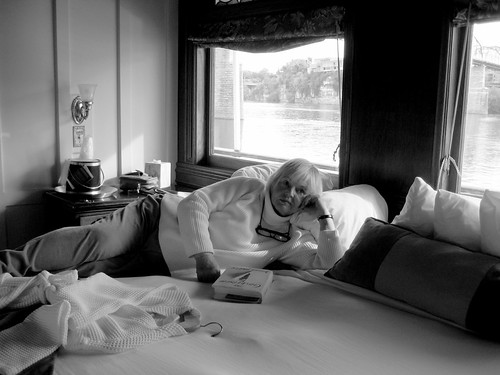
Sunrise at the Delta Queen Hotel, Tennessee River, Chattanooga, Tennessee, October 2013. Credit: Mzuriana.

My mother, Carol, and I are on a road trip that takes us through North Carolina and Tennessee.

In Chattanooga, we stayed at the Delta Queen Hotel, permanently moored on the Tennessee River, alongside the pleasing Coolidge Park with its fountain, walking/biking trails, and green space.

People who reconstitute historic structures can go so many ways to salvage a place. There's renovation, preservation, reproduction, rehabilitation, and conservation. A few days earlier, we'd lunched at a "historic" restaurant in Kentucky that still held its plantation-ish exterior, but its insides had drop ceilings, ersatz colonial-style "chandeliers," mediocre local wall art, and institutional-grade carpet.

What a difference between that and the Delta Queen Hotel!

Sunrise at the Delta Queen Hotel, Tennessee River, Chattanooga, Tennessee, October 2013. Credit: Mzuriana.


The room, albeit tiny, felt luxe.  Looking out the window onto the river reminded me of the luxury of lying back and watching the full moon on that overnight train trip Sandy and I took from Batumi to Tbilisi.

Sunrise at the Delta Queen Hotel, Tennessee River, Chattanooga, Tennessee, October 2013. Credit: Mzuriana.


The interior, common areas of the boat glowed with the ambiance of early-20th century salons. Sofas, game tables, dressers, low lighting, tray ceilings, wainscoting.


Sunrise at the Delta Queen Hotel, Tennessee River, Chattanooga, Tennessee, October 2013. Credit: Mzuriana.


On the deck one can rock slowly into a meditative state while boat traffic floats or zooms by, while walkers and bikers cross the pedestrian bridge, while cars and trucks thrum over the other bridge. Looking across the river is a bank of new construction that is reminiscent of Dutch or Eastern European waterside apartment buildings.


Sunrise at the Delta Queen Hotel, Tennessee River, Chattanooga, Tennessee, October 2013. Credit: Mzuriana.


On a clear night, the stars compete with the lights on the bridges.  


Sunrise at the Delta Queen Hotel, Tennessee River, Chattanooga, Tennessee, October 2013. Credit: Mzuriana.


People who love the Delta Queen had to have played a part in preserving what made it the Delta Queen when it was in its prime. Beautifully done.

Gifts like this - being able to spend the night on a historic riverboat at a price that is affordable for many - don't last forever. I wouldn't delay in spending at least one night here in the near future.

Some notes:

  • The hotel is not accessible for the wheelchair-bound. I don't know if there is an accessible sleeping room for individuals who have other kinds of access issues. 
  • There is pretty good wifi available in the common areas, including on the deck.
  • No TVs or phones in the rooms. There are a couple of TVs in the lounge. 
  • Parking is a pretty far piece from the boat, so pack lightly for your stay and leave the bulkier stuff in your vehicle. 
  • The location of the boat is fabulous - on walking trails and near restaurants and night life. 


A slide show, which includes a photo of Carol

Chattanooga

#30