Showing posts with label death. Show all posts

Thursday, April 2, 2026

5 Years Ago: Rootless: The Last Monday Letter


Five years later, there's nothing more I can add to this. I think of my mom often. 


Monday, March 29, 2021

Rootless: The Last Monday Letter


Carol Cottage, Missouri. January 2011.

Dear Mom, 

I've written you a letter almost every Monday since mid-December 2018. 

In that first weekly letter, I was at the end of an interregnum Missouri visit, about to depart for a Christmas-New Year layover in South Louisiana before heading westward to my next tourist-in-residency --> Tucson.  

When I wrote you that letter, I still had my 1995 Toyota Camry. When I wrote you that letter, I didn't know that, two weeks later, I would say good-bye forever to that sturdy stalwart of my rootless life.

It looks like this will be my last Monday letter to you, and I'm putting it here, seeing as how you don't live at Carol Cottage anymore, seeing as how you've died, of course. You, too, were a sturdy stalwart in my life. I think you'd chuckle at being compared to a car. Or you'd be annoyed. 

Carol Cottage, Missouri. January 2011.


So let me tell you about your funeral and burial.  It was everything you'd asked for.

You lay in your casket in a long-sleeved, white cotton nightgown. White-thread embroidery just below the neckline, a band of hand-stitched eyelets below the neckline, a pleated bodice. Pretty details, yet still in the range one can call simple. Exactly your style.

The James Lee Burke book, Pegasus Descending, featuring our mutual hero, Dave Robicheaux, rested on your belly, propped against the open half-lid of the casket. You had a perverse fondness for Dave's violent, psychopathic side-kick, Clete Purvis. 

As you'd asked, we ordered your casket from an online supplier and had it shipped to the funeral home to side-step the markup costs assessed by funeral homes for their caskets. We selected a poplar casket in a cherry finish that, like your nightgown, had pleasing details of interest, but overall, evoked the comfortable warmth and intimacy of your living room. And, gosh, did you know you can buy a casket at Costco? We chose yours from a different company, but knowing Costco's got caskets is something to tuck away for future reference.

As for how you looked in the casket, you didn't just "look good" like in the cliche about such things. You were beautiful. Astonishingly so. I'm serious, Mom. Even your nails were manicured and polished (with the barest of pink blush), just as you would like. And you wore the exact right shade of lipstick for your complexion. I'm not saying you looked beautiful "for your age," a woman of 91. No, you were beautiful in that casket irrespective of age. 

You wanted Ave Maria sung at your funeral. The soloist, a young woman, sang it to you, to us, in a clear, warm, mezzo-soprano voice, from the balcony behind us. The notes of that transcendent song washed over me.

Your Ave Maria was gorgeous. But when the young singer began to serenade you with Amazing Grace while your descendants escorted you from the altar to the waiting funeral car, well, that took my breath away.   


The car procession that followed you to the cemetery ... an unremarkable journey. 

No Fellini-esque plot twists on the way, as happened after your brother, Clement's, funeral. Remember? When dozens of us, including you and Dad, idled outside the church, seemingly forever, waiting for the priest to lead the vehicular cavalry? And when you asked the funeral director what was taking so long for us to get started, he conjectured that maybe the priest was eating a sandwich. 

We eventually did get going, one car following another, as they do in a funeral procession. We seemed to drive a long time, first on a congested arterial road, then on the highway, then off the highway onto another arterial road and then, oddly, the funeral car took a right turn onto a small side street. A dead-end, in fact. We followed, of course, only to understand that the funeral car driver had taken a wrong turn somewhere and he'd only entered this street so he could turn around (turn all of us around) and get onto the right path. Remember how we all poked our vehicles' noses into residents' driveways so we could then back up and restore our places in line behind the retreating funeral car?

There had been so much idling in front of the church before getting underway that your youngest child had to pull out of the funeral procession so he could gas up his truck before he ran out of fuel.

Oh, what a dramatic third act that was!

But getting back to your memorial day. It had rained earlier, but the rain abated for the final stop of our long good-bye to you. Chilly, though. If you'd been among us en vivo, at the cemetery, under the final-words canopy, you'd have been rolling your eyes and sighing while the priest used his bully pulpit to convince us of how fun it is to be in heaven. Me, I just shivered in the cold and waited impatiently for him to cut the commercial and get back to the program: you

Daughter Kit had a mission to visit Dad's grave (where you were about to join him) and her paternal grandfather's grave. She'd already obtained their grave 'addresses' and their locations on the cemetery map, and following your closing ceremony under the canopy, she and her family and I drove to Dad's cemetery neighborhood. 

So it was that we came upon the newly dug grave, into which you would be interred. We watched while the cemetery crew brought you to the grave in, let's call it a carriage, albeit a humble, utilitarian one. We watched how the crew pulled your casket from the carriage, centered you into a harness of sorts, and carefully lowered you into your grave with straps and winches, guiding your slow descent by hand. 

You would have been quite interested in watching this process. 

It felt good to be with you in your most final of final moments.

OK, then. This is my last Monday letter, Mom.

Love, 

Mzuri


Related posts


Post office and cows, Topawa, Tohono O'odham Nation, Arizona. July 2019.


Sunday, December 31, 2023

In Memorium


The end of the year seems a good time to remember the dead. Some who were very close to me, whether family or friends. Some who were not so close, but who were in one of my circles, and impactful. Some whose connection to me was ephemeral, but whose life touched me in some way. Some who died after this blog debuted. Some who died years before.

My mother, Carol: The Last Monday Letter and posts that featured her here.

Carol on the Delta Queen. October 2013. Credit: Mzuriana.


My father, Ron: I hold complicated feelings about my father, but as they relate to challenges and opportunities I encountered as an adult, he delivered support in both tangible and intangible ways. With eight children, and, at times, a dog and a duck, not to mention my mom - he was definitely rooted. Except. He had a life-long dream of learning to fly. My dad sustained that dream through a stint with the Air Force, marriage, college, various household relocations, raising and supporting the eight kids, until, finally, he made it happen in his 60s.


My father, Ron, and my mother, Carol

Dan Offret in Tucson: A Toast to Dan

Jessica Terrell in Missouri (then New Mexico): Voluntary Simplicity

Judy Ackerman in El Paso, whose orbit I circled through her varied avocations and activist work: hiking, land preservation, voter engagement, women's rights, and pro-choice rights.

Donna Snyder in El Paso, founder of the Tumblewords Project, a weekly writers' workshop - still going strong 28 years later, even beyond her death in 2022. This interview, A Conversation with Donna Snyder: An Advocate and Speaker for the Unseen, published in April 2022, serves as a memorial to some parts to her whole of a life.

Saturday, July 9, 2022

Mobile, Alabama: A Curiosity


A hanging fox tail. Mobile, Alabama. July 2022. Credit: Mzuriana.

It wasn't there the day before.

It was there the next day.

A fox tail, it seems.

Real? 

I didn't touch it. 

Why hanging? 

Why hanging there


Related fox posts

2016: On the Way to Colorado: Snapshots

2017: Big Bend National Park, Texas: Poop and Circumstance

2018: Backyard Fox


Monday, February 14, 2022

Mobile, Alabama: An Addition to the Carcass Gallery


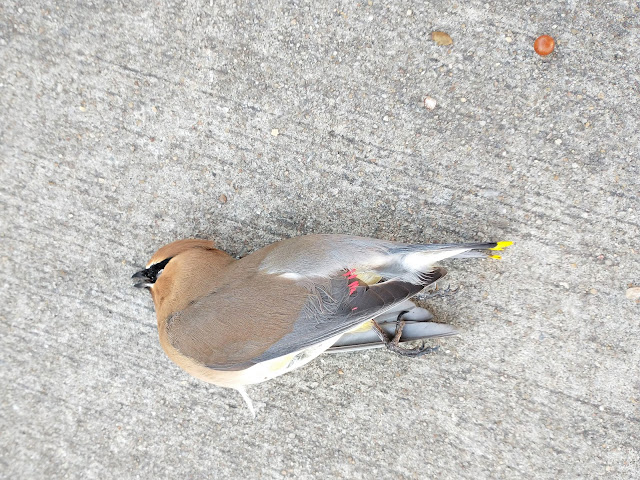
Cedar waxwing, dead. Mobile, Alabama. February 2022. Credit: Mzuriana.

Although I didn't touch the body, it emitted an essence of still-warm plumpness. 

I found a small stick and I gently moved it off the sidewalk pavement so as to save it from the indignity of an unintentional crush by a pedestrian's footfall. 

How did it die? There was no evidence of injury. Note the small berry in the upper right corner of the photo. If it is a nandina berry, this can kill cedar waxwings that binge on them. But is it a nandina? I don't know.

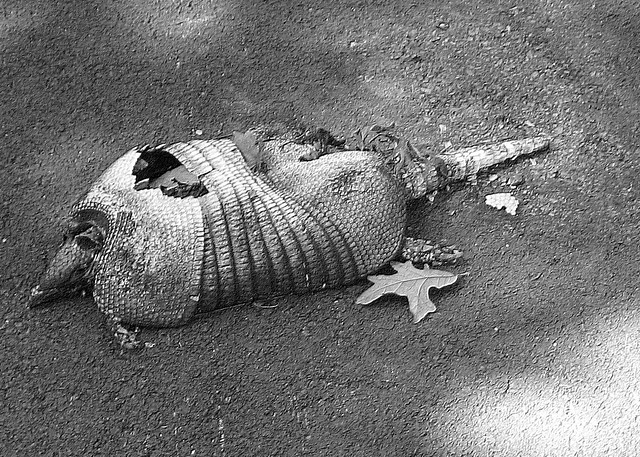
The cedar waxwing is the newest addition to the We Stop for Carcasses collection:

We Stop For Carcasses


Wednesday, December 1, 2021

Word of the Year: Joy 12: Remembrances


A little rock reservoir, Rocky Mountain National Park, Colorado. May 2016.

A few years ago, I caught myself remembering a vivid experience. The experience - a particularly exuberant dance move with a partner - had been unexpected and joyful. Exultant! I remembered clearly how I'd felt during that dance move - delightfully surprised in the way of a child seeing snow for the first time. Think the final lift scene from Dirty Dancing.


Catching myself remembering those few moments, and observing the pleasure that the act of remembering gave to me - it was the first time I understood that remembrances are like water in a reservoir, a source I can drink from to replenish my spirit.

Death took three people in my circles this year. 

My mother.

A friend.

An aunt, unexpectedly, only a week after my mother's funeral.


Bulb in leaves. St. Louis, Missouri. December 2007.

It's odd to think that death can bring forth thoughts of joy. But I catch myself remembering pleasurable moments with lost ones, usually prompted by a sensory trigger. A snatch of music. The ticking of a clock. A pair of earrings. A color reminiscent of homemade butterscotch pudding. The creaking of a kitchen cabinet door. A small pair of scissors. An old television show. These memories make me smile, gladdened for the pleasure they give me today and gladdened for having had the original experiences with the family or friends who have died. 

Challenges overcome

As I walked home from downtown Mobile on a recent night, I remembered a time when I, a single parent of a very young child, was terribly poor. I hadn't thought of those years in decades, but as I walked home, the memories came to me of what I'd accomplished since then.

The trigger was a Head Start booth at Mobile's Lighting of the Christmas Tree event, which I'd just attended. Head Start was a marvelous resource for my young one (and me) during a time of great need for us. Remembering that era, I went to deep appreciation of my maternal grandmother, May, who - for several years, as I walked through that desert - sent me a $25 check each month, along with a brief note. In my financial poverty, that $25 check made a meaningful difference to me and my child. 

As I walked home, remembering that time, I felt so .... proud .... of what I'd achieved since then, and the richness of the experiences that followed, both the exuberant and the sad. 

I felt joyful. 


The compilation of this year's joy

Joy 1: Word of the Year: Joy

Joy 2: Music

Joy 3: Surprise Vista

Joy 4: Happy, Joyous, and Free

Joy 5: The Science of Joy, Interrupted

Joy 6: Color

Joy 7: Birdsong

Joy 8: Here and Now, Boys

Joy 9: A Tomato and Onion Sandwich

Joy 10: Let in Light

Joy 11: Scentsuality


Monday, March 29, 2021

Rootless: The Last Monday Letter


Carol Cottage, Missouri. January 2011.

Dear Mom, 

I've written you a letter almost every Monday since mid-December 2018. 

In that first weekly letter, I was at the end of an interregnum Missouri visit, about to depart for a Christmas-New Year layover in South Louisiana before heading westward to my next tourist-in-residency --> Tucson.  

When I wrote you that letter, I still had my 1995 Toyota Camry. When I wrote you that letter, I didn't know that, two weeks later, I would say good-bye forever to that sturdy stalwart of my rootless life.

It looks like this will be my last Monday letter to you, and I'm putting it here, seeing as how you don't live at Carol Cottage anymore, seeing as how you've died, of course. You, too, were a sturdy stalwart in my life. I think you'd chuckle at being compared to a car. Or you'd be annoyed. 

Carol Cottage, Missouri. January 2011.


So let me tell you about your funeral and burial.  It was everything you'd asked for.

You lay in your casket in a long-sleeved, white cotton nightgown. White-thread embroidery just below the neckline, a band of hand-stitched eyelets below the neckline, a pleated bodice. Pretty details, yet still in the range one can call simple. Exactly your style.

The James Lee Burke book, Pegasus Descending, featuring our mutual hero, Dave Robicheaux, rested on your belly, propped against the open half-lid of the casket. You had a perverse fondness for Dave's violent, psychopathic side-kick, Clete Purvis. 

As you'd asked, we ordered your casket from an online supplier and had it shipped to the funeral home to side-step the markup costs assessed by funeral homes for their caskets. We selected a poplar casket in a cherry finish that, like your nightgown, had pleasing details of interest, but overall, evoked the comfortable warmth and intimacy of your living room. And, gosh, did you know you can buy a casket at Costco? We chose yours from a different company, but knowing Costco's got caskets is something to tuck away for future reference.

As for how you looked in the casket, you didn't just "look good" like in the cliche about such things. You were beautiful. Astonishingly so. I'm serious, Mom. Even your nails were manicured and polished (with the barest of pink blush), just as you would like. And you wore the exact right shade of lipstick for your complexion. I'm not saying you looked beautiful "for your age," a woman of 91. No, you were beautiful in that casket irrespective of age. 

You wanted Ave Maria sung at your funeral. The soloist, a young woman, sang it to you, to us, in a clear, warm, mezzo-soprano voice, from the balcony behind us. The notes of that transcendent song washed over me.

Your Ave Maria was gorgeous. But when the young singer began to serenade you with Amazing Grace while your descendants escorted you from the altar to the waiting funeral car, well, that took my breath away.   


The car procession that followed you to the cemetery ... an unremarkable journey. 

No Fellini-esque plot twists on the way, as happened after your brother, Clement's, funeral. Remember? When dozens of us, including you and Dad, idled outside the church, seemingly forever, waiting for the priest to lead the vehicular cavalry? And when you asked the funeral director what was taking so long for us to get started, he conjectured that maybe the priest was eating a sandwich. 

We eventually did get going, one car following another, as they do in a funeral procession. We seemed to drive a long time, first on a congested arterial road, then on the highway, then off the highway onto another arterial road and then, oddly, the funeral car took a right turn onto a small side street. A dead-end, in fact. We followed, of course, only to understand that the funeral car driver had taken a wrong turn somewhere and he'd only entered this street so he could turn around (turn all of us around) and get onto the right path. Remember how we all poked our vehicles' noses into residents' driveways so we could then back up and restore our places in line behind the retreating funeral car?

There had been so much idling in front of the church before getting underway that your youngest child had to pull out of the funeral procession so he could gas up his truck before he ran out of fuel.

Oh, what a dramatic third act that was!

But getting back to your memorial day. It had rained earlier, but the rain abated for the final stop of our long good-bye to you. Chilly, though. If you'd been among us en vivo, at the cemetery, under the final-words canopy, you'd have been rolling your eyes and sighing while the priest used his bully pulpit to convince us of how fun it is to be in heaven. Me, I just shivered in the cold and waited impatiently for him to cut the commercial and get back to the program: you

Daughter Kit had a mission to visit Dad's grave (where you were about to join him) and her paternal grandfather's grave. She'd already obtained their grave 'addresses' and their locations on the cemetery map, and following your closing ceremony under the canopy, she and her family and I drove to Dad's cemetery neighborhood. 

So it was that we came upon the newly dug grave, into which you would be interred. We watched while the cemetery crew brought you to the grave in, let's call it a carriage, albeit a humble, utilitarian one. We watched how the crew pulled your casket from the carriage, centered you into a harness of sorts, and carefully lowered you into your grave with straps and winches, guiding your slow descent by hand. 

You would have been quite interested in watching this process. 

It felt good to be with you in your most final of final moments.

OK, then. This is my last Monday letter, Mom.

Love, 

Mzuri


Related posts


Post office and cows, Topawa, Tohono O'odham Nation, Arizona. July 2019.


Sunday, September 8, 2019

Tucson, AZ: Samaritans: Artist Alvaro Enciso, the Crosses

Alvaro Enciso plants a Cross to honor a man who died seeking a decent life. Arizona. August 2019.


On a Humane Borders water run, I learned about Alvaro Enciso, an artist who has made it a mission to recognize the humanity of individual women, men, and children who have died in the desert in an attempt to claim a decent life.

Mr. Enciso honors the dead with painted wood Crosses that he plants into the Arizona soil.

Alvaro Enciso plants a Cross to honor a man who died seeking a decent life. Arizona. August 2019.

 Each Cross has a round red disk.

Alvaro Enciso plants a Cross to honor a man who died seeking a decent life. Arizona. August 2019.


The round red disk on a Cross represents a round red circle on the death map that Humane Borders maintains in partnership with the Pima County Medical Examiner's Office.


Each round red disk on the death map represents a woman, man, or child who died on their quest for a decent life.  Each round red disk on the death map corresponds to a precise geographic point on the planet where the human remains of a dream were found.

Alvaro Enciso plants a Cross to honor a man who died seeking a decent life. Arizona. August 2019.


There are so many collapsed dreams in the desert, individual collections of bone, sinew, skin, empty clothing, shoes, bags, papers. Maybe plastic baggies with garlic, dissolved in putrescence, to protect one from rattlesnake bites.

Garlic bulbs in a baggie, abandoned by a group of migrants, along with backpacks and other items, perhaps after pick-up by Border Patrol. Arizona. August 2019.


Most Tuesdays, Mr. Enciso leads a one- or two-car pilgrimage into the Sonoran Desert or adjoining highlands. He has selected the women, men, or children whose deaths he will commemorate on a trip, and he brings the day's Crosses with him. Sometimes he knows a fallen person's name, gender, and age; sometimes not.

The color of the painted Crosses vary according to the tint of the paint that someone donated to him or that he picked up somewhere on sale.

Democracy Now recently devoted a show to Mr. Enciso's mission, and I'll direct you there so you can learn more about his work in his own words: 


On the Cross pilgrimage I joined, there were small crews for ABC's Nightline and a freelance documentary company, and, I believe, a print journalist.

Alvaro Enciso plants a Cross to honor a man who died seeking a decent life. Arizona. August 2019.


In all, there were at least 10 of us. Upon arrival near the first site, several of us carried something that was a part of the planting - a bucket, a shovel, quickset concrete. And the Cross. I carried the Cross, grateful to do so. It didn't weigh much, and it felt well-balanced. It rested lightly in the crook of my right arm. I occasionally smoothed the wood with my left hand.

We walked, and I held the Cross, and I thought about this man who had died, and when we arrived at the spot where his remains had been found, it was .... gosh, it was so pretty. 

Alvaro Enciso plants a Cross to honor a man who died seeking a decent life. Arizona. August 2019.


Which doesn't surprise me like it might have long ago. When I think of the Rwandan Genocide, and my friend who survived that cycle of human madness, a question invariably comes to me: "Did birds continue to sing in the forest canopy above the screams of slaughter below"?

Of course they did.

The desert enchants and kills indiscriminately, thus a place for a pretty walk on a pleasant day for one is a place of death from heat stroke or thirst for another.

After Mr. Enciso planted the Cross in that grassy meadow, we embarked on a rather wild ride in the Samaritans' two SUVs up into the highlands, very close to the border. Mr. Enciso sought the last living place of another man, for whom he had brought a Cross. 

A man died in the saddle between those two peaks, in the search for a decent life. August 2019.


But this was not the day it would happen. See that saddle between the two mountains? There's a wide valley between there and the rise where we parked. Volunteer Samaritans would come another day and hike to the man's death ground.


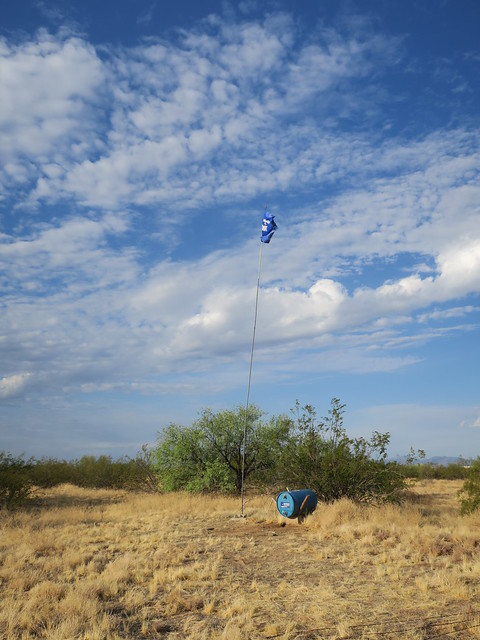
Samaritans left water for women, men, or children who might pass through. A man died in the saddle between those two peaks, in the search for a decent life. August 2019.


The group left jugs of water in and under the shade of a tree, which looked across that valley. Maybe they will save a life. These jugs and barrels of water. They are an act of faith, or maybe more accurately, an act of hope in a lucky roll of metaphysical dice, that someone who needs water will see it and have still the strength to reach it. 


Below is a slide show with more photos from this trip with Mr. Enciso, plus the accumulation of photos from the water runs to the Sonoran Desert via Humane Borders and Samaritans.

Desert Water Runs


Monday, August 19, 2019

Tucson, AZ: Ghost Bikes


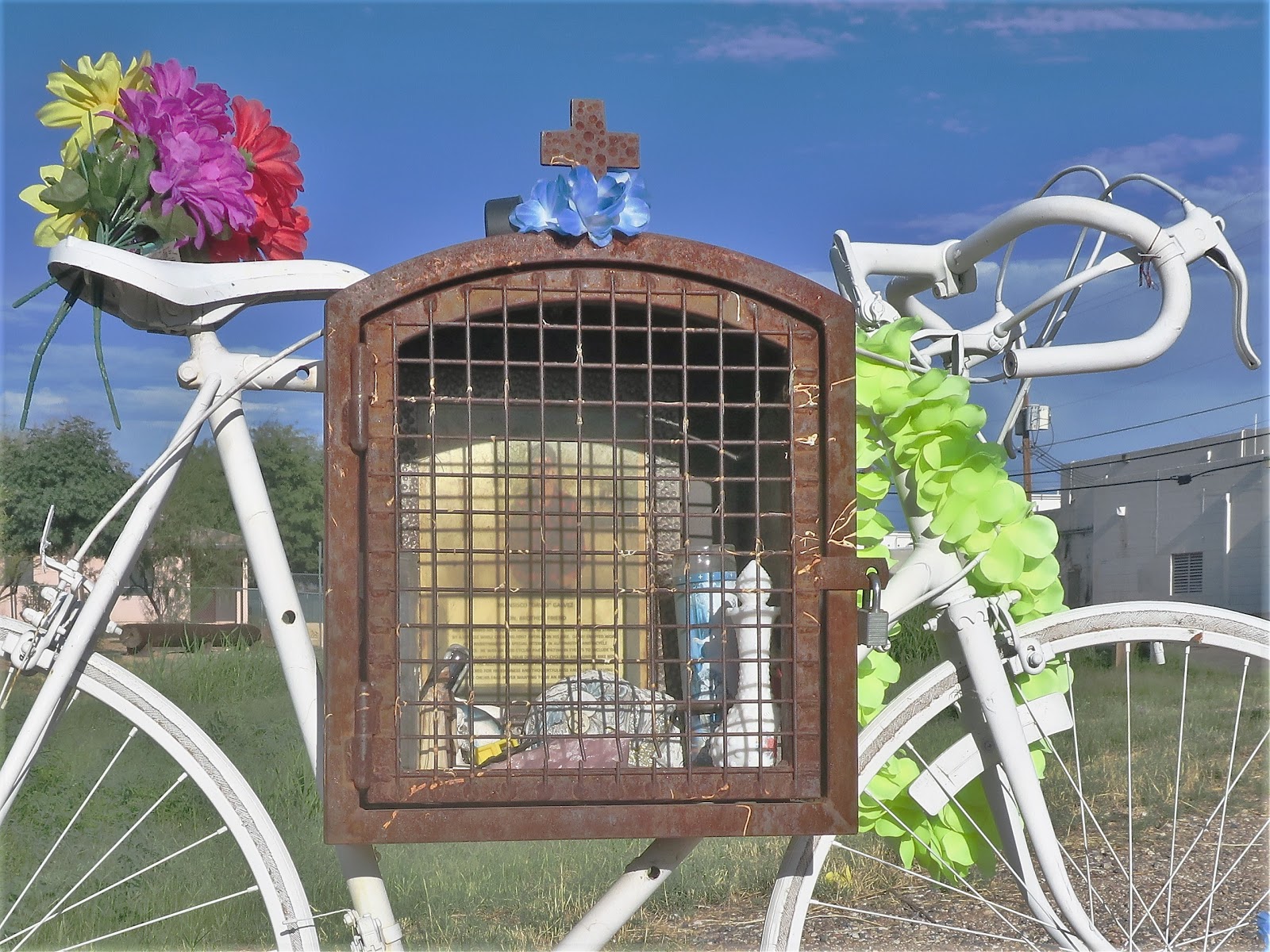
In memory of Francisco "David" Galdez, Tucson, Arizona. 1st Street. August 2019.


I'd seen them around the city, of course, but I didn't know their purpose.

Ideas I considered:

But neither quite fit. For one, all of the bikes were white, so not much artistic variety. Second, they didn't seem a good design for a bike rack.

It wasn't until my day trip to Globe, where I saw another white bike, that I determined to look 'em up.

Ghost bikes.

To commemorate the spot where a cyclist died on the road.


In memory of Miguel Quintera, Tucson, Arizona. 1st Street. August 2019.


History of the global memorials here.


In memory of Francisco "David" Galdez, Tucson, Arizona. 1st Street. August 2019.


Here are stats on cycling deaths in the U.S. in 2018. Tucson seems to be under the radar. On the other hand, this report states Tucson is the 2nd most dangerous city for cyclists.

In memory of Miguel Quintera, Tucson, Arizona. 1st Street. August 2019.


I've found that I have to be much more alert driving in Tucson than any other city I've lived in, due to the numbers of pedestrians and cyclists.


In memory of Miguel Quintera, Tucson, Arizona. 1st Street. August 2019.


I'm not complaining. I'm delighted to be in a city that strives to care for all of the modalities of travel on its thoroughfares. I used to live in a city where the joke was: "It's a great place to raise a car."

Cyclists in Tbilisi, Caucasus Georgia. September 2011.


Here are some best practices for city and street designs to respect the safety and ease of cyclists, pedestrians, drivers, and people with mobility assists:


Rental bikes, Sunset Heights, El Paso, Texas. August 2016.


Dan Burden used to be the walkable-community guy - I even had the privilege to hear him present once. He's still very much in the game. Take a look at AmericaWalks.


Cyclist achieving summit, Sandia Mountains, New Mexico. November 2008.


A month ago, a Tucson cyclist died in a collision with a car.

One soul maintains a public spreadsheet on bicycle fatalities in Arizona.


Wednesday, July 31, 2019

Rootless: Mortality 1


Sunset in Kobuleti, Black Sea, Caucasus Georgia. April 2012.


From Fall, by Neal Stephenson:
He saw life as a trench in the First World War sense of that term, dug very deep at one end but becoming more shallow as you marched along, gradually ramping up to surface level. Early in your life you were so deep down in it that you didn't even know that shells were bursting and bullets zipping over its top. As time went on these became noticeable but not directly relevant. At a certain point you began to see people around you getting injured or even killed by stray bits of shrapnel, but even if they were good friends of yours, you knew, in your grief and shock, that they were statistical aberrations. The more you kept marching, however, the more difficult it became to ignore the fact that you were drawing closer to the surface. People in front of you died singly, then in clusters, then in swathes. Eventually, when you were something like a hundred years old, you emerged from the trench onto open ground, where your life span was measured in minutes. Richard still had decades to go before it was like that, but he'd seen a few people around him buy the farm, and looking up that trench he could see in the great distance - but still close enough to see it - the brink above which the bullets flew in blazing streams. Or maybe it was just the music in his headphones making him think thus.


And, of course, shortly after Richard cogitated these thoughts, he died (sort of). 


Sunset in El Paso, Texas. June 2017.


Ah, mortality.

This has been on my mind of late.

Partly because I am a woman of a certain age, and it hasn't escaped my notice that my age becomes more certain with every year that passes.

Also, I have encountered a number of solo women of a certain age in Tucson who are role models for how I do and how I don't want to walk into the sunset.


Sunset in Monument Valley, Arizona. November 2008.

Although I've made decisions throughout my adult life that have moved me in the general direction of a decent denouement, it's time to get more intentional with decisions and actions.  I've got to factor in Scenarios A, B, and C.


Scenario A is a pleasant, extended visit on the planet with:
  1. All of our faculties and mobilities sufficiently intact to maintain physical independence;
  2. The financial means to be self-supporting;
  3. The freedom to exercise our rights to self-determination without invasive interference from others; 
  4. Convenient access to grocery stores, libraries, parks, and other points of interest that enrich our lives;
  5. Regular contact with delightful people of all ages; and
  6. A slide into death's arms peacefully, with a gentle smile on our lips, and a final surrendering sigh.

In Scenario B, we achieve a goodly age, but not so extended as we'd hoped, with all of the accoutrements of above, until lightning strikes us dead. Click.


Blechh. Scenario C. This is one we should plan for and hope we don't have to execute. The one where we can't live independently, at least for awhile, due to an accident or an illness or a new state of being that robs us of our cognitive abilities or accustomed mobility.

Sunset in Missouri. December 2006.


Time for me to get crack-a-lackin'.


Sunset in Texas on I-10. September 2017.


Buzzkill note:

I am so fucking lucky that I have had the privilege for most of my life to make decisions and to plan. I see solo women in Tucson, about my age, sometimes older and sometimes younger, who - for whatever reason - don't have this privilege; some never did. They live on the street. Or they "car camp," not in a fun, adventurous sort of way, but because that's all they can afford to do. Or they have four walls and a bed and a kitchen, but they ask for money on street corners to help pay their bills.

Saturday, August 6, 2016

Antigua, Guatemala: Volcano Family


Volcano presence, Antigua, Guatemala. April 2016.


I wonder how the omnipresent threat of volcanic eruptions and earthquakes shapes the Guatemalan worldview today, and how it shaped the Mayan mental model pre-Spanish era. Is there a dismal, fatalistic view? Life's a bitch and then it has puppies, and then you die! Or a fatalistic, but enjoy-the-moment outlook: Carpe diem! Or something that's somewhere in between. Like, pray to God but keep rowing the boat to shore. Or: Shit happens.


Volcano presence, Antigua, Guatemala. April 2016.


In Antigua, there's no escaping the archaeological emoji of memento mori: remember you must die.
They are the crumbling stone carcasses left by massive shudderings from subterranean Earth giants. Maybe the fallen structures are the flip side of sand paintings that the artists swipe away after having spent many hours of painstaking placement of color and shape. Some to illustrate the impermanence of life. Some to dissipate toxic spirits after a healing.


Volcano presence, Antigua, Guatemala. April 2016.


Raise your eyes just a bit and, always hovering, are those volatile family members who appear placid now, but you know it's just a matter of time before they'll blow out their molten rage or poisonous gray ash. Will it be today? Tomorrow? A year? A generation?


Volcano presence, Antigua, Guatemala. April 2016.


A passage from Joan Didion's Year of Magical Thinking sticks with me:
"... many people I knew .. believed absolutely in their own management skills. They believed absolutely in the power of the telephone numbers they had at their fingertips, the right doctor, the major donor, the person who could facilitate a favor at State or Justice. The management skills of these people were in fact prodigious. The power of their telephone numbers was in fact unmatched. I had myself for most of my life shared the same core belief in my ability to control events. If my mother was suddenly hospitalized in Tunis I could arrange for the American consul to bring her English-language newspapers and get her onto an Air France flight to meet my brother in Paris. ...Yet ... Some events would just happen. This was one of those events. You sit down to dinner and life as you know it ends."


Volcano presence, Antigua, Guatemala. April 2016.


When I drive by a nasty car crash, I think, "Remember, remember. Pay attention to your now. These people did not get up this morning thinking they'd be killed or maimed in a car crash."


Volcano presence, Antigua, Guatemala. April 2016.


In Aldous Huxley's book, The Island, there is the black, orange-beaked mynah that flies about the island, announcing: "Attention" and "Here and now, boys. Here and now, boys."

"That's what you always forget, isn't it? I mean, you forget to pay attention to what's happening And that's the same as not being here and now," said the little girl, Mary Sarojini MacPhail.


Volcano presence, Antigua, Guatemala. April 2016.


Antigua's volcanoes. Memento mori. Pay attention. Here and now, boys!


Volcano presence, Antigua, Guatemala. April 2016.


Monday, June 20, 2016

Antigua, Guatemala: San Lázaro Cemetery


San Lázaro Cemetery, Antigua, Guatemala. April 2016.


Is it the ultimate irony to name a cemetery after Lazarus? It would seem so to me, but maybe there's a nuance I'm not getting, or maybe Antigueños are an optimistic people.


I probably would have wandered over to the cemetery at some point during my Antigua stay, but what drove me to put it on my must-see list was a provocative conversation with my Spanish teacher.


San Lázaro Cemetery, Antigua, Guatemala. April 2016.


One day, during a lesson, I don't remember how the topic came up, but she casually mentioned formerly-interred bodies being thrown into the garbage dump if the deceased's descendants failed to pay the annual cemetery bill.

Internal squealing of brakes in my head, backing up. "Wha?"

At first I thought she was talking about tossing the cadavers into the city dump, about which I was incredulous, but after some refinement of terms and my understanding of same, I got that there was a garbage area in the cemetery itself. I am deliberately using the word "garbage" - or "trash" if you prefer - because that is the term my teacher used, i.e. "basura." Not that this was any less startling to me.


San Lázaro Cemetery, Antigua, Guatemala. April 2016.


So, really, this is how it works in Guatemala. You've got to pay recurring cemetery fees if you want your deceased loved one to remain in his eternal resting abode. My impression is that at San Lázaro Cemetery, there's a grace period of sorts, where maybe your loved one's body can stay in situ for awhile past the payment-due date, but then it's moved to another "resting area" to give the family more time to find the funds for (newer, but less stately?) digs, but once that period ends, the corpse is chucked into what one person might call a mass grave and what another might call a garbage dump.

Indeed, an article on the Guatemala system here: Evicted From Their Own Graves (2014) - Caution, disturbing photos included. 


San Lázaro Cemetery, Antigua, Guatemala. April 2016.


So I went to the cemetery so I could see this for myself, but in talking to the cemetery workers, who confirmed the practice, I was told visitors weren't allowed to go to that spot because of "safety" concerns.

I did note that at least one crypt, possibly that of a delinquent "renter," is used as a work shed of sorts. If so, perhaps that is a kindness, forestalling eviction.

San Lázaro Cemetery, Antigua, Guatemala. April 2016.


As with all cemeteries, there are the chi-chi neighborhoods and the more humble ones.

Overall, the cemetery is gracious, serene, and beautiful. The public area, that is.


Some other takes on San Lázaro Cemetery: 

Tree-Lined Cemetery Path (2007)
Wall of Graves (2016)
San Lazaro Cemetery (2015)


A slideshow below of San Lázaro Cemetery:


Some other cemeteries I have known are here.