Showing posts with label funeral. Show all posts

Thursday, April 2, 2026

5 Years Ago: Rootless: The Last Monday Letter


Five years later, there's nothing more I can add to this. I think of my mom often. 


Monday, March 29, 2021

Rootless: The Last Monday Letter


Carol Cottage, Missouri. January 2011.

Dear Mom, 

I've written you a letter almost every Monday since mid-December 2018. 

In that first weekly letter, I was at the end of an interregnum Missouri visit, about to depart for a Christmas-New Year layover in South Louisiana before heading westward to my next tourist-in-residency --> Tucson.  

When I wrote you that letter, I still had my 1995 Toyota Camry. When I wrote you that letter, I didn't know that, two weeks later, I would say good-bye forever to that sturdy stalwart of my rootless life.

It looks like this will be my last Monday letter to you, and I'm putting it here, seeing as how you don't live at Carol Cottage anymore, seeing as how you've died, of course. You, too, were a sturdy stalwart in my life. I think you'd chuckle at being compared to a car. Or you'd be annoyed. 

Carol Cottage, Missouri. January 2011.


So let me tell you about your funeral and burial.  It was everything you'd asked for.

You lay in your casket in a long-sleeved, white cotton nightgown. White-thread embroidery just below the neckline, a band of hand-stitched eyelets below the neckline, a pleated bodice. Pretty details, yet still in the range one can call simple. Exactly your style.

The James Lee Burke book, Pegasus Descending, featuring our mutual hero, Dave Robicheaux, rested on your belly, propped against the open half-lid of the casket. You had a perverse fondness for Dave's violent, psychopathic side-kick, Clete Purvis. 

As you'd asked, we ordered your casket from an online supplier and had it shipped to the funeral home to side-step the markup costs assessed by funeral homes for their caskets. We selected a poplar casket in a cherry finish that, like your nightgown, had pleasing details of interest, but overall, evoked the comfortable warmth and intimacy of your living room. And, gosh, did you know you can buy a casket at Costco? We chose yours from a different company, but knowing Costco's got caskets is something to tuck away for future reference.

As for how you looked in the casket, you didn't just "look good" like in the cliche about such things. You were beautiful. Astonishingly so. I'm serious, Mom. Even your nails were manicured and polished (with the barest of pink blush), just as you would like. And you wore the exact right shade of lipstick for your complexion. I'm not saying you looked beautiful "for your age," a woman of 91. No, you were beautiful in that casket irrespective of age. 

You wanted Ave Maria sung at your funeral. The soloist, a young woman, sang it to you, to us, in a clear, warm, mezzo-soprano voice, from the balcony behind us. The notes of that transcendent song washed over me.

Your Ave Maria was gorgeous. But when the young singer began to serenade you with Amazing Grace while your descendants escorted you from the altar to the waiting funeral car, well, that took my breath away.   


The car procession that followed you to the cemetery ... an unremarkable journey. 

No Fellini-esque plot twists on the way, as happened after your brother, Clement's, funeral. Remember? When dozens of us, including you and Dad, idled outside the church, seemingly forever, waiting for the priest to lead the vehicular cavalry? And when you asked the funeral director what was taking so long for us to get started, he conjectured that maybe the priest was eating a sandwich. 

We eventually did get going, one car following another, as they do in a funeral procession. We seemed to drive a long time, first on a congested arterial road, then on the highway, then off the highway onto another arterial road and then, oddly, the funeral car took a right turn onto a small side street. A dead-end, in fact. We followed, of course, only to understand that the funeral car driver had taken a wrong turn somewhere and he'd only entered this street so he could turn around (turn all of us around) and get onto the right path. Remember how we all poked our vehicles' noses into residents' driveways so we could then back up and restore our places in line behind the retreating funeral car?

There had been so much idling in front of the church before getting underway that your youngest child had to pull out of the funeral procession so he could gas up his truck before he ran out of fuel.

Oh, what a dramatic third act that was!

But getting back to your memorial day. It had rained earlier, but the rain abated for the final stop of our long good-bye to you. Chilly, though. If you'd been among us en vivo, at the cemetery, under the final-words canopy, you'd have been rolling your eyes and sighing while the priest used his bully pulpit to convince us of how fun it is to be in heaven. Me, I just shivered in the cold and waited impatiently for him to cut the commercial and get back to the program: you

Daughter Kit had a mission to visit Dad's grave (where you were about to join him) and her paternal grandfather's grave. She'd already obtained their grave 'addresses' and their locations on the cemetery map, and following your closing ceremony under the canopy, she and her family and I drove to Dad's cemetery neighborhood. 

So it was that we came upon the newly dug grave, into which you would be interred. We watched while the cemetery crew brought you to the grave in, let's call it a carriage, albeit a humble, utilitarian one. We watched how the crew pulled your casket from the carriage, centered you into a harness of sorts, and carefully lowered you into your grave with straps and winches, guiding your slow descent by hand. 

You would have been quite interested in watching this process. 

It felt good to be with you in your most final of final moments.

OK, then. This is my last Monday letter, Mom.

Love, 

Mzuri


Related posts


Post office and cows, Topawa, Tohono O'odham Nation, Arizona. July 2019.


Wednesday, November 29, 2017

St. Louis: A Sister of Selma Dies


Sister Antona Ebo. Source: Franciscan Media.


"[A friend told me:] 'Now, you know you don't know the Deep South. Go down there, stay with your group, and keep your mouth shut.' .... Well, I couldn't imagine that."
Source: 2014 interview with Mike Bush


St. Alphonsus Liguori "Rock" Catholic Church, St. Louis, Missouri. November 2017.


Shortly after I moved to Ferguson, Sister Antona Ebo died.

I heard about Sister Ebo's death at my first meeting of the Ferguson Readings on Race Book Club.

I didn't know who she was, but I soon learned she was famous.


2014 interview with Mike Bush, a KSDK news anchor below


I take issue with the reporter's statement: "They weren't activists; they were nuns." So many nuns are and have been activists. I recall today the nuns slaughtered in El Salvador. I follow the Global Sisters Report for inspiration from activist sisters, and as a counter-weight against the dark side of Catholicism: its reactionary, anti-woman side.

But anyhoo.

Article about Sister Ebo in the St. Anthony Messenger: Antona Ebo, FSM: Brave Sister of Selma


Sister Antona Ebo's rosary. St. Alphonsus Liguori "Rock" Catholic Church, St. Louis, Missouri. November 2017.


 "If we don't get involved when we know that it's happening, and we know that injustice is happening, then we are failing also." Sister Ebo in the 2014 KSDK interview

Sister Ebo had things to say about Ferguson, almost 50 years after her walk in Selma. From The Passionists
Sister Ebo’s advocacy did not stop at Selma. Throughout her life she continued to advocate for social justice issues, particularly to end the injustice of racism, and even at age 90 she led a prayer vigil for peace [at Our Lady of Guadalupe Church] after the events in Ferguson.  In an interview with the Missouri History Museum she said, “The one thing that I didn’t want to do was to become a sweet little old nun that was passing out holy cards and telling people, ‘I’ll pray for you.


St. Alphonsus Liguori "Rock" Catholic Church, St. Louis, Missouri. November 2017.


I attended Sister Ebo's funeral at the St. Alphonsus Liguori "Rock" Catholic Church. One of my maternal aunts attended high school here back in the 1940s.


Sister Antona Ebo's funeral. St. Alphonsus Liguori "Rock" Catholic Church, St. Louis, Missouri. November 2017.


I invite you to pause for a few minutes to share in this passing of history, which took the form of a tiny, but not quiet, woman.

Below is the procession of clergy, as they accompany Sister Ebo's casket to the altar:


A praise song:


And a couple more segments here and here (the latter I include for my mom, as Ave Maria is so dear to her for both weddings and funerals).

And a slide show:

Funeral of Sister Antona Ebo, St. Louis, MO


Monday, June 20, 2016

Antigua, Guatemala: San Lázaro Cemetery


San Lázaro Cemetery, Antigua, Guatemala. April 2016.


Is it the ultimate irony to name a cemetery after Lazarus? It would seem so to me, but maybe there's a nuance I'm not getting, or maybe Antigueños are an optimistic people.


I probably would have wandered over to the cemetery at some point during my Antigua stay, but what drove me to put it on my must-see list was a provocative conversation with my Spanish teacher.


San Lázaro Cemetery, Antigua, Guatemala. April 2016.


One day, during a lesson, I don't remember how the topic came up, but she casually mentioned formerly-interred bodies being thrown into the garbage dump if the deceased's descendants failed to pay the annual cemetery bill.

Internal squealing of brakes in my head, backing up. "Wha?"

At first I thought she was talking about tossing the cadavers into the city dump, about which I was incredulous, but after some refinement of terms and my understanding of same, I got that there was a garbage area in the cemetery itself. I am deliberately using the word "garbage" - or "trash" if you prefer - because that is the term my teacher used, i.e. "basura." Not that this was any less startling to me.


San Lázaro Cemetery, Antigua, Guatemala. April 2016.


So, really, this is how it works in Guatemala. You've got to pay recurring cemetery fees if you want your deceased loved one to remain in his eternal resting abode. My impression is that at San Lázaro Cemetery, there's a grace period of sorts, where maybe your loved one's body can stay in situ for awhile past the payment-due date, but then it's moved to another "resting area" to give the family more time to find the funds for (newer, but less stately?) digs, but once that period ends, the corpse is chucked into what one person might call a mass grave and what another might call a garbage dump.

Indeed, an article on the Guatemala system here: Evicted From Their Own Graves (2014) - Caution, disturbing photos included. 


San Lázaro Cemetery, Antigua, Guatemala. April 2016.


So I went to the cemetery so I could see this for myself, but in talking to the cemetery workers, who confirmed the practice, I was told visitors weren't allowed to go to that spot because of "safety" concerns.

I did note that at least one crypt, possibly that of a delinquent "renter," is used as a work shed of sorts. If so, perhaps that is a kindness, forestalling eviction.

San Lázaro Cemetery, Antigua, Guatemala. April 2016.


As with all cemeteries, there are the chi-chi neighborhoods and the more humble ones.

Overall, the cemetery is gracious, serene, and beautiful. The public area, that is.


Some other takes on San Lázaro Cemetery: 

Tree-Lined Cemetery Path (2007)
Wall of Graves (2016)
San Lazaro Cemetery (2015)


A slideshow below of San Lázaro Cemetery:


Some other cemeteries I have known are here.


Monday, October 24, 2011

Georgia: The 40th Day, Part 3: Cemetery and Supra

Kardanakhi, Georgia
Kardanakhi, Georgia
Where did I leave off? Oh yes, tables were set up in readiness for the supra to follow the cemetery visit in honor of Nely's sister-in-law, Jajuna, who died 40 days ago. Many loaves of bread awaited breaking. Plates, utensils, cutlery, glasses awaited filling.


But first it was time to go to the cemetery.


Kardanakhi, Georgia


Jajuna's sister, Lidia, gathered roses from the garden to place on the grave.


At first I thought we were to walk to the cemetery, which conformed to my sense of solemn drama.  

Kardanakhi, Georgia

But no, we were just walking to nearby vehicles.


Close family and friends gathered by Jajuna's grave.

Kardanakhi, Georgia

Kardanakhi, Georgia


Neighbor Rusudan gave Jajuna an emotional shout-out.

Irakli, Nely's husband and Jajune's sister, brought with him to the cemetery wine and glasses plus some food. Men and women drank half-glasses of wine and shared the other halves with Jajuna by tossing the remainders onto her grave in a cross pattern. A few people ate some token bites of food graveside, but the majority was left untouched, which Irakli dropped off at a villager's house on the way home. As is customary, the recipient was either a cemetery worker or someone down on his luck.

When we arrived back at home, the feast (supra) table was set.
   
Kardanakhi, Georgia

Kardanakhi, Georgia

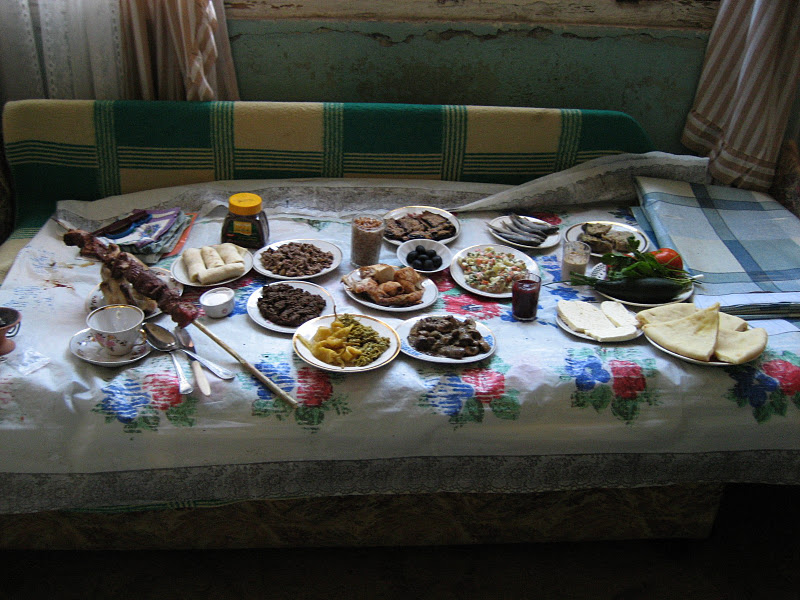
But wait, before we could eat, there was the "tabla" to complete and deliver. The tabla is a petite version of the main feast, with a few twists. It, along with china, cutlery, and some personal items are given to an individual (in honor of?)(in memory of?) the deceased. In this case, neighbor Elena would be the recipient.

Gathering the items, Kardanakhi, Georgia

Boiled chicken, svardi, roast chicken,boiled beef,  rice with meat,  Kardanakhi, Georgia

Cheese, fish, salad, corn bread, khachapuri, corn with honey, mustard in middle, Kardanakhi, Georgia

Potato salad, mushrroms, picked flower and pepper, roast chicken, eggplant with walnut sauce in middle

Blini, liver dish, coffee, greens dish, Kardanakhi, Georgia
 
Rusudan next to tabla items been placed on trays, Kardanakhi, Georgia
 
Kardanakhi, Georgia


Carrying the tabla items to Elena's house, Kardanakhi, Georgia
,
To Elena's house, Kardanakhi, Georgia

To Elena's house, Kardanakhi, Georgia
Kardanakhi, Georgia

Elena's house, Kardanakhi, Georgia
Elena receives the tabla, Kardanakhi, Georgia

Kardanakhi, Georgia

Kardanakhi, Georgia

Kardanakhi, Georgia


Some shots from Elena's house:


Dormant qvevri in floor, Kardanakhi, Georgia

Kardanakhi, Georgia


And now it was time to begin the supra (feast).

The seating more or less conformed with Georgia's traditional gender segregation. The tamada (toastmaster) toasted the deceased, God, families, country, everyone's health ...

That's not iced tea in those jugs. Kardanakhi, Georgia

Kardanakhi, Georgia

Next: Kardanakhi: Making Churchkhela

Sunday, October 23, 2011

Georgia: The 40th Day, Part 2: The Morning Of

Kardanakhi, Georgia
 
Friday evening, Nely's son, Paata, and daughter-in-law, Eka, picked up Nely and me to go to Kardanakhi. Before leaving Rustavi, we swung by and also picked up one of Paata's cousins.

We drove through Signaghi to pick up some pastries, made by another relative, to add to the next day's feast.

(Signaghi is Georgia's "city of love," called thus because its local laws make it very easy to get a quickie wedding.  Many expats, such as Americans, moved there and gentrified it. Known for artists who settled there, in addition to a very famous - in Georgia - American who, as they say, "went native." He married a Georgian woman, became a fluent and much-admired Georgian speaker, and opened a winery that embraces the ancient method of Georgian wine-making. Signaghi is definitely a tourist town. Some find Signaghi charming; others find it a Disney version of a Georgian village. I'll reserve judgment until I can see it during the day on a future visit.)

We arrived at Nely and her husband's village house to be welcomed by some relatives and neighbors with a light dinner and wine. Already visiting the house for some time were two of Irakli's sisters. They, and a sister who lives next door, are the three remaining sisters out of an original eight. Irakli, Nely's husband, is the only son of his father.

The house is a two-story building; external staircase gets you from one floor to the other. The main floor houses the kitchen, a living room, a small bedroom, and the storage/wine room.

Upstairs is a large balcony with a money-shot view of the valley below Kardanachi and, when the haze lifts, the Caucasus Mountains. There are also two "hard-wall" bedrooms and a curtain-wall bedroom and a salon, I guess you'd call it.

Kardanakhi, Georgia


The Georgian bed system is pretty basic. You've got your twin size, twin size or ... twin bed. The marital bed equals two twins pushed together. My experience thus far is that the guts consist of a somewhat springy metal lattice underpinning with thin cloth pallets laid on top. The bed has a flat sheet that lays nicely on the top pallet, but for some reason, the sheet is not quite long enough to cover both ends of the mattress. (This held true for the pricey hotel we stayed in during orientation.) On top of the sheet is a duvet. Georgian pillows are huge and square-shaped.

Well, I kind of digressed there ... I slept in the curtain-walled "room" on a twin bed. I knew it would be cold, so I had come prepared with layers to sleep in.

The next morning, Saturday, was the 40-day observance.
 
A neighbor slaughtered the sheep and then butchered it.
 
Butchering a sheep, Kardanakhi, Georgia

Butchering a sheep, Kardanakhi, Georgia

Butchering a sheep, Kardanakhi, Georgia

Butchering a sheep, Kardanakhi, Georgia

Butchering a sheep, Kardanakhi, Georgia

Butchering a sheep, Kardanakhi, Georgia

Butchering a sheep, Kardanakhi, Georgia

Butchering a sheep, Kardanakhi, Georgia

Butchering a sheep, Kardanakhi, Georgia

Butchering a sheep, Kardanakhi, Georgia

Butchering a sheep, Kardanakhi, Georgia. All that remains is the rope

Butchering a sheep, Kardanakhi, Georgia


Other men, both relatives and neighbors, prepared some beef, peeling onions and garlic.

Kardanakhi, Georgia

Kardanakhi, Georgia

Kardanakhi, Georgia


Women, both relatives and neighbors, readied big pots for cooking over the fire by applying wet wood ash on the sides of the pots.

Kardanakhi, Georgia

Kardanakhi, Georgia

This will sound peculiar to Americans but, by and large, the meat was boiled. Startling, I know, but it is tasty. Herbs, onions, garlic, and spices go into the pot, too.

Kardanakhi, Georgia


Kardanakhi, Georgia


Inside, women prepared other dishes.


Kardanakhi, Georgia

Kardanakhi, Georgia

Kardanakhi, Georgia


Tables were moved outside to prepare for the feast after the cemetery visit.

Kardanakhi, Georgia

Next: The 40th Day, Part 3: Cemetery and Supra